


Physics around us: from a first experiment to your own lab Lesson 4 of 8
Quantity, number, and unit
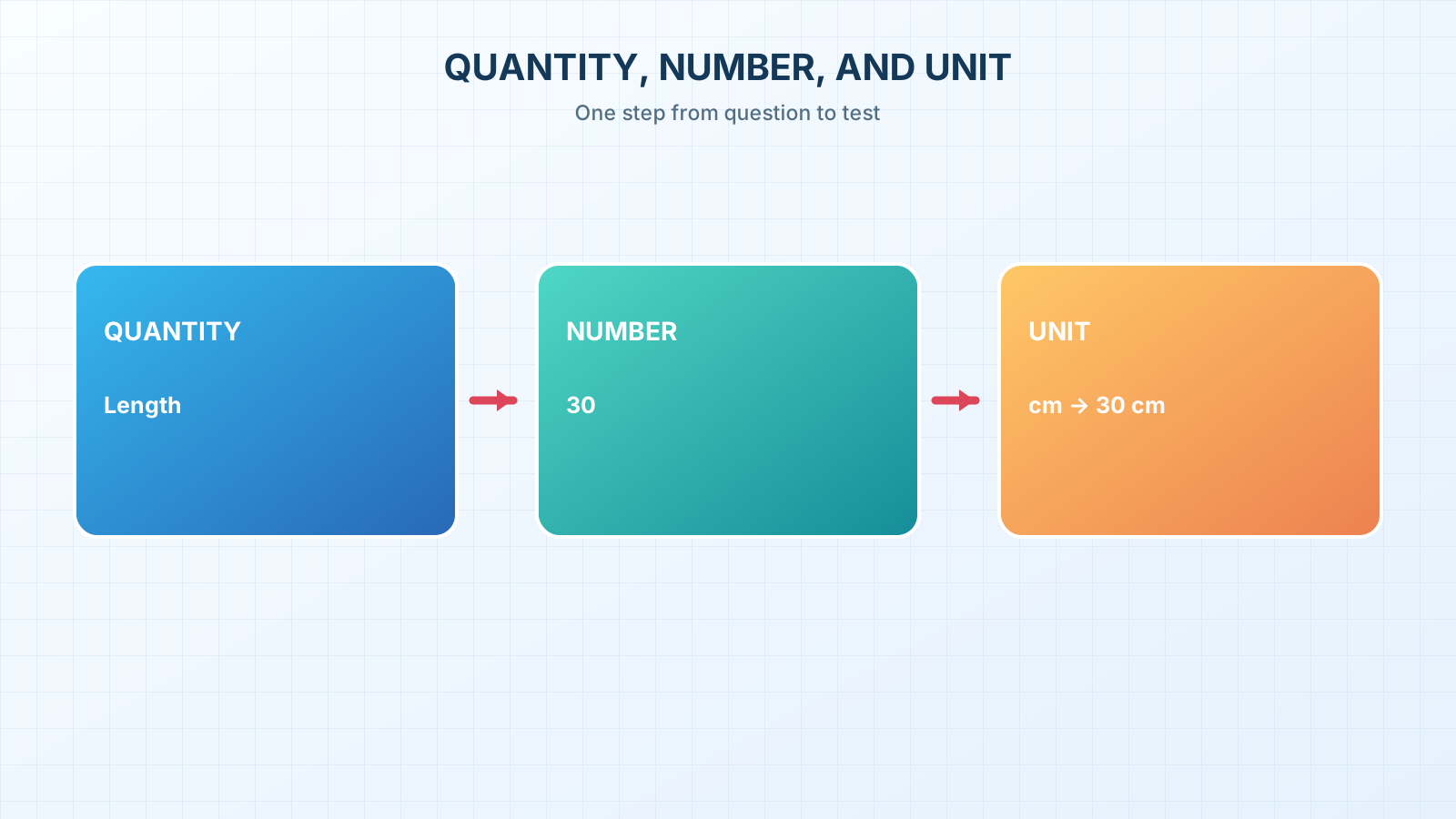
Find out why '30' does not specify a length but '30 cm' does.
Where we are on the map
The map shows the reasoning order. Its numbers are worked examples unless the lesson explicitly identifies your own measurement. You are in the first of eleven blocks.
A question from daily life
A friend asks you to cut a string ‘30’ long. Thirty what: millimetres, centimetres, or metres? A bare number does not specify a physical length.
Words and meanings
A physical quantity is a property that can be compared and measured by an agreed method, such as length or time. A unit is the agreed size for comparison. Length may be measured in centimetres (cm) or metres (m), time in seconds (s). A quantity value combines a number and a unit: 30 cm. Since 1 m = 100 cm, 30 cm = 0.30 m. The numbers differ, but the two expressions name the same length.
Predict before checking
Which is longer, 30 cm or 0.5 m? Before calculating, put both lengths into one unit and write your prediction.
Do it and record it
Find a ruler. Mark 0 cm, 10 cm, and 30 cm on paper; if the ruler is short, move it end to end with no gap. Label every number with a unit. A stopwatch will be useful later.
A worked example
0.5 m = 50 cm, so 50 cm exceeds 30 cm by 20 cm. Check the meaning: half a metre is half of 100 centimetres. ‘30 cm = 0.30 m’ writes one length in two ways.
A common mistake
‘30 cm = 30 m’ is false: equal numbers with different units need not be equal quantities. ‘10 swings = 10 seconds’ is also false: swings are counted, seconds measure time.
A new situation
One note says ’time for ten swings: 11.0’; another says ‘11.0 s’. Which can enter a table without guessing? Repair the first note.
Notebook entry and self-check
Make a tiny notebook dictionary: length → cm or m; time → s. Convert 30 cm to metres and 0.6 m to centimetres. Answers: 0.30 m and 60 cm.
If you have found a mistake or a typo in this article, tell us about it
Comments (0)
Log in to leave a comment →
No comments yet. Be the first.