


Physics around us: from a first experiment to your own lab Lesson 1 of 104
Why physics matters and what makes a question testable
Turn an everyday 'why?' into a question that an observation can answer, and start a lab notebook.
Where we are on the map
The map shows the reasoning order. Its numbers are worked examples unless the lesson explicitly identifies your own measurement. You are in the first of eleven blocks.
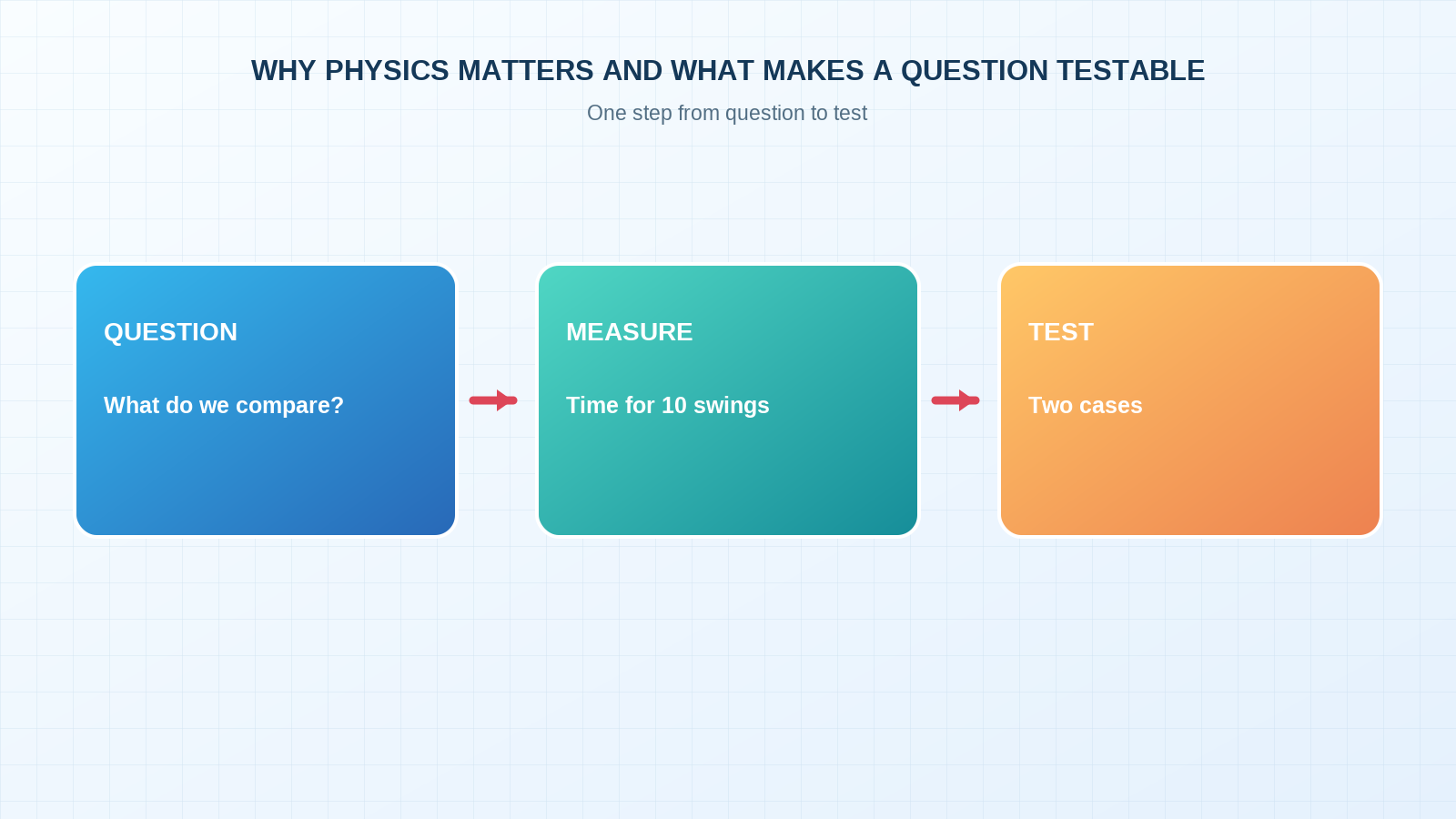
A question from daily life
From a window you see two playground swings moving. Why does one seem faster? Before answering, decide what ‘faster’ means and how you could compare them.
Words and meanings
Physics studies natural phenomena through observation, measurement, and explanations that can be checked. A phenomenon is a noticeable change, such as a moving swing. A testable question states what you will change or compare and what you will observe. One complete trip of a swing goes from one farthest position back to that same position. ‘Why is the world like this?’ is too broad; ‘does a swing with a longer rope take more time for one complete trip?’ can be checked. A model is a simplified description useful for one question, not a complete copy of the world.
Predict before checking
Predict what could be measured with two rope lengths: the number of swings in the same time, or the time for the same number of swings? Either works if you name the result precisely.
Do it and record it
Draw a swing with a short rope and one with a long rope. In your notebook write the question, your expected result, and a way to check it. Do not hang anything yet: first learn to ask a clear question.
A worked example
Vague: ‘Which swing is good?’ Testable: ‘With the same small starting tilt, which swing takes longer for ten complete swings?’ The comparison, count, and observable result are now clear. The answer is still unknown.
A common mistake
‘The longer swing is slower because physics says so’ treats an expectation as evidence. No experiment has happened yet. Keep ‘I predict’ separate from ‘I observed’.
A new situation
A wide glass and a narrow glass of water stand in a warm room. Write a testable question about cooling. What would you measure if an adult later approved the experiment? Do not handle hot water for this exercise.
Notebook entry and self-check
Write three lines: question, what could change, what could be measured. Could another person identify the two cases you intend to compare? If not, make the question more precise.
Slow the idea down
Imagine a friend saying, “This swing is faster.” Does it complete more whole swings in one minute, or does one whole swing take fewer seconds? Until you choose, you may be arguing about different meanings of “faster.” Draw two swings in your notebook and mark one farthest position. Begin counting as the seat passes that mark; count one only when it next returns to the same mark. Another person can then repeat your count.
“Which swing is better?” depends on preference. A question about the time for ten swings allows evidence that could challenge your guess. For example, the two times might be indistinguishable with your stopwatch. That is useful evidence, not a failed investigation. Do not rewrite your question to fit the answer you hoped to get.
Explain it to someone else
Say your question in one sentence, then explain which number you would record. If a friend asks, “Where does a swing begin and end?”, make the question clearer. Write “I predict…” and “I have not measured yet…” on separate lines.
If you have found a mistake or a typo in this article, tell us about it
Comments (0)
Log in to leave a comment →
No comments yet. Be the first.