


Physics around us: from a first experiment to your own lab Lesson 12 of 28
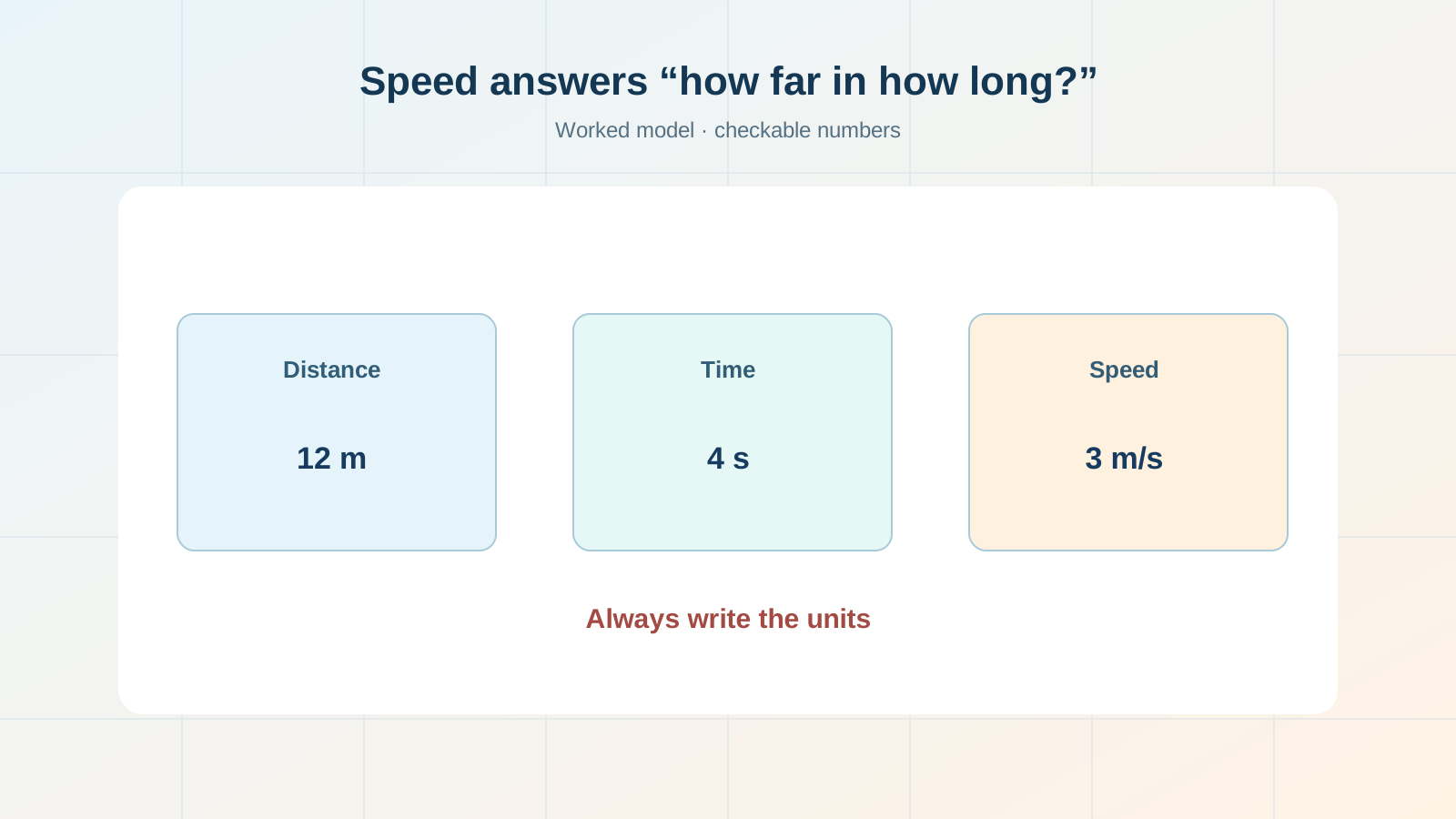
Speed answers “how far in how long?”
Divide distance by time and make sense of metres per second.
Where we are on the map
This is the second block. Keep the question, data, and source of each number in My World Lab Notebook. The numbers in the map are a worked model, not a measurement you performed.
A scene from everyday life
Two people use the same path. One covers 12 m in 4 s and the other in 6 s. Who moves faster? You do not need a wearable instrument: find how many metres correspond to one second. That gives a simple measure of how fast motion is.
New words, step by step
Speed here is distance travelled per unit of time; for steady motion v = s / Δt. Steady motion covers equal distances in equal time intervals over the part being studied. The letter v means speed, s distance, and Δt duration. The unit m/s is read “metres per second.” If the motion is not steady, the quotient gives only average speed over the whole interval.
Work through the numbers
A worked cart covers s = 12 m in Δt = 4 s. v = 12 m / 4 s = 3 m/s. For steady motion it covers 3 m during each second. Check by reversing the calculation: 3 m/s × 4 s = 12 m. A toy cart may be too slow for 3 m/s; these are teaching numbers, not measurements from our setup.
Your paper investigation
On paper make a table for steady motion at 3 m/s: at 0, 1, 2, 3, and 4 s, distance is 0, 3, 6, 9, and 12 m. Explain why this table would not fit a cart that stopped halfway.
An easy mistake to make
Do not write “3 m” for “3 m/s.” The first is a length; the second is a distance-to-time ratio. One overall result does not reveal speed at every instant.
Check your understanding
Close the worked example and explain aloud: what was given, what was calculated, and in which units? Change one number in the question and say which calculation must be repeated. If you need a word you do not yet understand, return to its definition above.
Notebook entry
Record the answer with units and one short limit: what does this example not yet prove? If you did not perform a trial, label the numbers “worked data.”
If you have found a mistake or a typo in this article, tell us about it
Comments (0)
Log in to leave a comment →
No comments yet. Be the first.