


Physics around us: from a first experiment to your own lab Lesson 17 of 28
A stop and a reversal on a graph
Read forward motion, a pause, and a return from changes in position.
Where we are on the map
This is the second block. Keep the question, data, and source of each number in My World Lab Notebook. The numbers in the map are a worked model, not a measurement you performed.
A scene from everyday life
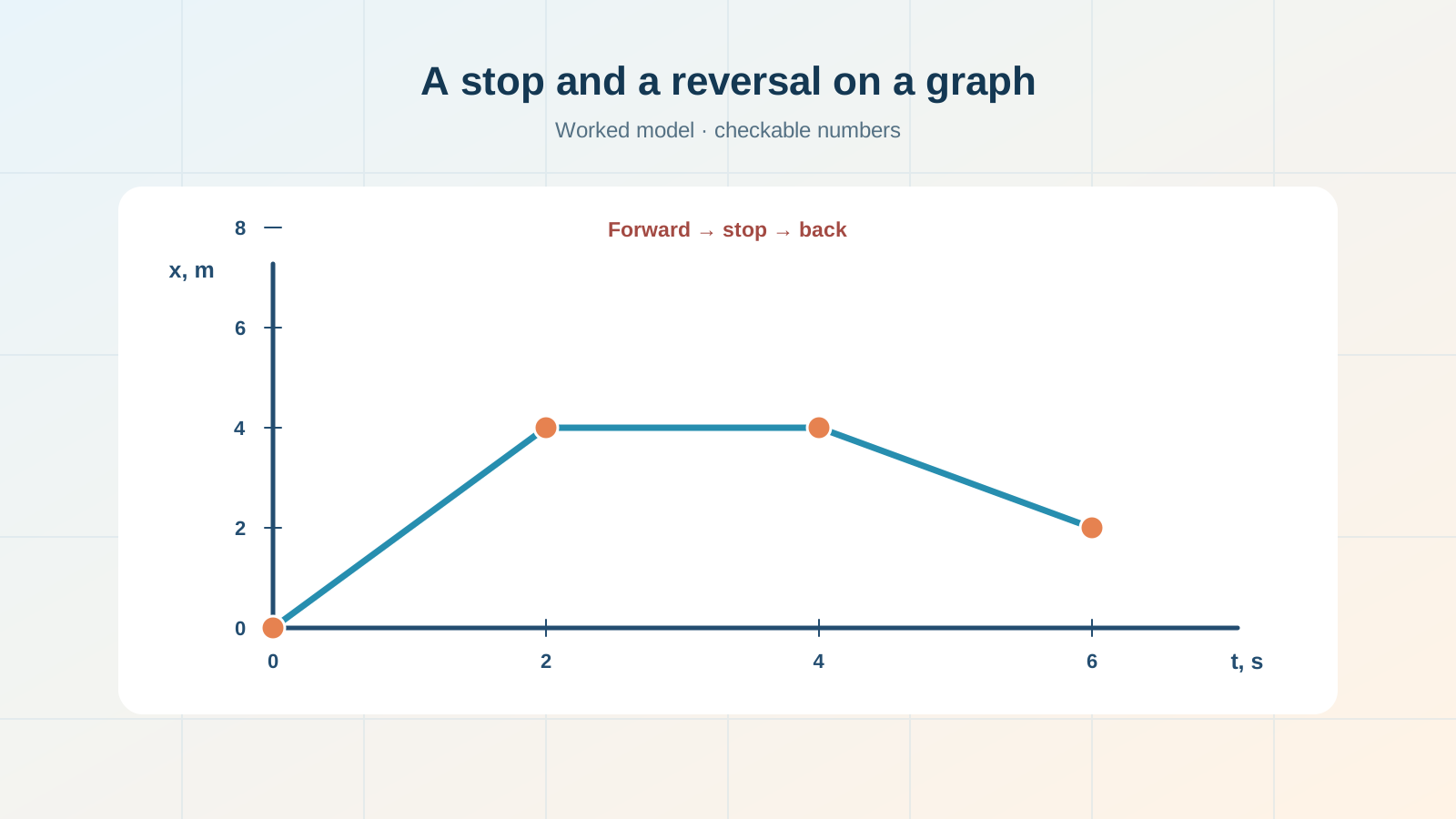
Imagine walking towards an exit, stopping to talk, and returning for a phone. On a position graph those are three distinct parts: rising, flat, and falling. Falling does not mean “time ran backwards”: the horizontal time axis always moves forwards.
New words, step by step
A stop on the chosen axis means position does not change during an interval. A reversal changes the sign of the position change: first Δx is positive, then negative. Signed velocity on a section is Δx/Δt and may be negative; that means motion towards smaller x, not “negative quickness.” We do not need the word “acceleration” yet: a turn alone does not give its numerical value.
Work through the numbers
Worked table: at t = 0 s, x = 0 m; at 2 s, x = 4 m; at 4 s, x = 4 m; at 6 s, x = 2 m. If motion is steady within each leg, signed velocities are +2 m/s, 0 m/s, and −1 m/s. Total distance is 4 + 0 + 2 = 6 m; final displacement is +2 m.
Your paper investigation
Plot the four points and join them with straight segments as a model of steady motion inside each interval. Explain why a downward graph does not mean the cart went under the table. Find average speed over 6 s: 6/6 = 1 m/s.
An easy mistake to make
Do not replace the 6 m total distance with the 2 m displacement. Negative signed velocity does not mean “worse” movement.
Check your understanding
Close the worked example and explain aloud: what was given, what was calculated, and in which units? Change one number in the question and say which calculation must be repeated. If you need a word you do not yet understand, return to its definition above.
Notebook entry
Record the answer with units and one short limit: what does this example not yet prove? If you did not perform a trial, label the numbers “worked data.”
Next lesson: Checkpoint: a cart’s motion from data to conclusion
If you have found a mistake or a typo in this article, tell us about it
Comments (0)
Log in to leave a comment →
No comments yet. Be the first.