


Physics around us: from a first experiment to your own lab Lesson 27 of 28
Where energy goes when a cart stops: transfer and conservation
Build a balance without treating “lost” as vanished.
One cart, one story
We continue the cart story from Motion and Graphs. Now ask not only “how did it move?” but “which objects changed its motion?” Link each new word to a visible scene before using an equation. Numbers on the support map are given teaching values, not a replacement for your own measurements.
A cart rolls to a stop. Its energy seems gone. Look closer: surfaces warm slightly during friction; air may vibrate and sound may be made. The warmth need not be noticeable by hand in a small trial; not feeling it proves little. “Motion energy became zero” does not mean “the energy of the universe decreased.”
What the words mean
Energy transfer means energy moves between objects or forms. Conservation of energy says energy in a closed system is not created from nothing or destroyed. A system is the collection of objects we choose to consider. A cart alone can lose mechanical energy. Include the table and surrounding air, and energy transfers to their internal energy and sound. “Internal” here concerns motion and interaction of particles; the heat block will explore that further.
Check the numbers and limits
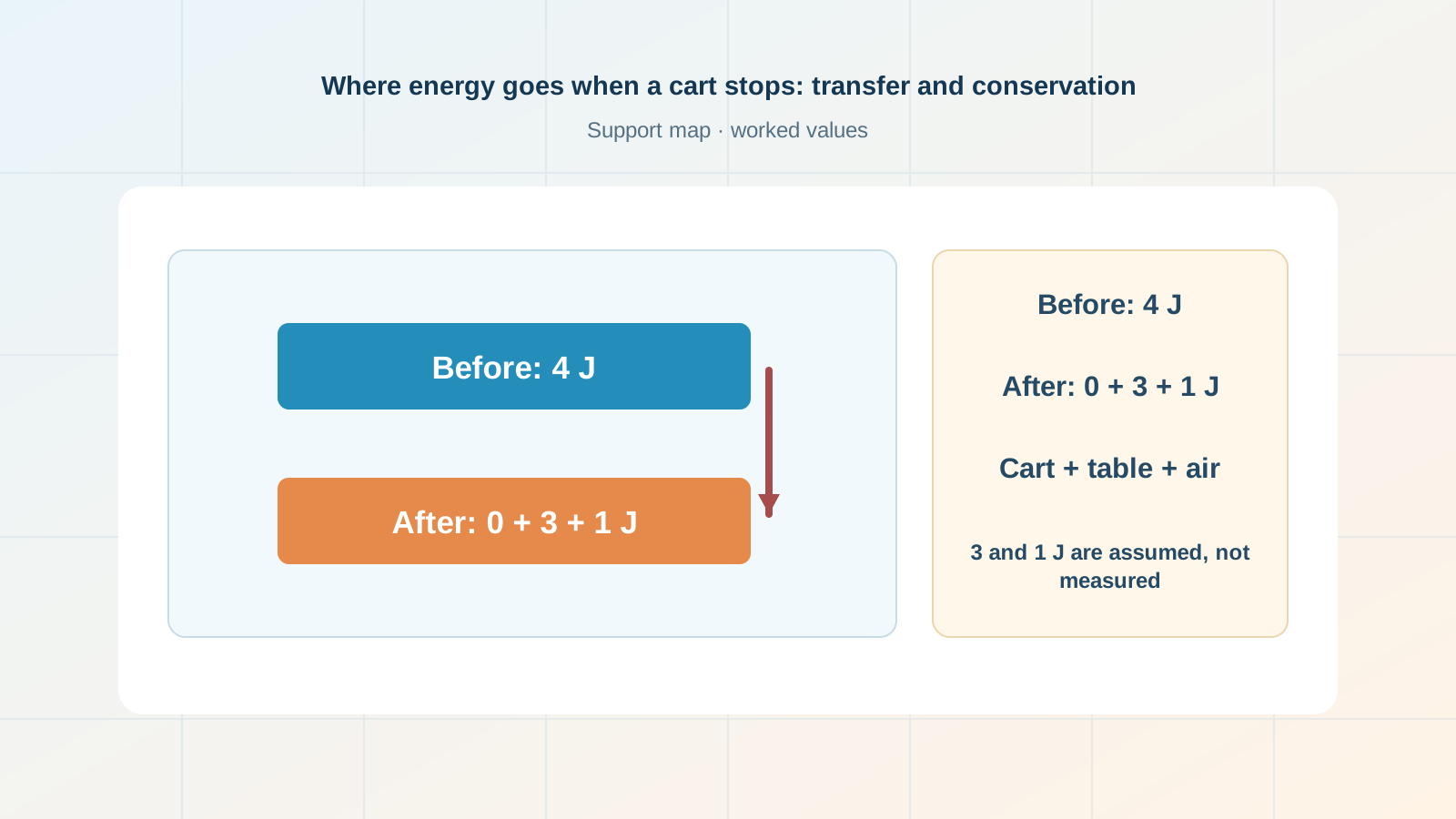
Worked balance: a cart begins with 4 J kinetic energy and stops. Suppose 3 J transfers to warming contact surfaces and 1 J to other processes including sound. Then 4 J = 0 J kinetic + 3 J + 1 J. The split of 3 and 1 is given only for this example; we have not measured it. For the cart alone, kinetic energy changed by −4 J.
Try it yourself
Draw a boundary around “cart + table + air” with transfer arrows. Write cards showing 4 J before and 0 + 3 + 1 J after. Change the hypothetical split to 2 and 2 J: total remains 4 J. Which measurements would you need to confirm real shares?
A common trap
Do not say friction “destroyed” energy. State your system and transfer paths, and do not present unmeasured shares as facts.
Support map
Check without hints
Cover the calculation. Name the object receiving forces, their sources, and the chosen positive direction. Rebuild the arithmetic with units. Change one given number and explain which conclusion changes. If you did not run a real trial, write “worked model” in your notebook.
Notebook entry
Write four lines: “What did I see?”, “What was given?”, “What did I calculate?”, and “Which assumptions does this conclusion need?” This separates observation from model and lets you revisit an error later.
If you have found a mistake or a typo in this article, tell us about it
Comments (0)
Log in to leave a comment →
No comments yet. Be the first.