


Physics around us: from a first experiment to your own lab Lesson 13 of 28
Kilometres per hour and metres per second
Convert speed units and check the answer against common sense.
Where we are on the map
This is the second block. Keep the question, data, and source of each number in My World Lab Notebook. The numbers in the map are a worked model, not a measurement you performed.
A scene from everyday life
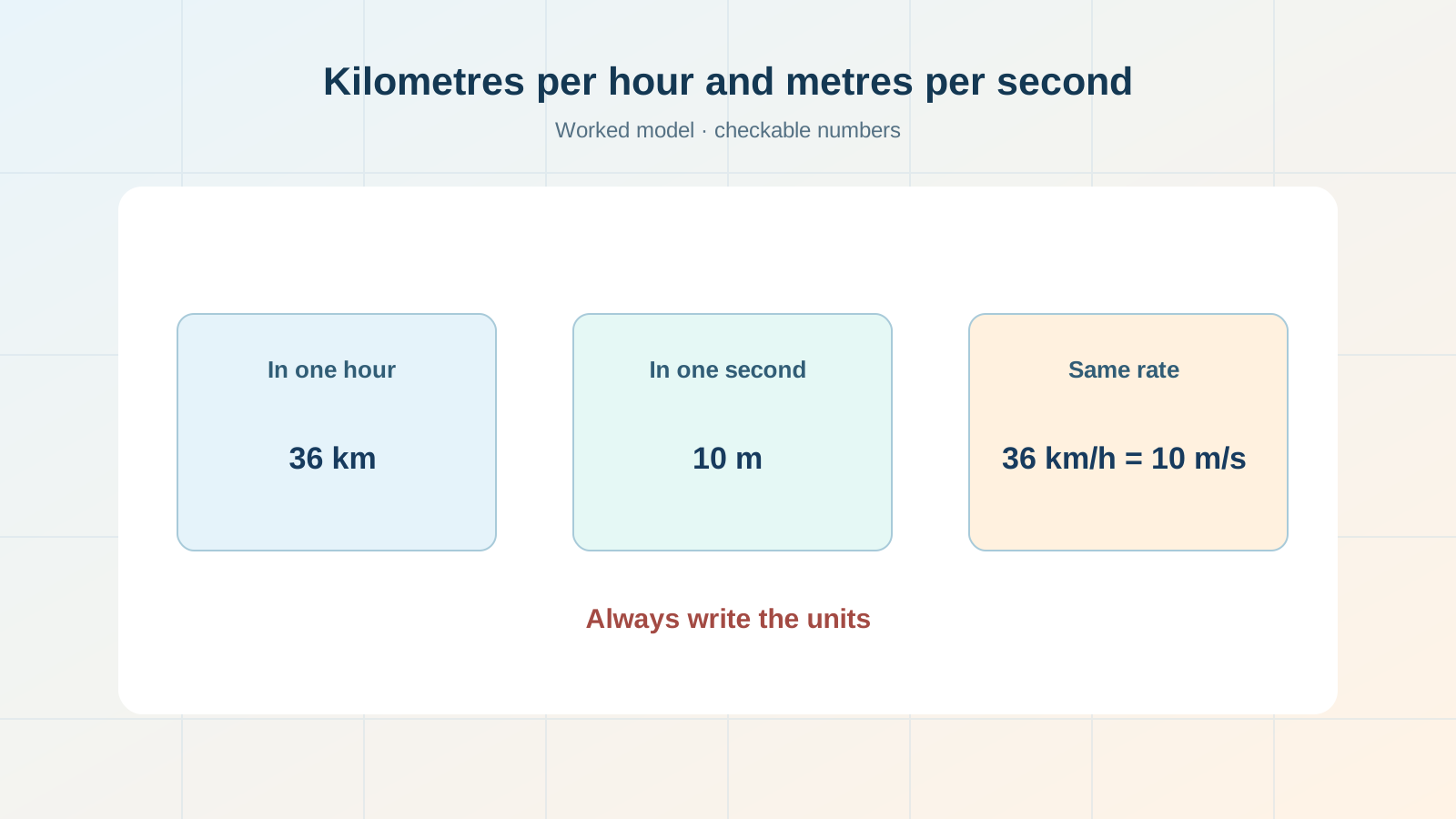
A road sign shows 36 km/h; a lab table shows 10 m/s. The numbers look different. Do they describe the same speed? Replace kilometres with metres and hours with seconds without changing the motion itself.
New words, step by step
1 km = 1000 m and 1 h = 3600 s. Therefore 1 km/h = 1000/3600 m/s = 1/3.6 m/s. Divide a km/h value by 3.6 to get m/s; multiply an m/s value by 3.6 to go back. The units cancel: (km/h) × (1000 m/km) × (1 h/3600 s) = m/s. This is unit replacement, not a magic rule.
Work through the numbers
36 km/h ÷ 3.6 = 10 m/s. Check the meaning: 36 km in an hour is 36,000 m in 3600 s, or 10 m each second if the motion is steady. Reversing the step gives 10 m/s × 3.6 = 36 km/h. This is a teaching value for transport; our toy cart moves much more slowly.
Your paper investigation
Convert 18 km/h to m/s: 18 ÷ 3.6 = 5 m/s. Convert 2 m/s to km/h: 2 × 3.6 = 7.2 km/h. Write units at every step and check by reversing the conversion.
An easy mistake to make
Multiplying 36 by 3.6 when going to m/s gives the wrong direction. Write a fraction with units to see what cancels.
Check your understanding
Close the worked example and explain aloud: what was given, what was calculated, and in which units? Change one number in the question and say which calculation must be repeated. If you need a word you do not yet understand, return to its definition above.
Notebook entry
Record the answer with units and one short limit: what does this example not yet prove? If you did not perform a trial, label the numbers “worked data.”
If you have found a mistake or a typo in this article, tell us about it
Comments (0)
Log in to leave a comment →
No comments yet. Be the first.