


Physics around us: from a first experiment to your own lab Lesson 19 of 28
Why a cart changes motion: interactions and force
Identify who acts on the cart before calculating a force.
One cart, one story
We continue the cart story from Motion and Graphs. Now ask not only “how did it move?” but “which objects changed its motion?” Link each new word to a visible scene before using an equation. Numbers on the support map are given teaching values, not a replacement for your own measurements.
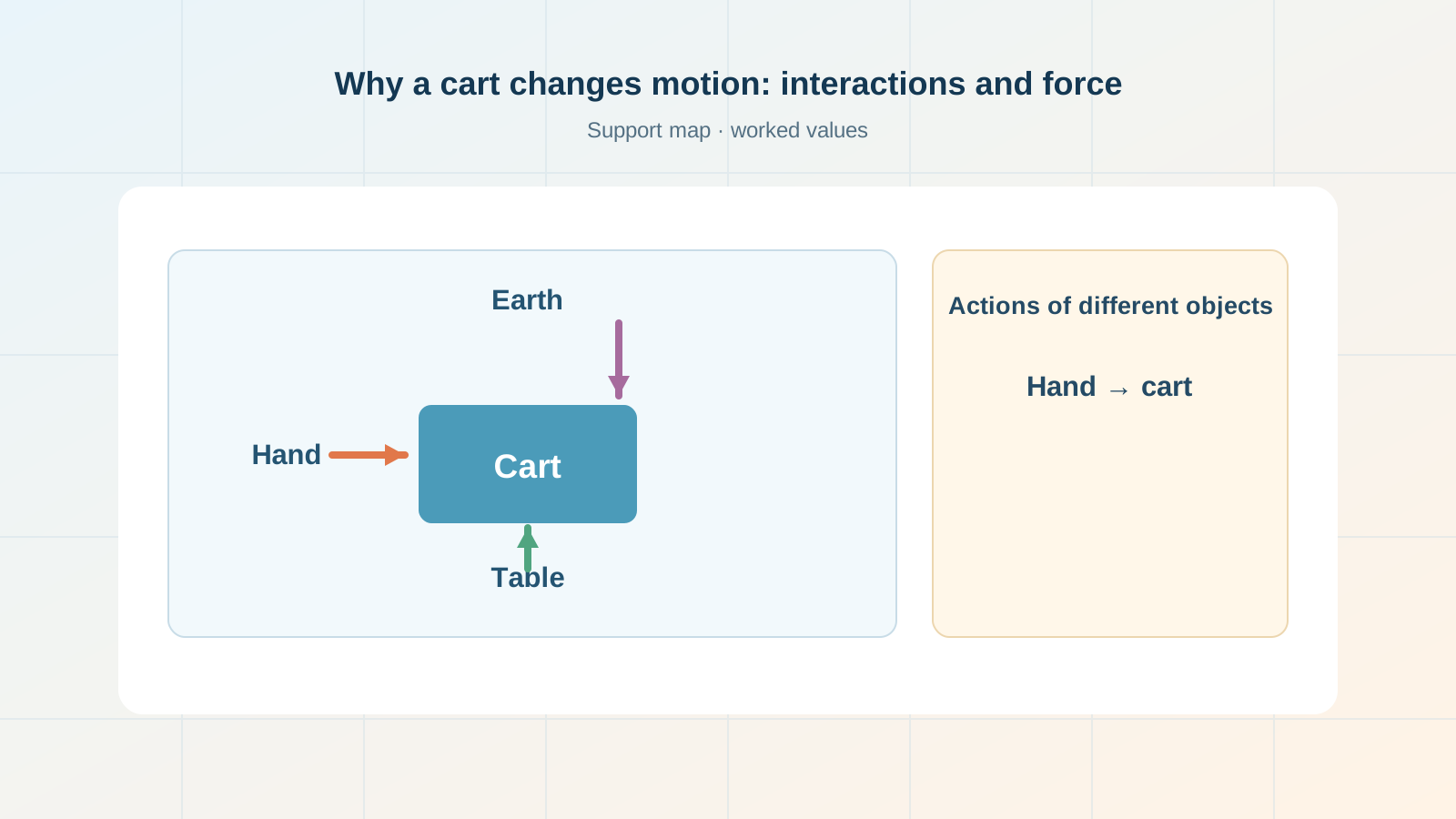
Gently push a toy cart on a table. It starts rolling. Put your palm in its path and it stops. Motion changes in both cases, but begin with a question, not a formula: which two objects interact? First, your hand and the cart; then, your palm and the cart. Earth and the table act on it too, though their effects are less obvious.
What the words mean
An interaction is two objects acting on each other. A force F describes one object’s action on another and has a direction. Its unit is the newton, N. A contact force needs touching, as a push does; Earth’s pull acts without contact. Force is not a store of motion inside the cart. To explain a change, name the object receiving the force and the object producing it.
Check the numbers and limits
Worked scene: a hand pushes the cart right. “Hand → cart: force right” states both source and receiver. “Table → cart: support upward” is a different force. “The cart moves right” alone does not tell us that the hand is still pushing: it may roll for a while after release.
Try it yourself
Draw a cart, then separately draw a hand, table, and Earth. Connect each pair with the words “acts on.” Remove the hand: which actions remain? Gently push an empty box on a level table, well away from its edge. In your notebook separate what you saw from what you inferred.
A common trap
Do not write merely “the cart’s force.” Name who acts on whom: the hand’s force on the cart differs from the cart’s force on the hand.
Support map
Check without hints
Cover the calculation. Name the object receiving forces, their sources, and the chosen positive direction. Rebuild the arithmetic with units. Change one given number and explain which conclusion changes. If you did not run a real trial, write “worked model” in your notebook.
Notebook entry
Write four lines: “What did I see?”, “What was given?”, “What did I calculate?”, and “Which assumptions does this conclusion need?” This separates observation from model and lets you revisit an error later.
Next lesson: Draw and measure force: arrows and a spring scale
If you have found a mistake or a typo in this article, tell us about it
Comments (0)
Log in to leave a comment →
No comments yet. Be the first.