


Physics around us: from a first experiment to your own lab Lesson 28 of 28
Checkpoint: one cart, forces, work, and energy
Bring the whole block into a checkable table with honest model limits.
One cart, one story
We continue the cart story from Motion and Graphs. Now ask not only “how did it move?” but “which objects changed its motion?” Link each new word to a visible scene before using an equation. Numbers on the support map are given teaching values, not a replacement for your own measurements.
Another learner sends only an answer: “the cart reached 4 m/s.” Can you trust it? You now know what to request: mass, forces, track distance, initial speed, and measurement method. The numbers should agree by two routes: net force and work with energy. These are not two independent experiments, but two consistency checks on one model.
What the words mean
A consistency check compares results obtained by different expressions under the same assumptions. A model simplifies reality: straight level track, constant forces, start from rest, no other losses. Gravity and the support balance vertically. Do not confuse horizontal pull or resistance with weight. If real readings disagree, inspect these assumptions before “correcting” data.
Check the numbers and limits
Worked conditions: m = 0.5 kg, pull 3 N right, resistance 1 N left, distance 2 m right. Net force is 2 N and acceleration a = 2/0.5 = 4 m/s². Pull does +6 J work, resistance −2 J, total +4 J. Starting from rest, kinetic energy rises by 4 J. Thus ½ × 0.5 × v² = 4 J and v = 4 m/s. These are given, consistent numbers, not measurements of a real cart.
Try it yourself
Make a table headed “given,” “calculation,” “unit,” and “assumption.” Fill the route from 3 N to 4 m/s. Change resistance to 2 N, leaving all else. What are net force, total work, and final speed in the model? Hint: +2 J kinetic energy gives v² = 8 m²/s², so v ≈ 2.83 m/s.
A common trap
Do not call the calculated speed measured. Do not claim resistance is always constant for a real cart or that rounded values apply everywhere.
Support map
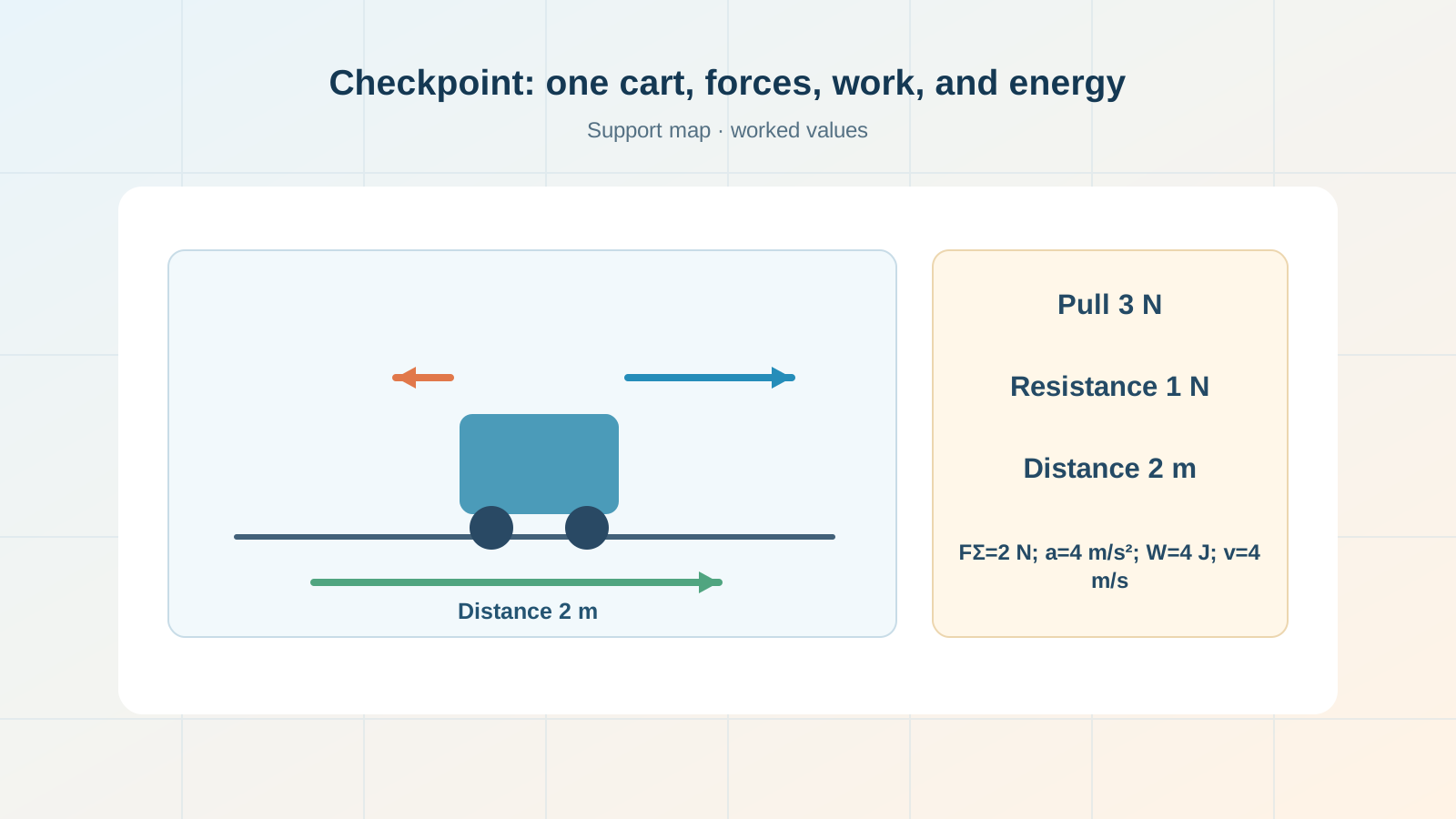
Check without hints
Cover the calculation. Name the object receiving forces, their sources, and the chosen positive direction. Rebuild the arithmetic with units. Change one given number and explain which conclusion changes. If you did not run a real trial, write “worked model” in your notebook.
Notebook entry
Write four lines: “What did I see?”, “What was given?”, “What did I calculate?”, and “Which assumptions does this conclusion need?” This separates observation from model and lets you revisit an error later.
If you have found a mistake or a typo in this article, tell us about it
Comments (0)
Log in to leave a comment →
No comments yet. Be the first.