


Physics around us: from a first experiment to your own lab Lesson 11 of 28
Time reading and time interval: when and how long
Separate a clock reading from the duration of an experiment.
Where we are on the map
This is the second block. Keep the question, data, and source of each number in My World Lab Notebook. The numbers in the map are a worked model, not a measurement you performed.
A scene from everyday life
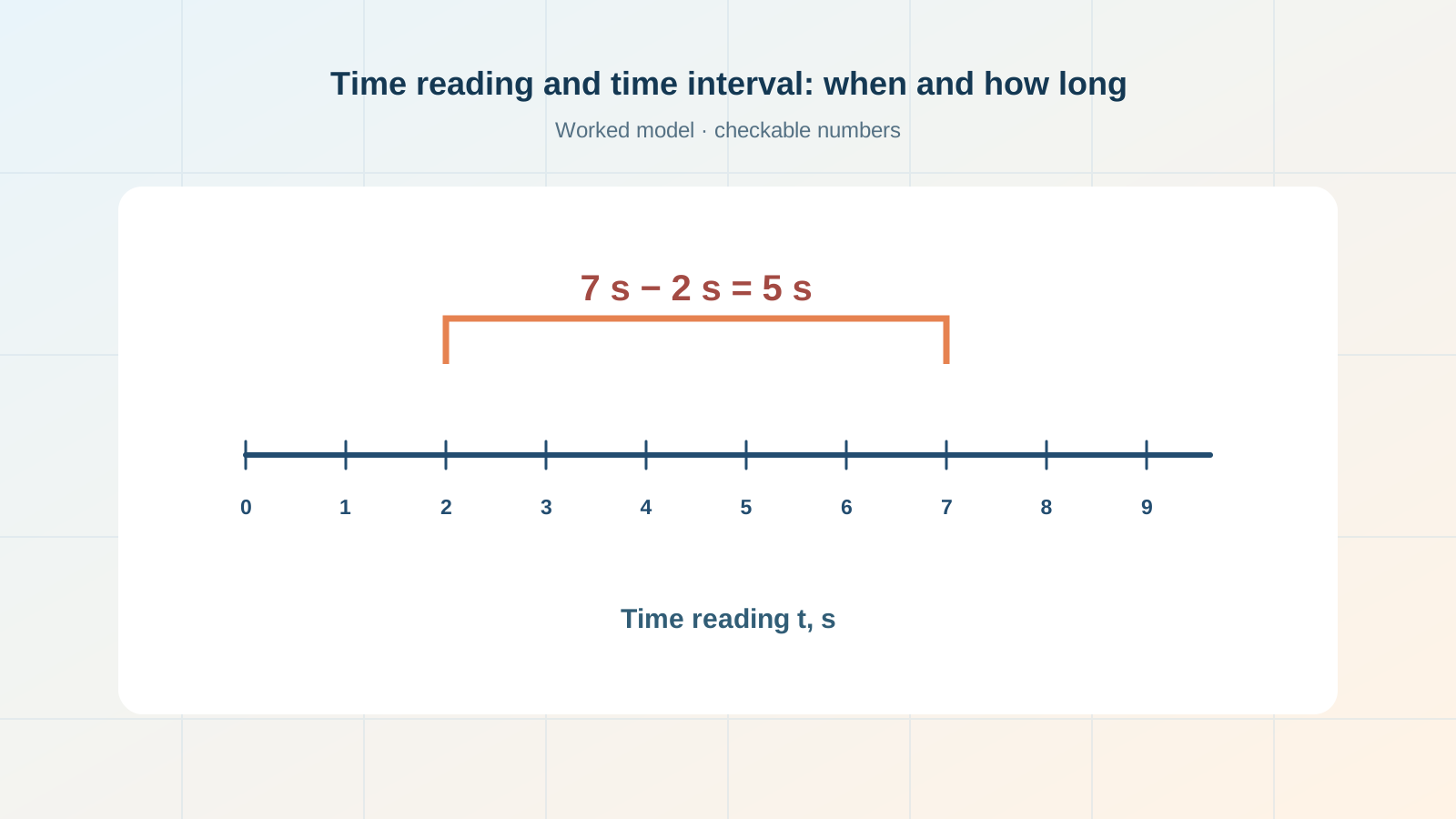
A teacher says, “Class starts at 9:00 and ends at 9:45.” The first two values are instants; 45 minutes is the duration. In an experiment a stopwatch may read 2 s when the cart passes one mark and 7 s at the next. “Time = 7 s” without more detail would be ambiguous.
New words, step by step
An instant t is a clock reading in an agreed time system. A time interval Δt is the duration between two instants: Δt = t₂ − t₁. We measure it in seconds, minutes, or hours. The stopwatch’s zero does not have to coincide with the start of the cart’s movement.
Work through the numbers
The cart passes A at t₁ = 2 s and B at t₂ = 7 s. The interval is Δt = 7 − 2 = 5 s. Check: 2 + 5 = 7. These readings alone do not reveal its speed on every tiny part of the track.
Your paper investigation
Draw a time line and mark 2 and 7 s. Shade the stretch between them: it represents 5 s, not 7 s. Invent another experiment starting at 12 s and lasting the same 5 s. It ends at 17 s.
An easy mistake to make
A common error is dividing the track length by the final stopwatch reading, 7 s. If timing began earlier, use the 5 s interval.
Check your understanding
Close the worked example and explain aloud: what was given, what was calculated, and in which units? Change one number in the question and say which calculation must be repeated. If you need a word you do not yet understand, return to its definition above.
Notebook entry
Record the answer with units and one short limit: what does this example not yet prove? If you did not perform a trial, label the numbers “worked data.”
If you have found a mistake or a typo in this article, tell us about it
Comments (0)
Log in to leave a comment →
No comments yet. Be the first.