


Physics around us: from a first experiment to your own lab Lesson 10 of 28
Distance travelled and displacement are different answers
Follow an outward and return route to obtain two honest but different quantities.
Where we are on the map
This is the second block. Keep the question, data, and source of each number in My World Lab Notebook. The numbers in the map are a worked model, not a measurement you performed.
A scene from everyday life
Imagine walking from home to a bus stop, returning for a forgotten notebook, and setting off again. You may end up near home even though your feet covered many metres. “How far did you walk?” and “How much did your position change?” are different questions. A straight track makes the distinction visible.
New words, step by step
Distance travelled s is the sum of the lengths of every part of a journey; it cannot be negative. Displacement Δx is final position minus initial position. On a line, its sign gives the direction. If start and finish match, Δx = 0 even when the distance is large. The Greek Δ means “change”; it is not a new unit.
Work through the numbers
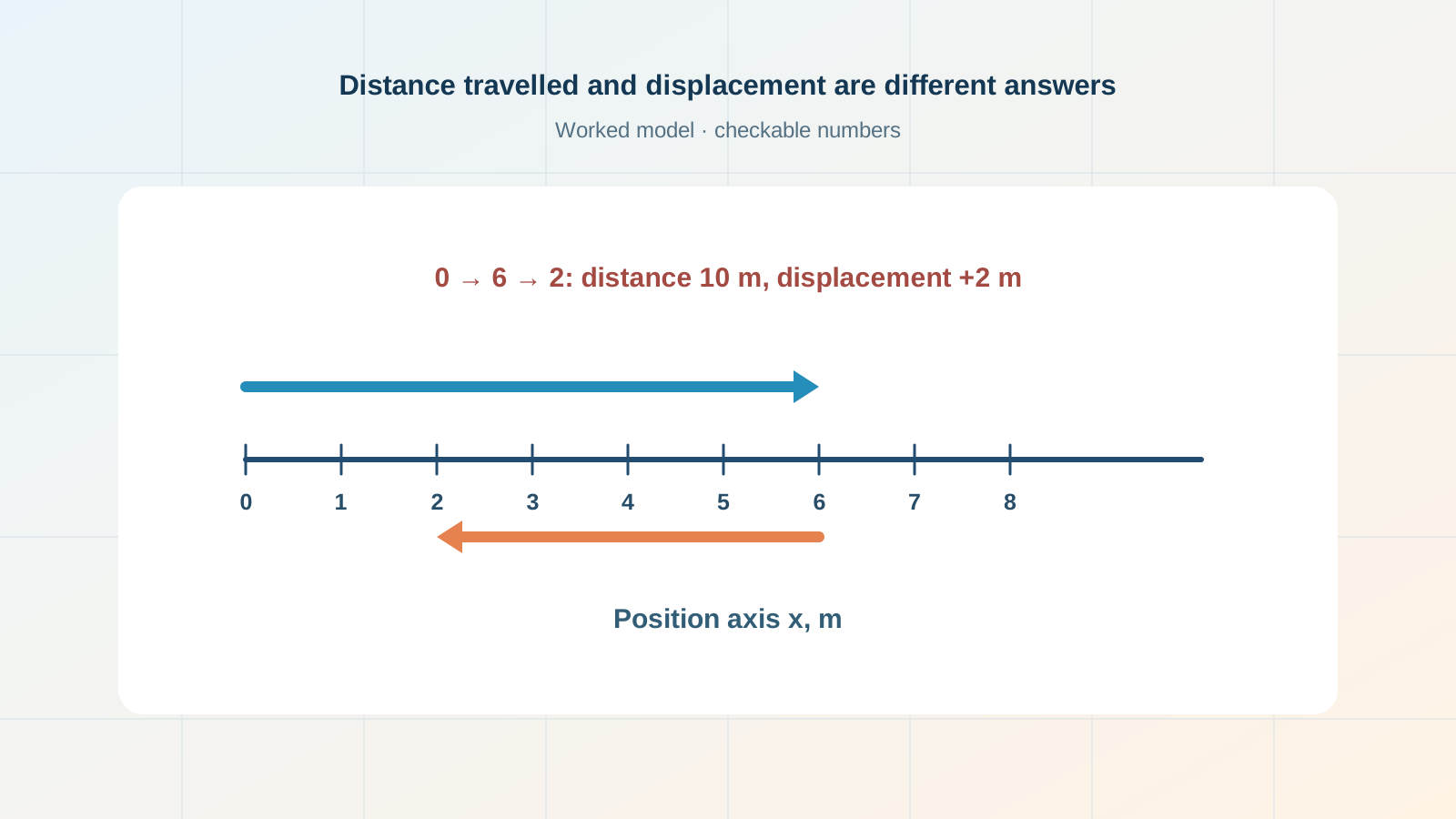
A cart goes from x = 0 m to x = 6 m and returns to x = 2 m. It travels 6 m outward and 4 m back. Distance s = 6 + 4 = 10 m. Displacement Δx = 2 − 0 = +2 m. Both answers are correct if attached to their own questions.
Your paper investigation
Draw an axis from 0 to 6. Use a blue arrow for 0 → 6 and an orange arrow for 6 → 2. Add the lengths of the two legs. Then cover the route, leaving only the start and finish visible, and find Δx. Explain why the number changed.
An easy mistake to make
“Distance = 2 m because the cart returned to the 2 m mark” loses 8 m of real travel. Distance needs every part of the route.
Check your understanding
Close the worked example and explain aloud: what was given, what was calculated, and in which units? Change one number in the question and say which calculation must be repeated. If you need a word you do not yet understand, return to its definition above.
Notebook entry
Record the answer with units and one short limit: what does this example not yet prove? If you did not perform a trial, label the numbers “worked data.”
Next lesson: Time reading and time interval: when and how long
If you have found a mistake or a typo in this article, tell us about it
Comments (0)
Log in to leave a comment →
No comments yet. Be the first.