


Physics around us: from a first experiment to your own lab Lesson 24 of 28
Friction and resistance: where did the push go?
See why a 3 N pull need not give a 3 N net force.
One cart, one story
We continue the cart story from Motion and Graphs. Now ask not only “how did it move?” but “which objects changed its motion?” Link each new word to a visible scene before using an equation. Numbers on the support map are given teaching values, not a replacement for your own measurements.
Drag a book across a table and feel it resist. Force has not mysteriously “disappeared”: the book and table surfaces interact. Rolling resistance and air can matter for a cart too. We cannot promise every surface behaves alike; a fair comparison needs matching conditions and measurements.
What the words mean
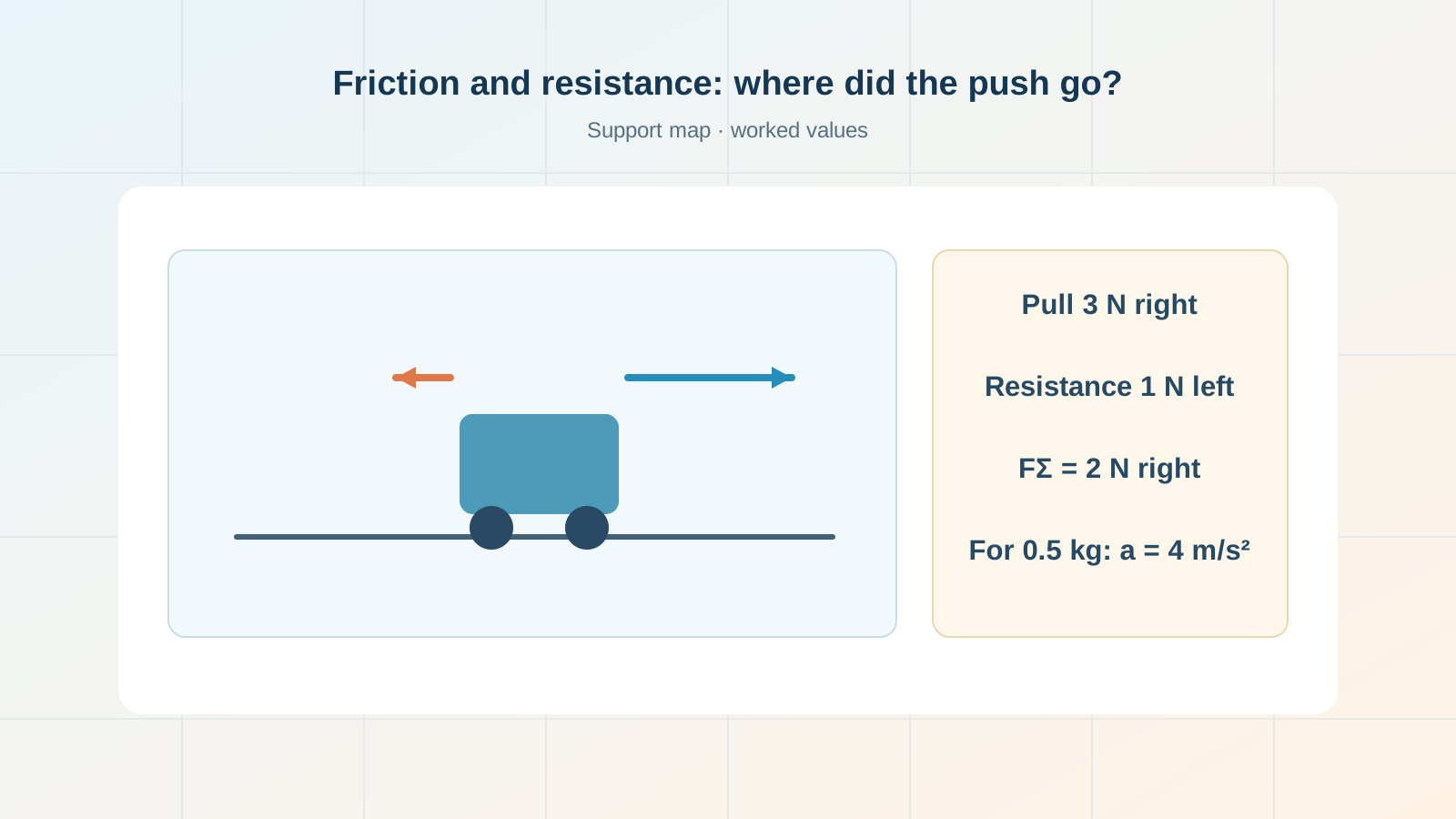
Friction is a contact interaction between surfaces; in this example it opposes relative sliding or the tendency to slide. Air resistance is air acting on an object moving relative to it. In a simple straight-line model with opposite forces, FΣ = Fpull − Fresistance. Real friction depends on surface and circumstances. Hold mass, pulling method, and path steady while changing only the covering.
Check the numbers and limits
Take worked values: pull 3 N right, total resistance 1 N left. Then FΣ = 3 − 1 = 2 N right. With mass 0.5 kg, a = 2 / 0.5 = 4 m/s² right. Using the 3 N pull alone would yield 6 m/s², inconsistent with the stated forces. For a real cart, the 1 N resistance needs measurement or a justified estimate, not a guess.
Try it yourself
On paper draw two identical tracks. Assign worked resistance 1 N to one and 2 N to the other, with pull 3 N in both. Compare net forces. If you try it, gently pull a light object with a spring scale at similar steady speed on two surfaces; do not call the reading a friction coefficient.
A common trap
Friction is not always harmful: we need it to walk. Nor does a stronger pull mean a cart is necessarily faster right now; initial velocity and net force matter.
Support map
Check without hints
Cover the calculation. Name the object receiving forces, their sources, and the chosen positive direction. Rebuild the arithmetic with units. Change one given number and explain which conclusion changes. If you did not run a real trial, write “worked model” in your notebook.
Notebook entry
Write four lines: “What did I see?”, “What was given?”, “What did I calculate?”, and “Which assumptions does this conclusion need?” This separates observation from model and lets you revisit an error later.
If you have found a mistake or a typo in this article, tell us about it
Comments (0)
Log in to leave a comment →
No comments yet. Be the first.