


Physics around us: from a first experiment to your own lab Lesson 9 of 28
Where is the cart? Reference point and position
Locate an object without confusing its position with the distance it travelled.
Where we are on the map
This is the second block. Keep the question, data, and source of each number in My World Lab Notebook. The numbers in the map are a worked model, not a measurement you performed.
A scene from everyday life
Imagine a long school corridor. “I am by the door” is little help to a friend on another floor: there are many doors. Choose one entrance as a starting point and treat the direction towards the library as positive. “I am 6 m from the entrance” can now be checked. In our lab, a straight track for a toy cart will replace the corridor.
New words, step by step
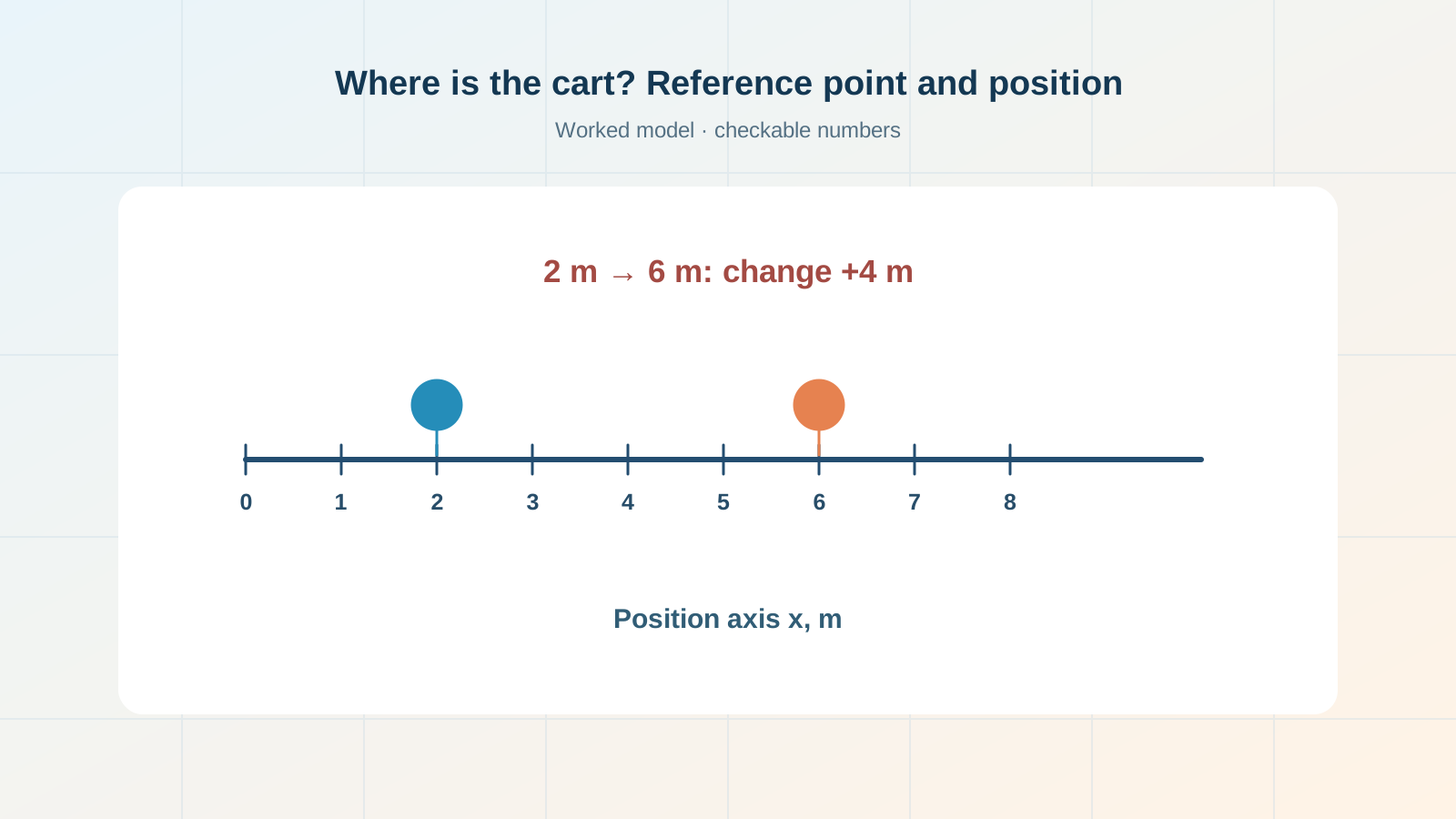
A reference point is the agreed place called zero. An axis is a chosen straight line with direction and scale. Position x is a signed number with a unit that locates an object relative to zero. We might have x = +6 m to the right and x = −2 m to the left. The sign names a side, not good or bad motion. The number 6 m alone says nothing about travel time or distance travelled.
Work through the numbers
In the diagram the cart begins at x = 2 m and is later placed at x = 6 m. The initial position is x₁ = 2 m; the final one is x₂ = 6 m. The difference x₂ − x₁ = +4 m tells us the change in position, not any hidden detour. If we moved the cart by hand, we must not describe that as a measured run.
Your paper investigation
Put a ruler’s zero at the edge of a sheet and mark 2 and 6 cm. Where would a mark “left of zero” go if the line continued? Describe the 2 cm place in words and numerals. Move a paper token out and back: a matching final place need not mean a matching journey.
An easy mistake to make
Do not call a coordinate a distance travelled. “The cart is 6 m from the entrance” is a present place; “it travelled 6 m” describes a journey.
Check your understanding
Close the worked example and explain aloud: what was given, what was calculated, and in which units? Change one number in the question and say which calculation must be repeated. If you need a word you do not yet understand, return to its definition above.
Notebook entry
Record the answer with units and one short limit: what does this example not yet prove? If you did not perform a trial, label the numbers “worked data.”
Next lesson: Distance travelled and displacement are different answers
If you have found a mistake or a typo in this article, tell us about it
Comments (0)
Log in to leave a comment →
No comments yet. Be the first.