


Physics around us: from a first experiment to your own lab Lesson 18 of 28
Checkpoint: a cart’s motion from data to conclusion
Bring position, time, graph, and honest limits into one notebook report.
Where we are on the map
This is the second block. Keep the question, data, and source of each number in My World Lab Notebook. The numbers in the map are a worked model, not a measurement you performed.
A scene from everyday life
You can now answer “where?”, “how far?”, and “how fast?” At the end of the block the aim is not to guess the right picture. Show a route from observation to conclusion that another learner can recalculate and question.
New words, step by step
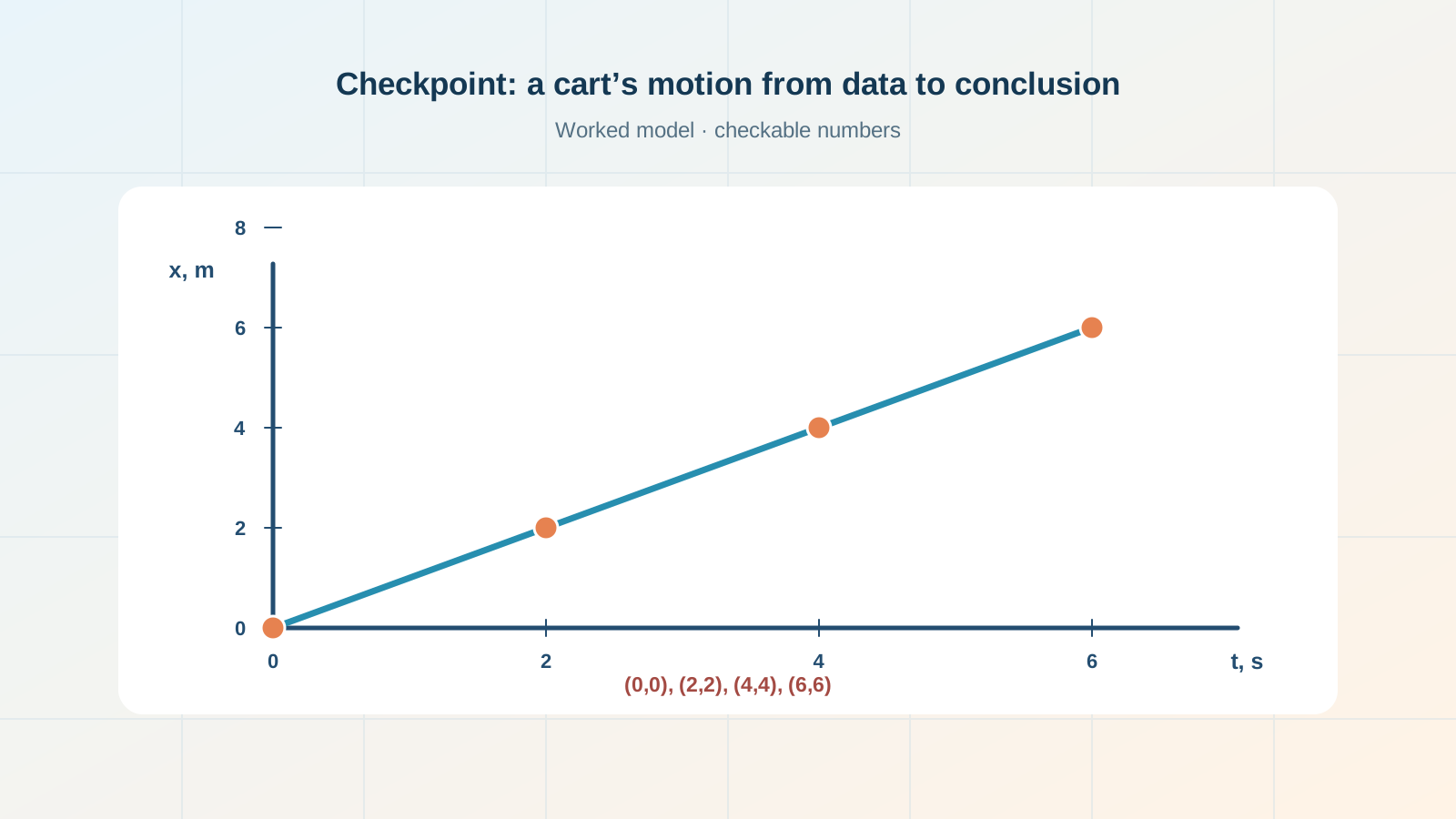
A motion report states its reference point, direction, original positions and time readings, calculated intervals, graph, and a conclusion with limits. Label the numbers below as worked data if you use them. A real trial with a light toy cart and measuring tape is only suitable on a clear level surface, away from people and fragile objects.
Work through the numbers
Worked pairs (t, x): (0 s, 0 m), (2 s, 2 m), (4 s, 4 m), (6 s, 6 m). Position changes by +6 m in 6 s. If the cart did not reverse, distance is 6 m and average speed is 6/6 = 1 m/s. The points lie on a line consistent with steady motion. Sparse observations cannot prove there were no brief stops between them.
Your paper investigation
Submit seven parts: question, data source, axis sketch with zero, table with units, one calculation with units, labelled graph, and conclusion with a limit. Can a friend obtain 1 m/s without prompting? If the origin of 6 m is unclear, improve the report.
An easy mistake to make
Do not turn worked numbers into “I measured.” A straight line through sparse observations does not prove constant instantaneous speed between observations.
Check your understanding
Close the worked example and explain aloud: what was given, what was calculated, and in which units? Change one number in the question and say which calculation must be repeated. If you need a word you do not yet understand, return to its definition above.
Notebook entry
Record the answer with units and one short limit: what does this example not yet prove? If you did not perform a trial, label the numbers “worked data.”
If you have found a mistake or a typo in this article, tell us about it
Comments (0)
Log in to leave a comment →
No comments yet. Be the first.