


Physics around us: from a first experiment to your own lab Lesson 14 of 28
Average speed counts the whole journey
See why averaging two speed readings may not give the speed of a complete trip.
Where we are on the map
This is the second block. Keep the question, data, and source of each number in My World Lab Notebook. The numbers in the map are a worked model, not a measurement you performed.
A scene from everyday life
Imagine walking quickly to a shop and taking much longer on the return. “My average speed” describes the whole journey, including stops if the clock kept running. You need the full distance travelled and all elapsed time.
New words, step by step
Average speed = total distance / total time. It does not give the speed in every second. A leg is a part of a journey with its own distance and duration. To combine legs, add distances, add durations, and only then divide. Averaging speeds directly works only in special cases, such as equal time intervals.
Work through the numbers
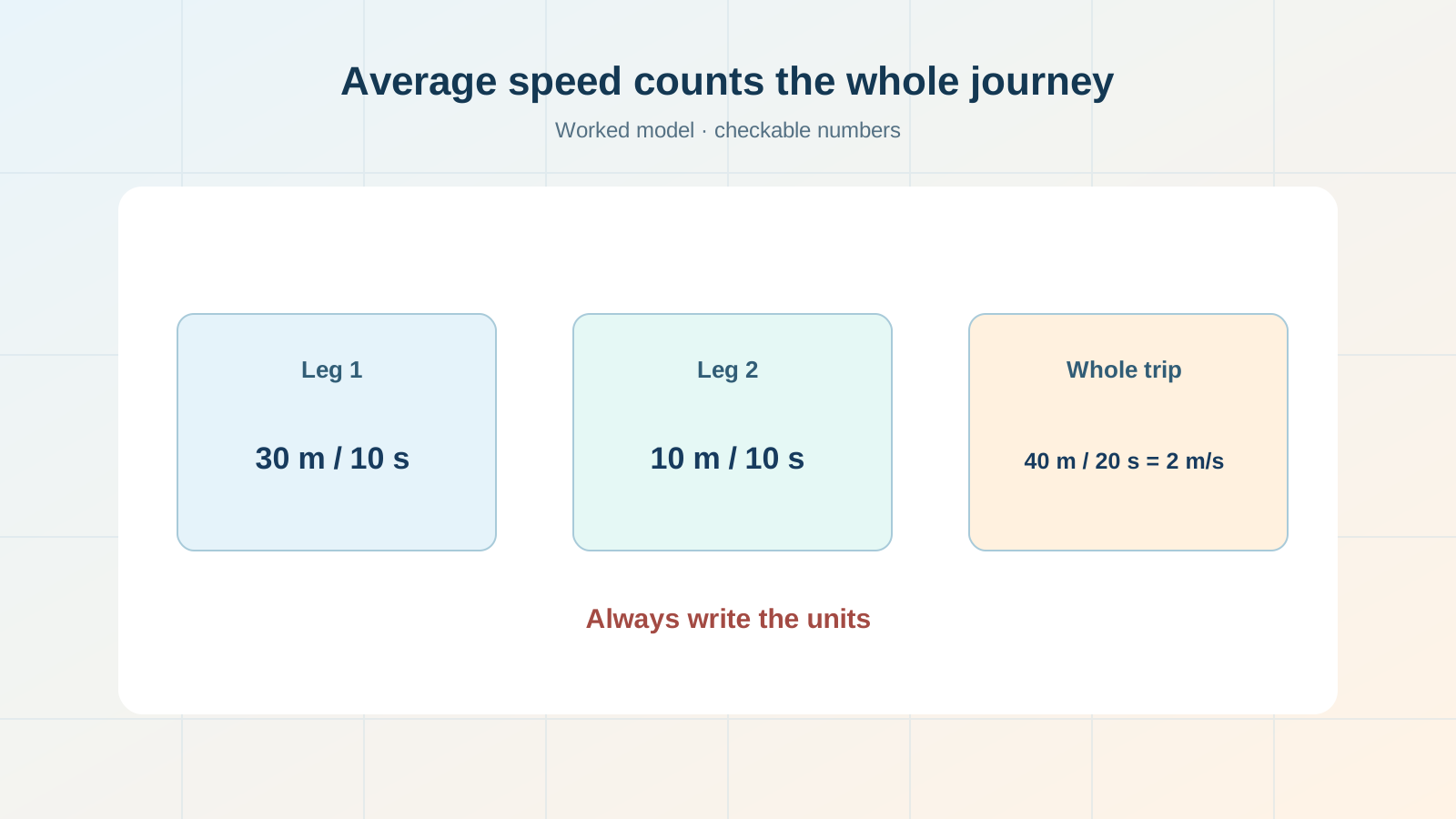
A worked cart travels 30 m in 10 s and then 10 m in another 10 s. Total distance is 30 + 10 = 40 m; total time is 10 + 10 = 20 s. Average speed is 40 / 20 = 2 m/s. The legs have speeds 3 and 1 m/s; their simple average also happens to be 2 m/s because the durations match. This is not guaranteed when durations differ. These are teaching values, not dimensions of our track.
Your paper investigation
Try 30 m in 10 s followed by 10 m in 20 s. The whole-trip average is 40 / 30 ≈ 1.33 m/s. The simple mean of 3 and 0.5 is 1.75 m/s, which is wrong for this journey. Explain which slower leg occupied more time.
An easy mistake to make
Do not omit a stop if timing ran from departure to arrival. Do not substitute displacement for distance when calculating average speed.
Check your understanding
Close the worked example and explain aloud: what was given, what was calculated, and in which units? Change one number in the question and say which calculation must be repeated. If you need a word you do not yet understand, return to its definition above.
Notebook entry
Record the answer with units and one short limit: what does this example not yet prove? If you did not perform a trial, label the numbers “worked data.”
If you have found a mistake or a typo in this article, tell us about it
Comments (0)
Log in to leave a comment →
No comments yet. Be the first.