


Physics around us: from a first experiment to your own lab Lesson 26 of 28
Energy of motion and height: two ways to store change
Compare matching 4 J examples without confusing speed and height.
One cart, one story
We continue the cart story from Motion and Graphs. Now ask not only “how did it move?” but “which objects changed its motion?” Link each new word to a visible scene before using an equation. Numbers on the support map are given teaching values, not a replacement for your own measurements.
A rolling cart can move a soft obstacle; a raised cart can also set things moving as it descends. Both have energy, but under different conditions. First agree that table level is zero height. Then compare worked values without claiming that “there is no energy” whenever height is zero.
What the words mean
Kinetic energy Eₖ comes with motion: Eₖ = ½mv², where v is speed. Gravitational potential energy Eₚ relative to a chosen level near Earth is approximately mgh. Energy is measured in joules, J. Doubling speed quadruples kinetic energy at the same mass. Potential energy depends on the height reference; differences in height can be compared physically.
Check the numbers and limits
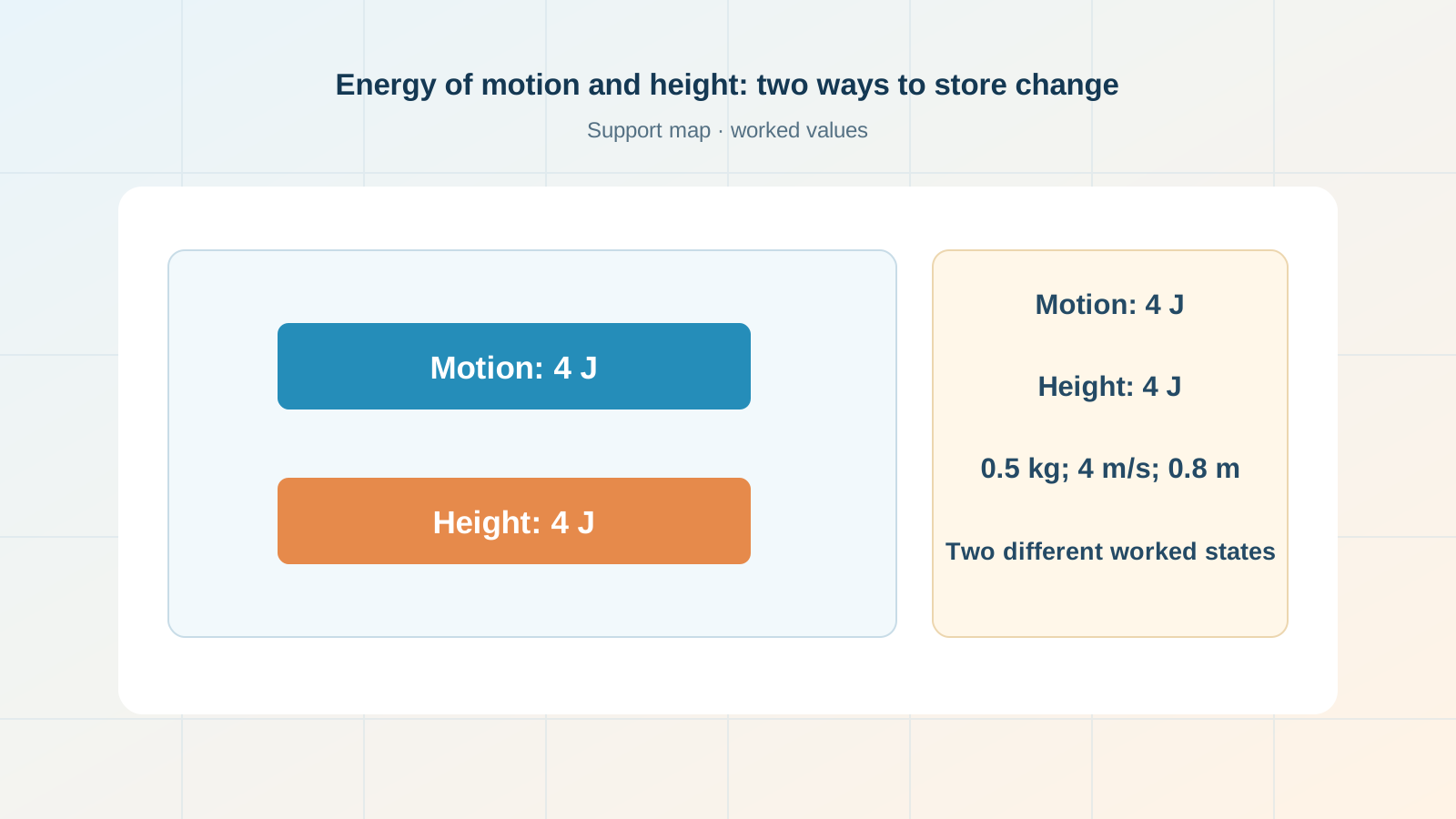
For mass 0.5 kg and speed 4 m/s, Eₖ = ½ × 0.5 × 4² = 4 J. For the same body at height 0.8 m above our zero, with g ≈ 10 N/kg, Eₚ ≈ 0.5 × 10 × 0.8 = 4 J. We chose equal numbers for comparison; it does not mean a cart on a table rises 0.8 m by itself.
Try it yourself
Make two paper cards: “motion: 0.5 kg; 4 m/s” and “height: 0.5 kg; 0.8 m.” Check arithmetic and units. Double speed to 8 m/s at unchanged mass: energy becomes 16 J, not 8 J. Do not lift heavy objects to test the formula.
A common trap
Do not call Eₚ absolute without naming a zero height. Do not replace v² with 2v: squaring speed matters.
Support map
Check without hints
Cover the calculation. Name the object receiving forces, their sources, and the chosen positive direction. Rebuild the arithmetic with units. Change one given number and explain which conclusion changes. If you did not run a real trial, write “worked model” in your notebook.
Notebook entry
Write four lines: “What did I see?”, “What was given?”, “What did I calculate?”, and “Which assumptions does this conclusion need?” This separates observation from model and lets you revisit an error later.
Next lesson: Where energy goes when a cart stops: transfer and conservation
If you have found a mistake or a typo in this article, tell us about it
Comments (0)
Log in to leave a comment →
No comments yet. Be the first.