


Physics around us: from a first experiment to your own lab Lesson 22 of 28
Balanced forces and inertia: motion needs no continuous push
Add forces on one object and distinguish velocity from its change.
One cart, one story
We continue the cart story from Motion and Graphs. Now ask not only “how did it move?” but “which objects changed its motion?” Link each new word to a visible scene before using an equation. Numbers on the support map are given teaching values, not a replacement for your own measurements.
Imagine two people pulling a light cart equally in opposite directions. It may stay still. But if it was already rolling on a very smooth track, balanced forces would not stop it instantly. Familiar friction hides the rule: real objects often slow down without a further push because of resistance.
What the words mean
The net force is the vector sum of forces on one chosen object. Along a line, choose right as positive and left as negative. Balanced forces mean zero net force. Inertia means preserving rest or straight, constant-velocity motion when the net force is zero. This is Newton’s first law in an inertial frame; a level lab track is only an approximation.
Check the numbers and limits
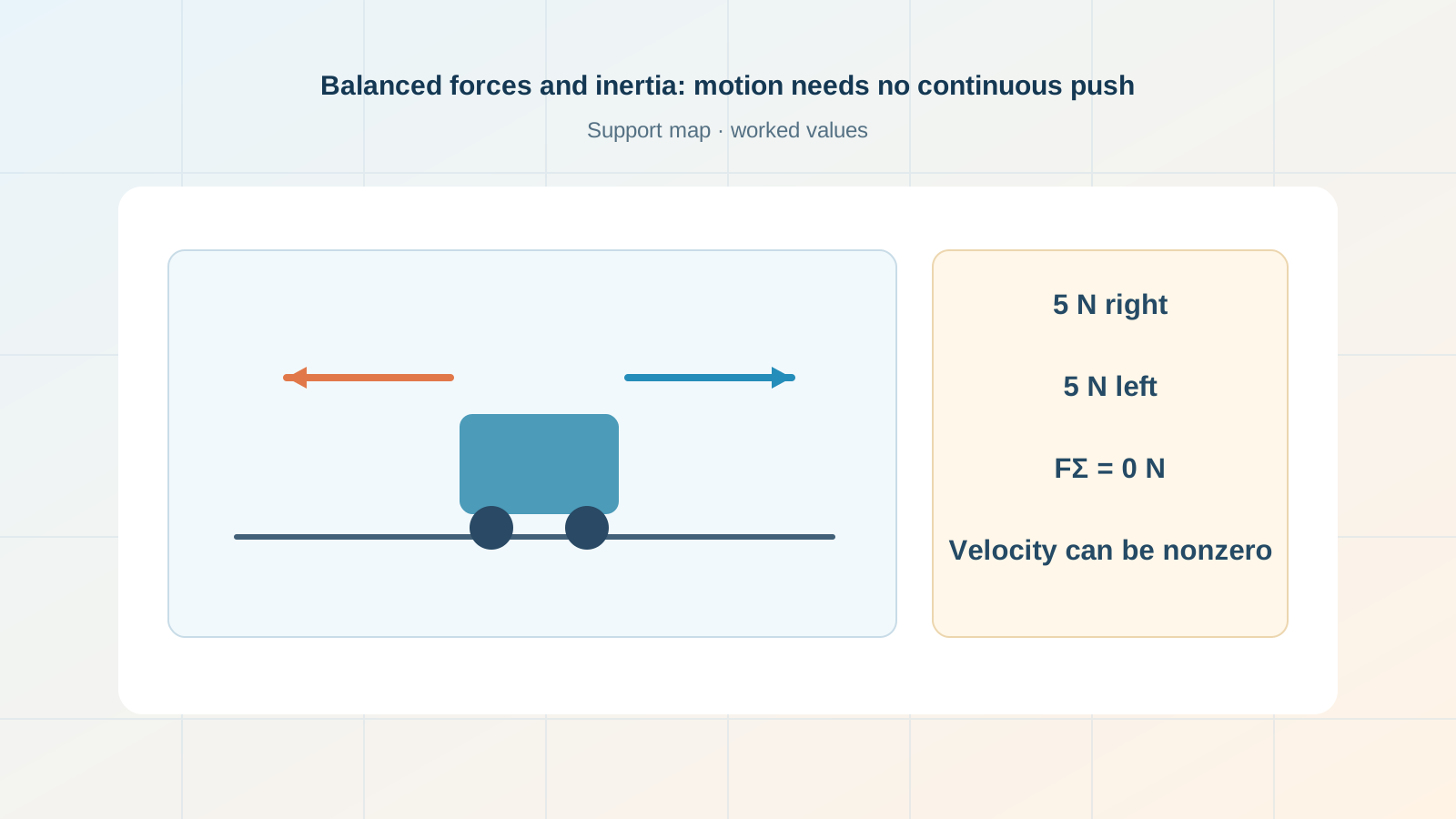
Forces of 5 N right and 5 N left act on the cart. Along our axis FΣ = +5 N − 5 N = 0 N. If initially at rest it stays at rest; if already moving right steadily, its velocity stays unchanged in the ideal model. Vertical forces balance separately. Do not add a hand’s force on a table to a table’s force on the cart: they act on different objects.
Try it yourself
Draw a token and two equal opposite arrows. Describe two starting conditions: resting and moving steadily. What conclusion do both share? Add a third arrow of 1 N right and predict what changes. Do not claim you applied any measured force to a real object unless you actually measured it.
A common trap
“Zero net force means zero velocity” is false. The change in velocity is zero; velocity itself need not be.
Support map
Check without hints
Cover the calculation. Name the object receiving forces, their sources, and the chosen positive direction. Rebuild the arithmetic with units. Change one given number and explain which conclusion changes. If you did not run a real trial, write “worked model” in your notebook.
Notebook entry
Write four lines: “What did I see?”, “What was given?”, “What did I calculate?”, and “Which assumptions does this conclusion need?” This separates observation from model and lets you revisit an error later.
If you have found a mistake or a typo in this article, tell us about it
Comments (0)
Log in to leave a comment →
No comments yet. Be the first.