


Physics around us: from a first experiment to your own lab Lesson 25 of 28
Mechanical work: when force transfers energy
Calculate joules when force acts along the displacement.
One cart, one story
We continue the cart story from Motion and Graphs. Now ask not only “how did it move?” but “which objects changed its motion?” Link each new word to a visible scene before using an equation. Numbers on the support map are given teaching values, not a replacement for your own measurements.
Hold a closed door with your palm. You tire, yet the door does not move. Everyday speech calls that work. In our physical model the force does zero mechanical work if its point of application does not move. That does not mean your muscles used no energy: a body is more complex than this model. Now pull a light cart across a table: force and displacement point together.
What the words mean
Mechanical work W measures energy transferred by a force during displacement. For a constant force along the displacement, W = F·s. The unit is the joule, J: 1 J = 1 N·m. If the force opposes motion, its work is negative: W = −F·s, using positive magnitudes F and s. No displacement means zero work by that force in this model. A force at an angle requires its component along the motion; that comes later.
Check the numbers and limits
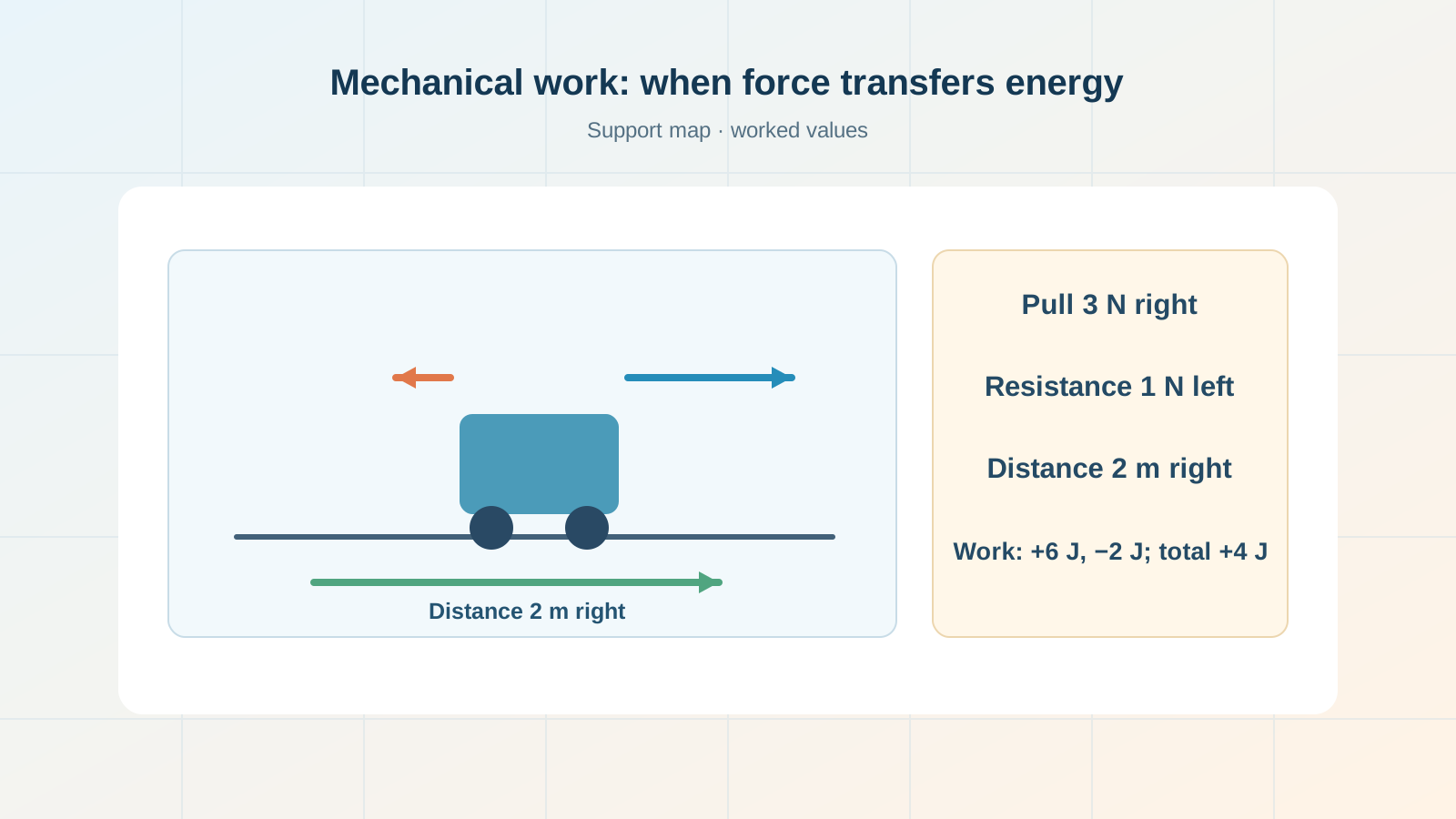
Worked pull of 3 N right acts while the cart moves 2 m right. Pulling work Wpull = 3 N × 2 m = +6 J. If 1 N resistance acts left over the same distance, Wresistance = −1 N × 2 m = −2 J. Total work is +4 J. This is not a measure of all energy spent by a person or the whole room.
Try it yourself
Draw a 2 m path and two forces: 3 N right, 1 N left. Give each work a sign, calculate both, then add them. Set the distance to 0 m: what happens? Explain negative work in words: resistance takes mechanical energy from the cart’s motion.
A common trap
Do not add 3 N to 2 m or call 6 J a force. Newtons and joules answer different questions.
Support map
Check without hints
Cover the calculation. Name the object receiving forces, their sources, and the chosen positive direction. Rebuild the arithmetic with units. Change one given number and explain which conclusion changes. If you did not run a real trial, write “worked model” in your notebook.
Notebook entry
Write four lines: “What did I see?”, “What was given?”, “What did I calculate?”, and “Which assumptions does this conclusion need?” This separates observation from model and lets you revisit an error later.
Next lesson: Energy of motion and height: two ways to store change
If you have found a mistake or a typo in this article, tell us about it
Comments (0)
Log in to leave a comment →
No comments yet. Be the first.