


Physics around us: from a first experiment to your own lab Lesson 3 of 104
Prediction and experiment: change one condition
Compare two cases so a result can be linked to the condition you changed.
Where we are on the map
The map shows the reasoning order. Its numbers are worked examples unless the lesson explicitly identifies your own measurement. You are in the first of eleven blocks.
A question from daily life
Two people time swings. The first has a short rope and a strong push; the second has a long rope and a weak push. If the times differ, which difference mattered? We cannot tell from this comparison.
Words and meanings
An experimental condition is something we set, such as rope length. The changed condition is the one difference we want to investigate. Held conditions are things we try to keep the same. A prediction is an expected result written before observation. A hypothesis is a testable proposed explanation; it may be wrong. Agreement with a result does not prove it forever.
Predict before checking
Which takes longer for ten complete swings: a 30 cm or a 60 cm pendulum? Record your answer before seeing any times. It is only a prediction so far.
Do it and record it
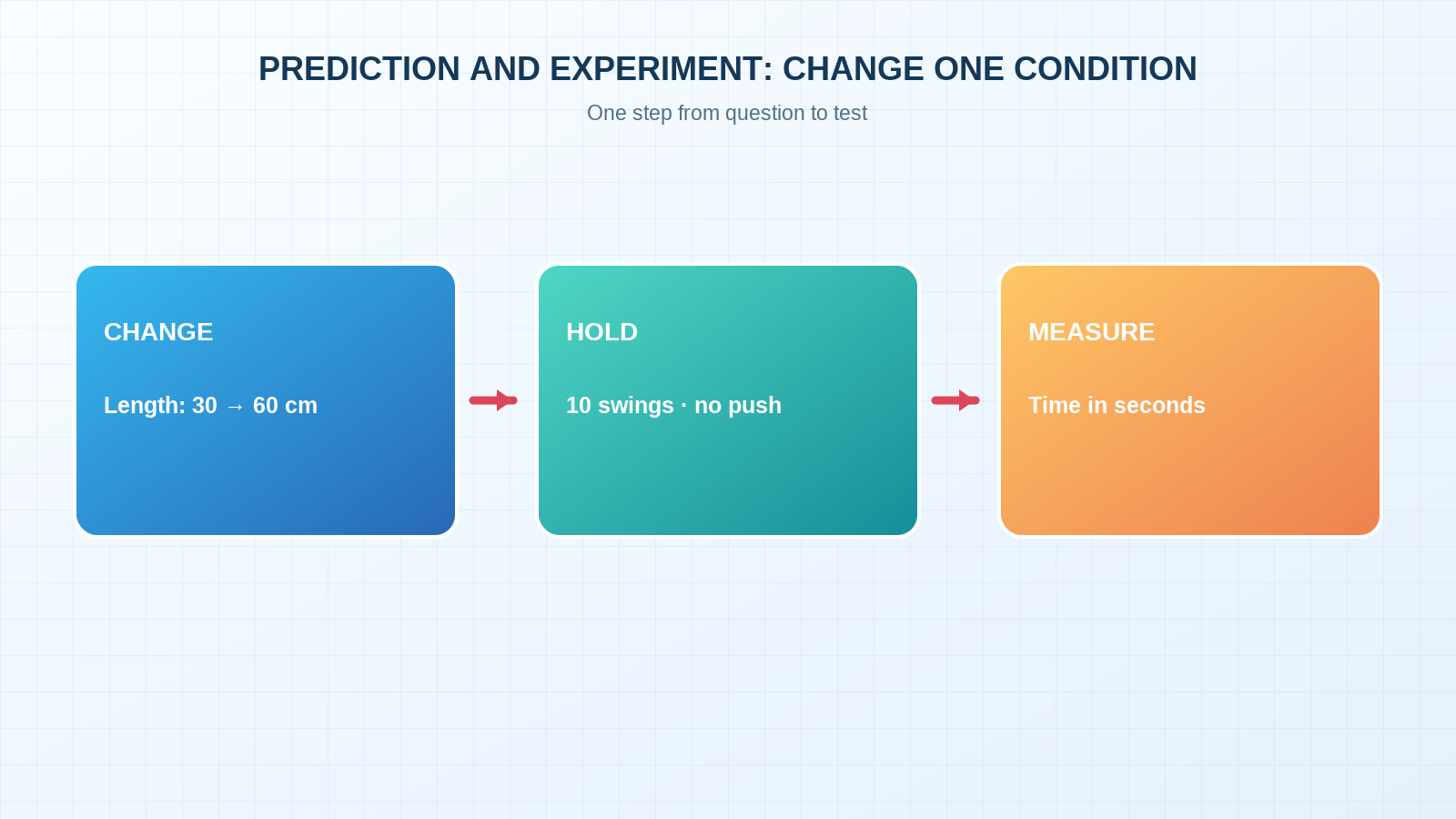
Plan on paper: use the same lightweight weight, count ten swings each time, start from a small tilt without pushing, and start the timer in the same way. Change only the distance from the hanging point to the weight’s centre: 30 cm and 60 cm. Actual measurement comes later.
A worked example
Unfair comparison: count 10 swings at 30 cm but 20 at 60 cm. Fair comparison: count 10 at both lengths. Worked values of 11.0 and 15.6 seconds do not establish that their ratio applies under every condition.
A common mistake
‘I changed one condition, so everything else was identical’ is too strong. A person’s reaction when starting the timer and moving air can still vary. That is why we repeat measurements.
A new situation
Two equal damp towels dry, one in shade and one near a window. Which conditions are hard to hold fixed? Do not hang anything on a heater for this exercise.
Notebook entry and self-check
Record your prediction, the one changed condition, three held conditions, and one possible unwanted difference. Was the prediction written before the result?
Slow the idea down
Think of testing two recipes. If you change the sugar, flour, and baking time together, you cannot tell which change affected the taste. Likewise, changing both a pendulum’s length and its weight does not isolate the role of length. Here we deliberately change the distance from support to the weight’s centre. We keep the weight, number of complete swings, and small starting tilt as similar as possible.
That does not make every other condition perfectly equal. Someone might press the stopwatch late; the air might move; the weight may be released from a slightly different point. Several repeats at each length help reveal such variation. Write the prediction before seeing the results. A prediction written afterwards is just a disguised answer.
Rehearse on paper
Write two lines: “30 cm — 10 swings — same weight” and “60 cm — 10 swings — same weight.” Circle the one condition you intend to change. Name one accidental difference that repeats may reveal.
If you have found a mistake or a typo in this article, tell us about it
Comments (0)
Log in to leave a comment →
No comments yet. Be the first.