


Physics around us: from a first experiment to your own lab Lesson 103 of 104
Why is a kilowatt not a kilowatt-hour?
Separate power, energy and cost in a supplied electric-kettle example.
The question
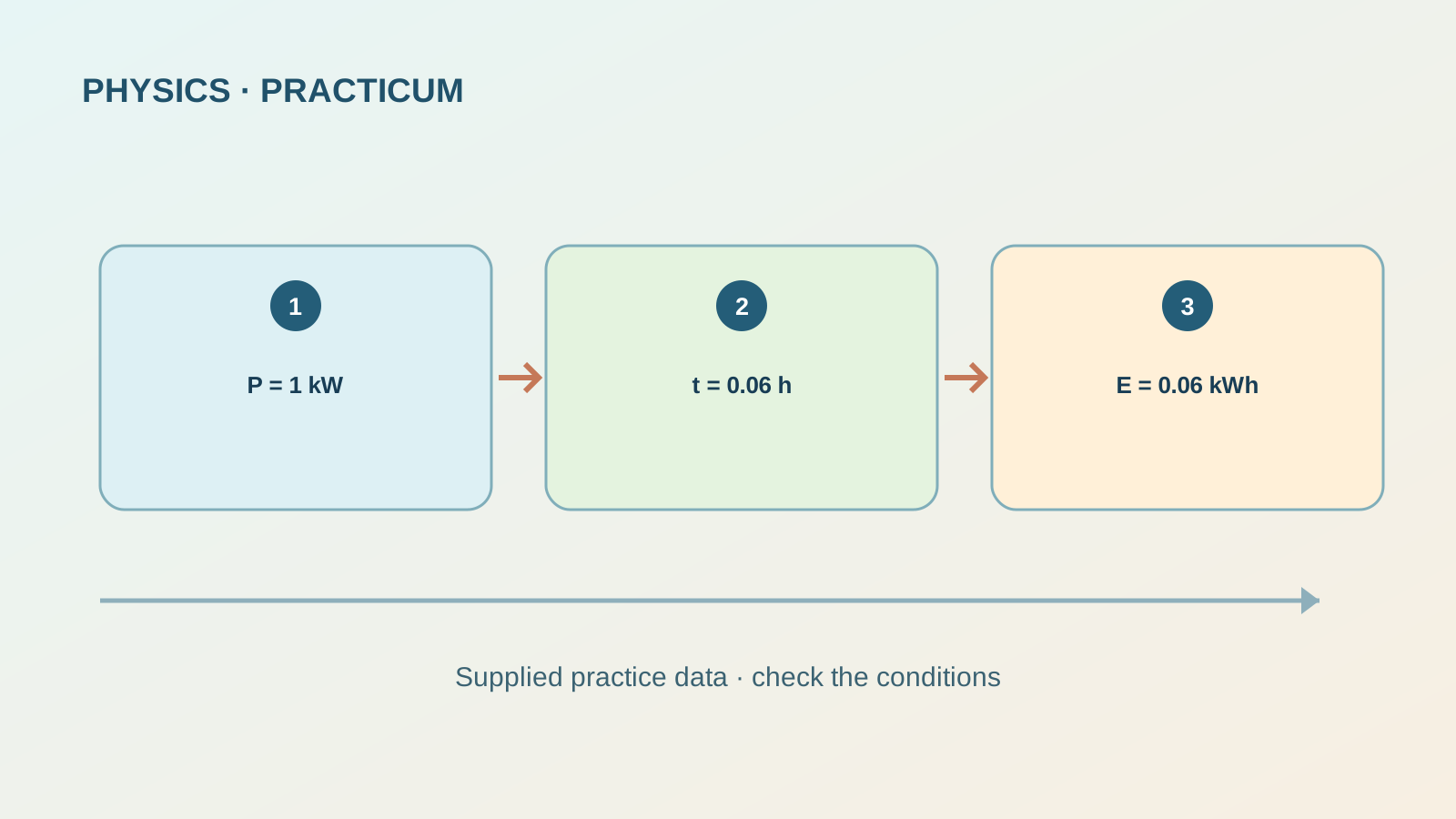
The appliance label says “1000 W”, while the electricity bill uses “kWh”. Confusing them makes cost estimates meaningless. Imagine a 1000 W kettle operating for 3.6 minutes. How much energy did it take from the supply? We do not switch on an appliance here; we use its label and calculation only.
Concept map
Power P is the rate of energy transfer: one watt (W) is one joule per second. 1000 W is one kilowatt (kW). At constant power, energy E = P·t. A kilowatt-hour (kWh) is the energy transferred by 1 kW in 1 hour; it is not a “kilowatt per hour”. Since an hour has 3600 seconds, 1 kWh = 3,600,000 J. Money cost is energy in kWh multiplied by the price per kWh. That price depends on place and date, so we will not invent a current tariff.
Worked numbers
Supplied example: 3.6 minutes = 0.06 hours = 216 seconds. Input energy is E = 1 kW × 0.06 h = 0.06 kWh = 216,000 J. Heating 1 kg of water from 20 to 60 °C adds about Q = 1 × 4200 × 40 = 168,000 J to the water. The ratio Q/E ≈ 0.78, or 78%. This is a conditional efficiency for these chosen numbers, not a measurement of a real kettle. Some energy warms the body and surrounding air. For cost, insert your own published unit tariff T: cost = 0.06 × T.
Safe practice
Make an appliance card with four fields: power in watts, time in minutes, energy in kWh and a cost formula. Check the time conversion: treating 3.6 minutes as 3.6 hours makes the answer sixty times too large. At the same 3.6 minutes a 500 W device would use 0.03 kWh. Yet lower power does not prove lower energy for an equal task: it might need to run longer. No experiment with sockets, extension leads or opened appliances is needed.
Check your reasoning
Self-check: what does 1000 W tell you, and how is 0.06 kWh different? Why cannot one supplied example establish every kettle’s efficiency or a current tariff? Transfer: if operating time doubles while power stays constant, what happens to energy?
Investigation map
Lab notebook
Give your notebook three columns: “My prediction”, “What the data show”, and “What the data cannot prove”. Fill the first before looking at the worked answer; revise an explanation that fails the check. If you perform a real experiment, keep your own readings distinct from the supplied practice values.
If you have found a mistake or a typo in this article, tell us about it
Comments (0)
Log in to leave a comment →
No comments yet. Be the first.