


Physics around us: from a first experiment to your own lab Lesson 51 of 56
How does a resistor protect a circuit?
Connect voltage, current and resistance for a suitable resistor while learning the limits of Ohm’s law.
Situation and prediction
Imagine a corridor: a narrower passage admits fewer people under the same conditions. This only suggests a direction of change; current comes from the electric field around the circuit, not from electrons running like people. Apply the same 3 V to two model resistors and predict which carries more current.
New words, step by step
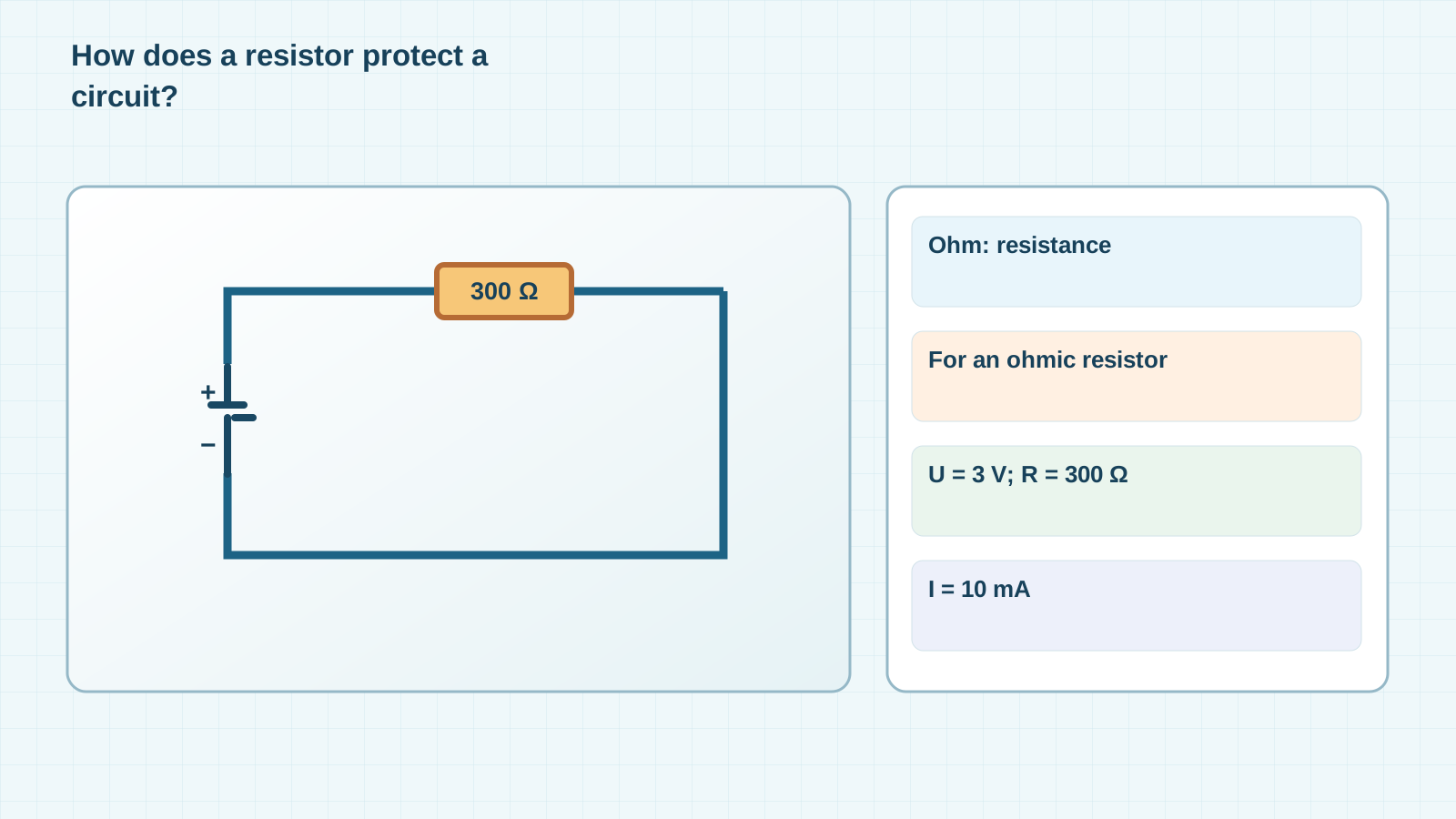
Resistance R describes how strongly a component opposes current under stated conditions; its unit is the ohm (Ω). For an ohmic resistor at roughly constant temperature, Ohm’s law is I = U/R. The letter R does not make every device’s resistance constant. A lamp filament changes resistance as it heats; an LED is nonlinear. Apply this equation to the resistor, not uncritically to every electronic component.
Working through supplied data
With an ideal 3 V source and a 300 Ω resistor, I = 3/300 = 0.01 A = 10 mA. At the same voltage a 600 Ω resistor would carry 0.005 A = 5 mA. These are supplied values, not measurements. An LED current-limiting resistor must account for the voltage across the LED; simply dividing 3 V by 300 Ω does not give its current.
A safe check
Draw two paper circuits and indicate the change in current. For a real ready-made kit, use only cells and adequately rated resistors under adult supervision. Never directly connect cell terminals with a wire; a resistor can get warm.
A reasoning trap
A mistake is to imagine that current disappears inside resistance. The same current enters and leaves a resistor in a single series path; electrical energy becomes mainly heat.
Support map
Transfer to a new case
Calculate the current for 3 V and 150 Ω in A and mA. Explain why the result alone does not describe an LED.
Lab notebook entry
Add a page to My World Lab Notebook with four lines: question; prediction before reading the answer; observation or calculation from supplied numbers; revised conclusion and its conditions. If you did not do an experiment, do not write ‘measured’. After the diagram, explain where charge moves, where energy is transferred, and where the model simplifies a real device.
If you have found a mistake or a typo in this article, tell us about it
Comments (0)
Log in to leave a comment →
No comments yet. Be the first.