

Physics around us: from a first experiment to your own lab Lesson 42 of 46
How does the Sun warm us across space?
The third energy-transfer process is radiation. Explore it without dangerous lamps or heaters.
A real-life question and prediction
On a clear day, one side of a bench is sunlit and the other shaded. Air near both may be similar in temperature, yet the surfaces differ. Where does the extra energy on the lit side come from? Space between Sun and Earth is nearly empty, so air circulation alone cannot explain it. Predict what happens if an opaque screen shades a surface.
Pause before the explanation: what exactly do you expect to see, and why? Write a prediction before calculating. After the lesson, separate what you observed, what you calculated from supplied numbers, and what you only inferred about invisible particles. That record lets you correct a model without replacing evidence with a neat answer.
Words to understand
Thermal radiation transfers energy by electromagnetic waves; no material is needed along a path through empty space. Absorption means a surface receives energy; reflection sends some incoming radiation away. The Sun emits different kinds of radiation, and Earth’s surface also emits radiation. Opaque shade reduces direct solar input but need not stop all energy received from air and surrounding objects.
A worked example
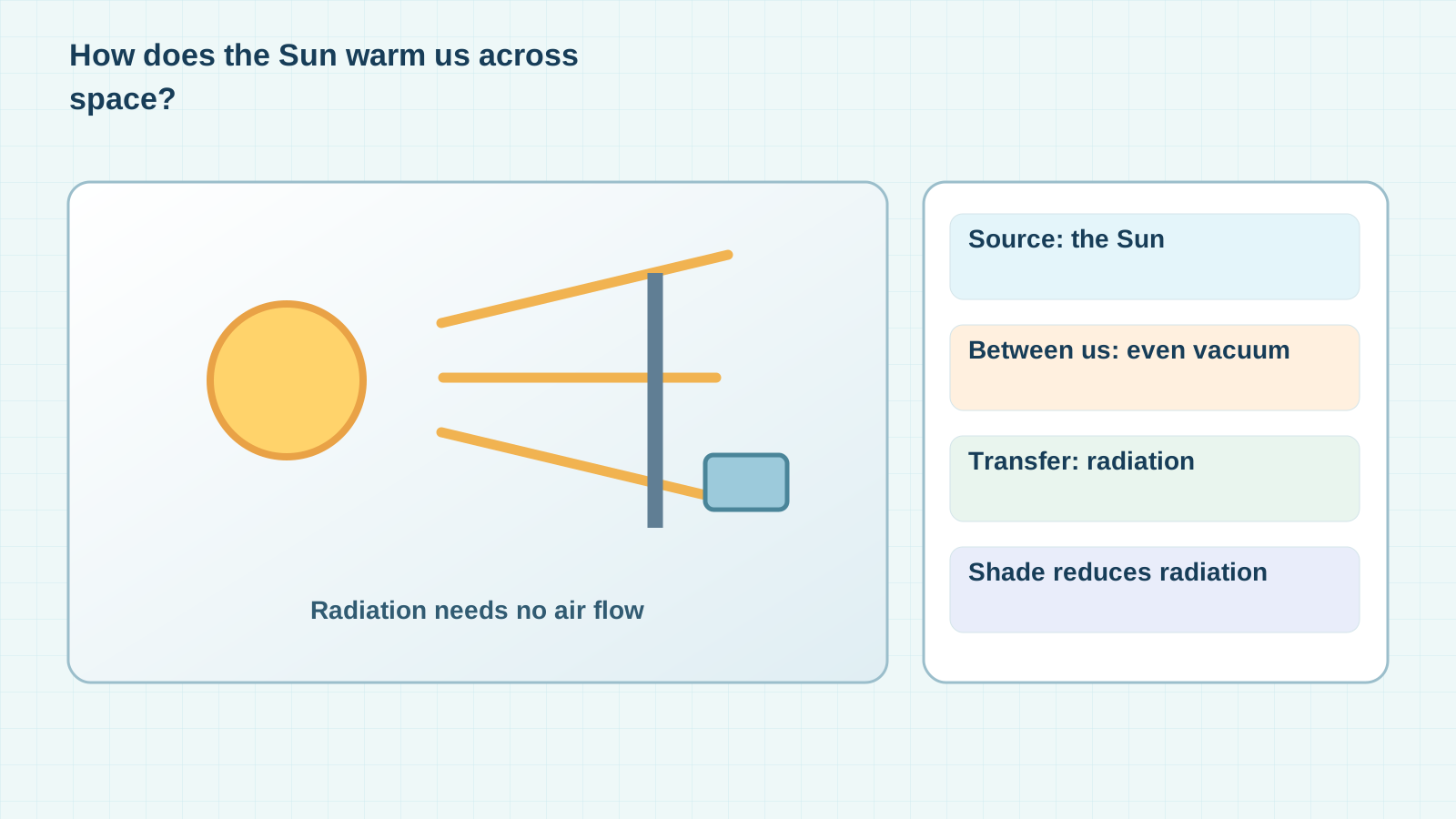
The teaching map has the Sun as source, even vacuum along the route, radiation as the transfer, and shade reducing direct flow. No exact temperature follows from those four labels: we also need illumination, surface properties, time and energy losses. Therefore “black cloth is always hotter than white cloth” without equal test conditions is too strong a claim.
Test it safely
Place two identical sheets of paper side by side, one in sunlight and one in shade, and describe the conditions. Do not touch very hot surfaces, stare at the Sun or use a powerful lamp. Compare measured surface temperatures only if a thermometer is suited to the surface and the wait time is identical. Otherwise record a qualitative observation.
An easy mistake to make
Mistake: treating radiation as warm air that travelled from the Sun. There is no such air bridge through nearly empty space. Shade does not automatically make an object colder than surrounding air, either: other exchange processes remain.
Support map
Your turn
Cover the worked solution. Draw a boundary around the system: what is inside and what is outside? Label energy-flow arrows and the units of each quantity. Change just one supplied number and explain in words which way the result changes. If there was no experiment, write “calculated from teaching data”, not “measured”.
Lab notebook entry
Write four lines: question; initial prediction; observation or supplied values; revised conclusion with its conditions. Identify one concrete source of error, such as a coarse thermometer, energy escaping into the room, or a changed amount of water. Return to the conclusion after the next lesson and see whether it survives a new situation.
Next lesson: Why can a small cup of water warm faster than a large one?
If you have found a mistake or a typo in this article, tell us about it
Comments (0)
Log in to leave a comment →
No comments yet. Be the first.