

Physics around us: from a first experiment to your own lab Lesson 43 of 46
Why can a small cup of water warm faster than a large one?
Connect mass, temperature change and transferred energy without reporting a calculation as an experiment.
A real-life question and prediction
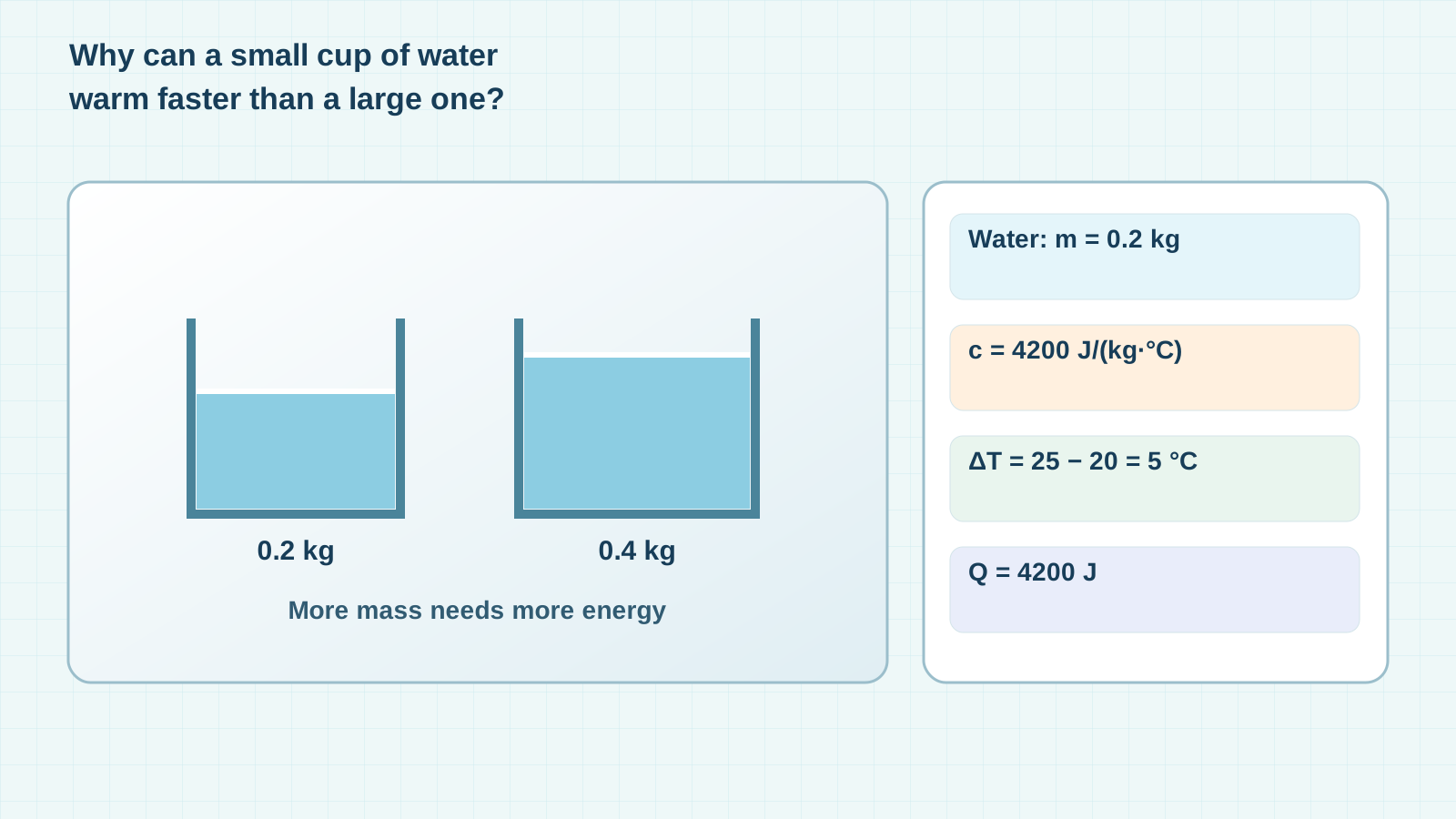
A kitchen has a small and a large cup of water. If both receive the same energy, their temperatures may change differently. In a first model, more water means more particles share the energy. Equal heater power, however, does not guarantee equal losses. Predict the energy needed to warm twice as much water by the same 5 °C.
Pause before the explanation: what exactly do you expect to see, and why? Write a prediction before calculating. After the lesson, separate what you observed, what you calculated from supplied numbers, and what you only inferred about invisible particles. That record lets you correct a model without replacing evidence with a neat answer.
Words to understand
Mass m describes how much material is in our model and is measured here in kilograms. Specific heat capacity c is the energy needed to raise 1 kg of a material by 1 °C when no phase change occurs; our school value for water is approximately 4200 J/(kg·°C). Temperature change is ΔT = Tfinal − Tinitial. Hence the energy received is Q ≈ mcΔT. “Specific” here means “per unit mass”.
A worked example
Teaching data: 0.2 kg of water warms from 20 to 25 °C. ΔT = 5 °C, so Q ≈ 0.2 × 4200 × 5 = 4200 J. For 0.4 kg with the same change, the result is 8400 J. That is energy reaching the water in a simplified model; a real appliance also warms its container and loses energy to the room.
Test it safely
Without a heater, sketch two cups labelled 0.2 and 0.4 kg and compare the calculations. You may measure the starting temperature of room-temperature water at home; no stove or boiling water is required. Write units at every step: kg × J/(kg·°C) × °C = J.
An easy mistake to make
Mistake: using 25 °C where the formula needs ΔT = 5 °C. It describes a change, not a final reading. Also do not claim that 4200 J was measured when c and mass were supplied teaching values.
Support map
Your turn
Cover the worked solution. Draw a boundary around the system: what is inside and what is outside? Label energy-flow arrows and the units of each quantity. Change just one supplied number and explain in words which way the result changes. If there was no experiment, write “calculated from teaching data”, not “measured”.
Lab notebook entry
Write four lines: question; initial prediction; observation or supplied values; revised conclusion with its conditions. Identify one concrete source of error, such as a coarse thermometer, energy escaping into the room, or a changed amount of water. Return to the conclusion after the next lesson and see whether it survives a new situation.
If you have found a mistake or a typo in this article, tell us about it
Comments (0)
Log in to leave a comment →
No comments yet. Be the first.