


Physics around us: from a first experiment to your own lab Lesson 36 of 36
Checkpoint: design a safe floating platform
Combine pressure, density, buoyancy and hydraulics in one project. Keep observations, given teaching values and assumptions separate.
Story and prediction
Challenge: a light platform should hold a small load on water. Writing “it floats” is not enough: calculate the needed displaced volume, sketch the waterline and report a test honestly. Draw the platform and specify what is included in its mass. If you experiment, use only a shallow tray, foil or a sealed plastic container and light coins. Keep water away from electrical equipment.
Before reading, put your prediction in your notebook and justify it in one sentence. After calculating, return to it: a result matching your guess does not yet prove your explanation. Check which conditions were supplied and which things you actually observed.
Words to learn
A criterion is a success condition chosen in advance, such as “cargo stays dry for one minute”. A constraint is a limit you may not break: tray depth, stability or cargo mass. An iteration is a deliberate change after testing. Write observation, calculation and explanation separately. p = F/A concerns load on a support; ρgh is added pressure in still water; Fᵦ = ρgV concerns buoyancy. One formula cannot answer all three questions.
Check the model with numbers
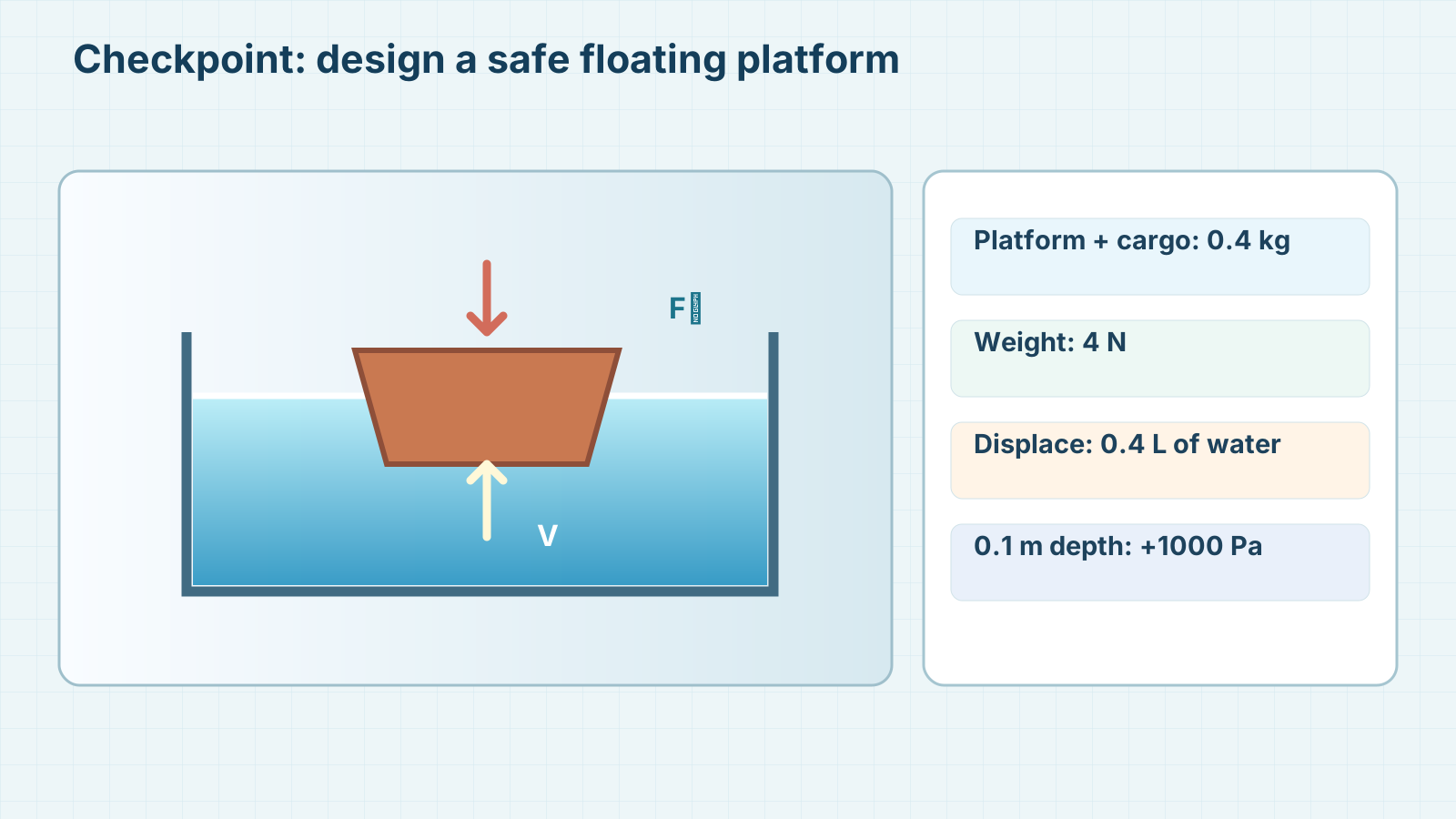
Worked brief: platform plus cargo has mass 0.4 kg. Its weight is about 4 N, so floating equilibrium requires V = 4/(1000 × 10) = 0.0004 m³ = 0.4 L of displaced water. In a separate model, if the entire system pushes with 4 N on a flat 0.02 m² support, average pressure is 4/0.02 = 200 Pa. This is not water pressure at the bottom. At 0.1 m depth, water adds about 1000 Pa relative to its surface.
A safe investigation
Make a table with “prediction, test method, result, change”. Compare two shapes while changing only width or side height. Without a trial, calculate the model for 0.6 kg: 0.6 L of displaced water. On paper, add a hydraulic lift for the platform: piston areas 2 and 10 cm², with 4 N on the small one. Find the 20 N output and explain its shorter travel. Do not lift a real platform. Extension: why does Fᵦ equalling weight alone fail to guarantee stability?
A likely mistake
Trap: presenting the predicted 0.4 L as measured, or promising stability from one equation. Spills, deformation and a shifted load may change the real result. State your model’s limits and return to your first-block notebook.
Support map
A new case without hints
Cover the worked example. Redraw the situation, name the object and the forces acting on it. Then change just one given number, recalculate with units and say what stayed the same. If you had no measuring instrument, write “calculated from a worked model”, not “measured”.
Lab notebook entry
Write four lines: question; prediction; given data or observation; conclusion with a condition. Add one reason a real trial may differ from the ideal drawing. Return to this page after the next lesson and revise the conclusion if a new check changes it.
If you have found a mistake or a typo in this article, tell us about it
Comments (0)
Log in to leave a comment →
No comments yet. Be the first.