


Physics around us: from a first experiment to your own lab Lesson 35 of 36
How can a small piston move a larger load?
Understand Pascal’s principle, force gain and the shorter travel that pays for it. No needles or high pressure.
Story and prediction
Two connected, water-filled needle-free syringes can have different piston areas. Pressing the small piston gently can yield a larger force at the big one. But the big piston moves a shorter distance. Energy has not been created for free: the fluid transmits pressure while the volume displaced must be accounted for. Before calculating, predict which piston travels farther.
Before reading, put your prediction in your notebook and justify it in one sentence. After calculating, return to it: a result matching your guess does not yet prove your explanation. Check which conditions were supplied and which things you actually observed.
Words to learn
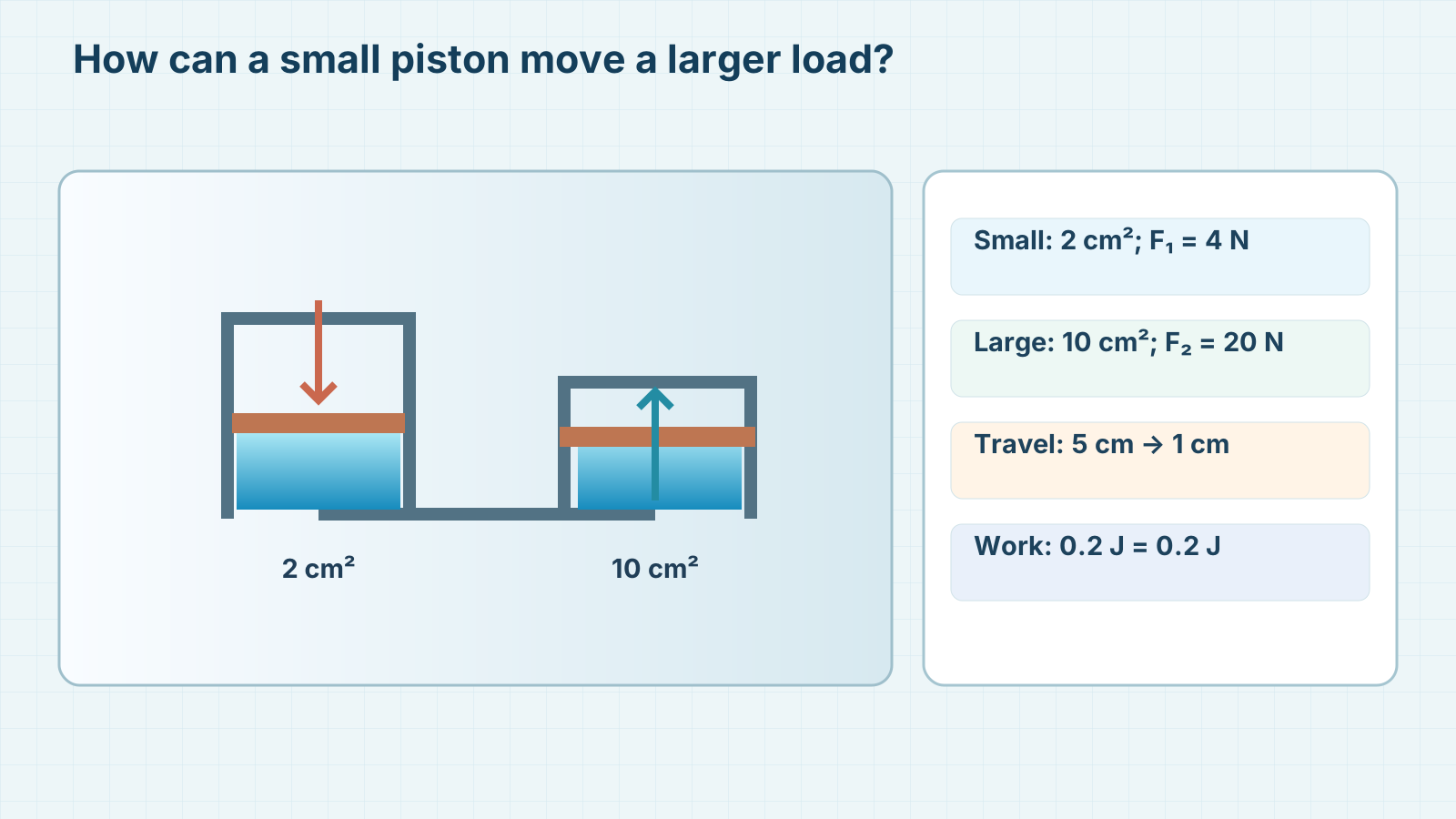
Pascal’s principle says a change in pressure in a confined stationary liquid is transmitted through it. For ideal pistons at the same height, p = F₁/A₁ = F₂/A₂. Hydraulics uses liquid to transmit an action. For an incompressible liquid, displaced volume gives A₁s₁ = A₂s₂, where s is piston travel. Seals, friction, air bubbles and height difference affect real results; our equations describe an ideal model.
Check the model with numbers
Take A₁ = 2 cm², A₂ = 10 cm² and F₁ = 4 N. The area ratio is 5, so F₂ = 20 N. If the small piston travels 5 cm, the big one moves only 1 cm: 2 × 5 = 10 × 1 cm³. Work check: 4 N × 0.05 m = 0.2 J, while 20 N × 0.01 m = 0.2 J. A real device delivers less because of losses.
A safe investigation
Sketch piston faces with 2 and 10 grid squares. Draw travel arrows of 5 and 1 squares. If you have a ready-made set of needle-free syringes, use water only, with adult supervision, no high pressure and no hard pushing. Without it, calculate the force for areas 3 and 6 cm² with a 3 N input: 6 N.
A likely mistake
Trap: “five times more force means five times more energy”. No; the larger piston travels one fifth as far. Never try to lift a real heavy load with a homemade device.
Support map
A new case without hints
Cover the worked example. Redraw the situation, name the object and the forces acting on it. Then change just one given number, recalculate with units and say what stayed the same. If you had no measuring instrument, write “calculated from a worked model”, not “measured”.
Lab notebook entry
Write four lines: question; prediction; given data or observation; conclusion with a condition. Add one reason a real trial may differ from the ideal drawing. Return to this page after the next lesson and revise the conclusion if a new check changes it.
If you have found a mistake or a typo in this article, tell us about it
Comments (0)
Log in to leave a comment →
No comments yet. Be the first.