


Physics around us: from a first experiment to your own lab Lesson 34 of 36
Why does a steel ship float while a steel ball sinks?
Connect average density, displaced-water volume and force balance. A ship does not break Archimedes’ principle.
Story and prediction
A steel ship can float while a small solid steel ball sinks. Looking only at the material misleads us: a hull encloses air, spreading the whole ship’s mass over a large outer volume. To float, it displaces enough water for buoyancy to balance its weight. If overloaded beyond the volume it can safely displace, it begins to sink.
Before reading, put your prediction in your notebook and justify it in one sentence. After calculating, return to it: a result matching your guess does not yet prove your explanation. Check which conditions were supplied and which things you actually observed.
Words to learn
Average density of the whole body is total mass divided by outer volume, including hollows inside the hull. Do not confuse it with the density of steel. Floating equilibrium means upward buoyant force equals downward gravitational force. Draft is how far the hull lies below the waterline. More cargo requires more displaced water and usually a greater draft.
Check the model with numbers
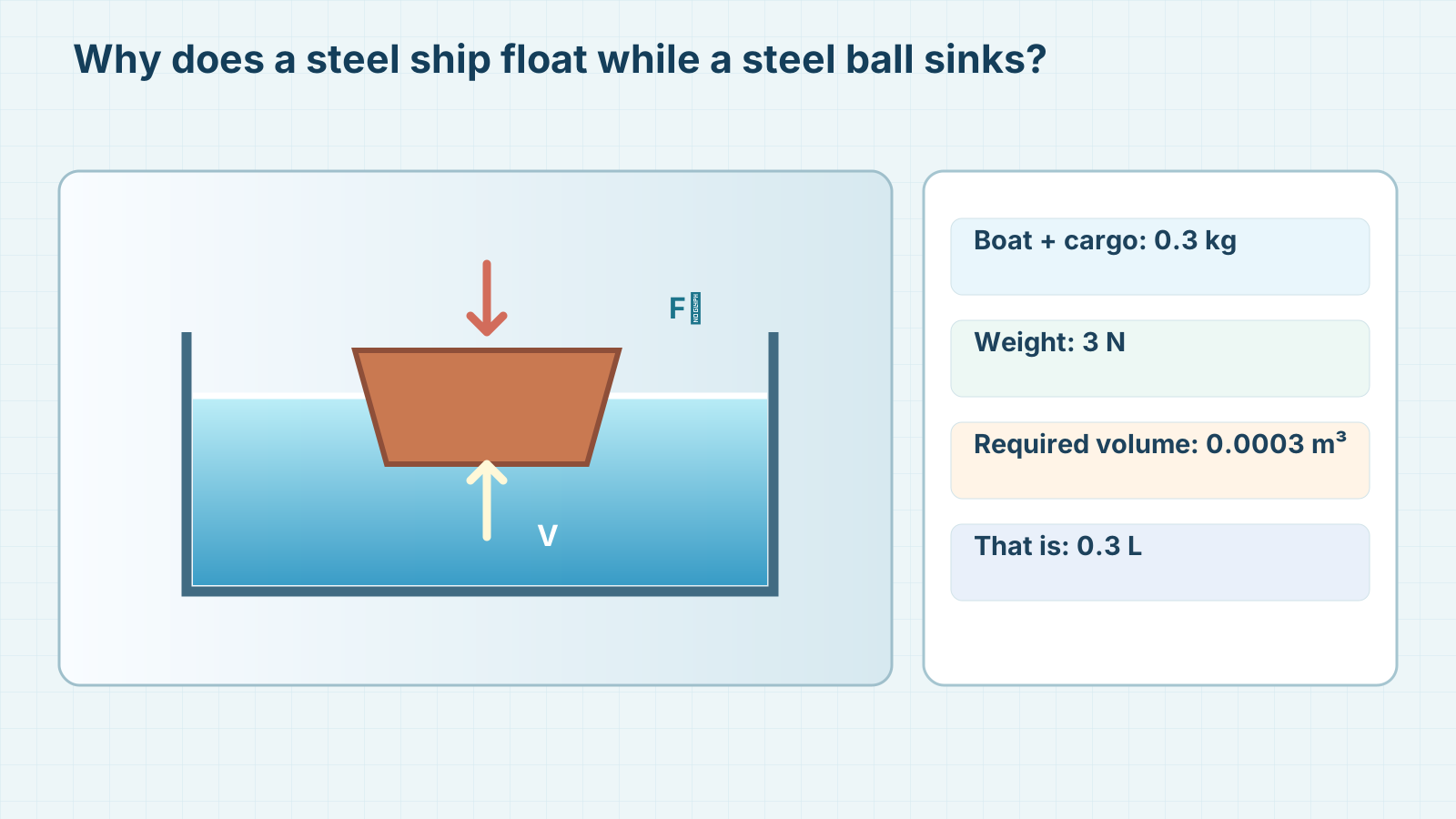
Worked model: a little boat and cargo have mass 0.3 kg. At g ≈ 10 N/kg, their weight is 3 N. Equilibrium in water requires V = 3/(1000 × 10) = 0.0003 m³ = 0.3 L of displaced water. One litre is the volume of a 10 cm by 10 cm by 10 cm cube: 1 L = 0.001 m³. If the boat’s outer volume is too small, that static floating state is impossible.
A safe investigation
Fold a small foil boat and place it in a shallow tray of water. Add identical light coins one at a time and sketch the draft. Do not turn a visual observation into an invented force measurement. Stop before water spills. With no experiment, calculate the displaced volume for 0.5 kg: 0.5 L. Why does a wide hollow shape help keep a larger air volume?
A likely mistake
Trap: “steel becomes lighter than water”. Steel density does not change; we consider the average density of the whole air-filled hull. An empty and an overloaded boat are different systems.
Support map
A new case without hints
Cover the worked example. Redraw the situation, name the object and the forces acting on it. Then change just one given number, recalculate with units and say what stayed the same. If you had no measuring instrument, write “calculated from a worked model”, not “measured”.
Lab notebook entry
Write four lines: question; prediction; given data or observation; conclusion with a condition. Add one reason a real trial may differ from the ideal drawing. Return to this page after the next lesson and revise the conclusion if a new check changes it.
If you have found a mistake or a typo in this article, tell us about it
Comments (0)
Log in to leave a comment →
No comments yet. Be the first.