


Physics around us: from a first experiment to your own lab Lesson 31 of 36
Why does water pressure rise with depth?
Connect the height of a water column to pressure, and separate water’s added pressure from atmospheric pressure. No bottles need to be pierced.
Story and prediction
Put your fingers in a bowl of water, then a little deeper: the difference is hard to feel. That does not prove there is no pressure. Instead, imagine a clear column of water above a small horizontal patch. A taller column has more water whose weight acts on the patch. Predict whether the extra pressure doubles when the depth doubles while the liquid stays the same.
Before reading, put your prediction in your notebook and justify it in one sentence. After calculating, return to it: a result matching your guess does not yet prove your explanation. Check which conditions were supplied and which things you actually observed.
Words to learn
Depth h is vertical distance below the liquid surface, not distance along a sloping wall. Density ρ (rho) means mass per unit volume; use approximately 1000 kg/m³ for water in our worked examples. Gravitational field strength g is about 10 N/kg in this approximation. Hydrostatic gauge pressure p = ρgh is the pressure added by a stationary liquid column above the pressure at its surface. Air also pushes on an open surface, so absolute pressure includes atmospheric pressure.
Check the model with numbers
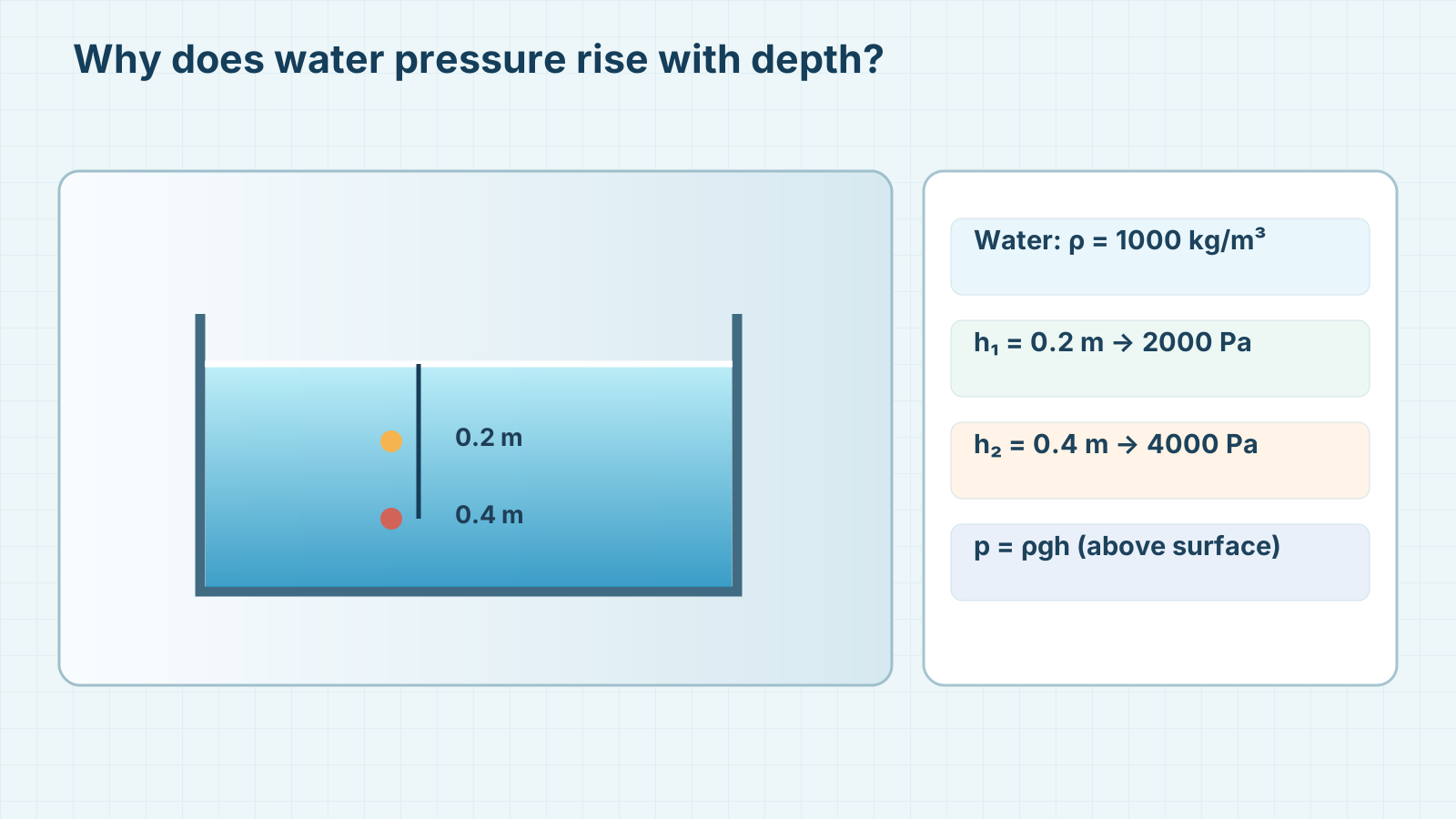
At a depth of 0.2 m, our water model gives p = 1000 × 10 × 0.2 = 2000 Pa of additional pressure. At 0.4 m, it gives 4000 Pa. For the same fluid, the pressure ratio equals the depth ratio. This assumes stationary water and nearly constant ρ and g. Depth alone cannot tell us whether a vessel wall is strong enough.
A safe investigation
Pour a little water into a clear glass and mark depths of 2 cm and 4 cm on paper. Pierce nothing and do not pressurise the vessel. Calculate the model values: 200 and 400 Pa. Write down that the marks are observed and the pressures are calculated. Extension: why is pressure at equal depth the same in wide and narrow containers?
A likely mistake
Trap: saying p = ρgh is all the pressure inside an open vessel. It is only the increase relative to the surface. Also avoid using a sloping path length where a vertical depth is required.
Support map
A new case without hints
Cover the worked example. Redraw the situation, name the object and the forces acting on it. Then change just one given number, recalculate with units and say what stayed the same. If you had no measuring instrument, write “calculated from a worked model”, not “measured”.
Lab notebook entry
Write four lines: question; prediction; given data or observation; conclusion with a condition. Add one reason a real trial may differ from the ideal drawing. Return to this page after the next lesson and revise the conclusion if a new check changes it.
Next lesson: Why do connected vessels settle at the same water level?
If you have found a mistake or a typo in this article, tell us about it
Comments (0)
Log in to leave a comment →
No comments yet. Be the first.