


Physics around us: from a first experiment to your own lab Lesson 32 of 36
Why do connected vessels settle at the same water level?
Investigate connected vessels and why a water tower’s height matters more than the pipe’s shape.
Story and prediction
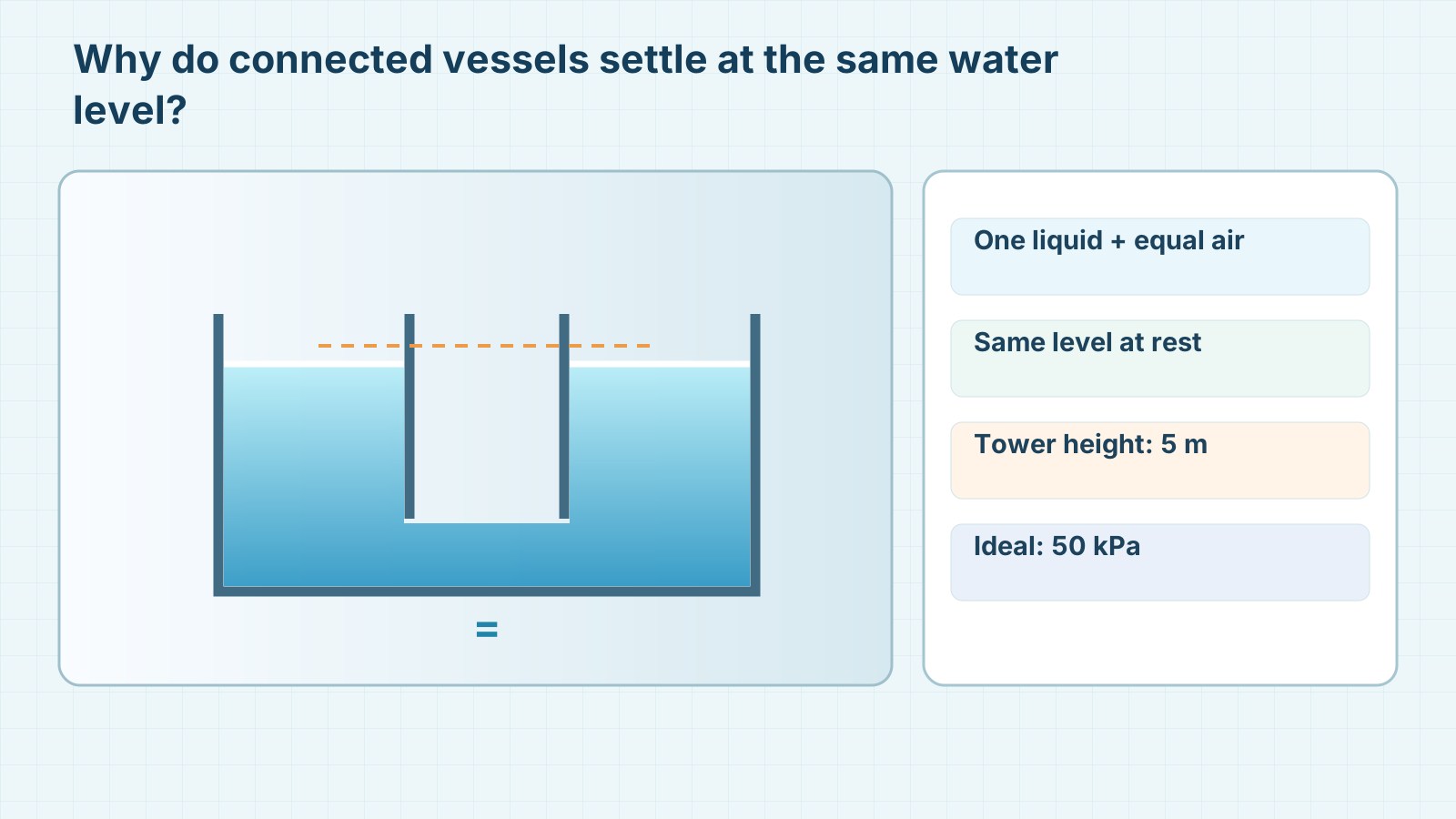
Imagine two clear vessels joined by a tube near their bases. The water is initially higher in one. What happens when the connection opens? Water moves until the free surfaces reach the same height, provided both vessels are open to the same air pressure and hold the same liquid. This explains part of a water tower: a high reservoir establishes a height difference.
Before reading, put your prediction in your notebook and justify it in one sentence. After calculating, return to it: a result matching your guess does not yet prove your explanation. Check which conditions were supplied and which things you actually observed.
Words to learn
Communicating vessels are containers through which liquid can flow via a lower connection. Level means the free surface’s height relative to a chosen horizontal reference. Pressure at the same depth in connected, still water is equal; otherwise water would keep flowing. In our first model, head relates to height difference. It is not a tap’s flow speed, nor a promise of the same flow through any pipe. Friction and flow rate matter when water moves.
Check the model with numbers
If the reservoir is 5 m above a tap, the lossless model gives ρgh = 1000 × 10 × 5 = 50,000 Pa, or 50 kPa of added pressure. At 10 m it gives 100 kPa. These are ideal model values at a closed outlet. During flow, especially through narrow pipes, pressure at the tap may be lower. Curving a pipe does not create additional energy.
A safe investigation
Without tubing, sketch two open connected vessels of different widths and draw one horizontal water level. Then imagine a closed tap 2 m below the reservoir surface: calculate 20 kPa. Separate sketch, prediction and calculation from actual observation in your notebook. If an adult helps with a ready-made transparent U-tube, use only water and a tray.
A likely mistake
Trap: “the wider side holds more water, so its level must be higher”. With one liquid and equal air pressure the levels match. A sealed vessel, different liquids or moving flow needs different conditions.
Support map
A new case without hints
Cover the worked example. Redraw the situation, name the object and the forces acting on it. Then change just one given number, recalculate with units and say what stayed the same. If you had no measuring instrument, write “calculated from a worked model”, not “measured”.
Lab notebook entry
Write four lines: question; prediction; given data or observation; conclusion with a condition. Add one reason a real trial may differ from the ideal drawing. Return to this page after the next lesson and revise the conclusion if a new check changes it.
If you have found a mistake or a typo in this article, tell us about it
Comments (0)
Log in to leave a comment →
No comments yet. Be the first.