


Physics around us: from a first experiment to your own lab Lesson 33 of 36
Where does an object’s weight “go” underwater?
Discover buoyancy through displaced water and distinguish weight, a force-meter reading and floating.
Story and prediction
A small stone hanging from a string feels easier to hold underwater than in air. It has not lost mass; water pushes it upwards. Why upwards? Its lower face is deeper, so water pressure there is greater than at its upper face. Sideways forces cancel in a simple symmetric model. The resulting fluid force points upwards.
Before reading, put your prediction in your notebook and justify it in one sentence. After calculating, return to it: a result matching your guess does not yet prove your explanation. Check which conditions were supplied and which things you actually observed.
Words to learn
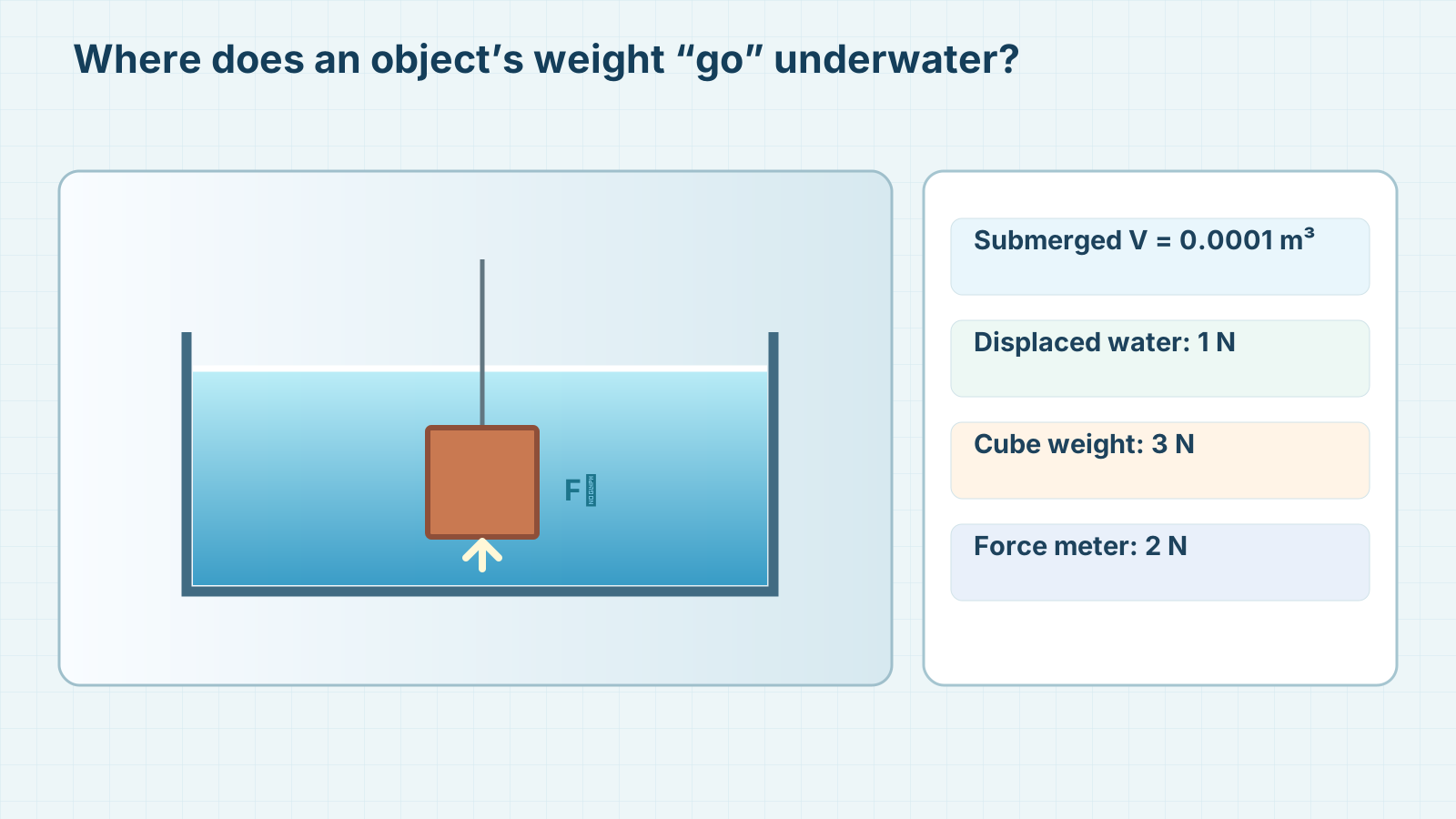
Displaced volume is the volume of the object’s submerged part, which takes the place of liquid. Buoyant force Fᵦ is the fluid’s net upward force: Fᵦ = ρfluid g Vsubmerged. Here ρfluid is liquid density and Vsubmerged is submerged volume. Archimedes’ principle says this force equals the weight of displaced fluid for a stationary liquid. A force meter holding the object reads less by Fᵦ, but its mass does not change.
Check the model with numbers
Worked cube: volume 0.0001 m³, completely underwater. Fᵦ = 1000 × 10 × 0.0001 = 1 N. If its weight in air is 3 N and it is held still underwater, a force meter would read about 2 N. If half the cube is submerged, displaced volume halves and Fᵦ ≈ 0.5 N in this model. This assumes the stated geometry and the same water density.
A safe investigation
Put a light plastic cap in a shallow bowl of water and sketch how much of it lies below the surface. Do not attach the example’s numbers to your cap: you did not measure its volume. With no equipment, work another case: a fully submerged body displaces 0.0002 m³ of water; estimate Fᵦ = 2 N. Record that “easier to hold” is a sensation while 2 N is calculated.
A likely mistake
Trap: buoyant force always equals the object’s whole weight. That holds for a freely floating body in equilibrium, but not for a cube held underwater or an object sinking.
Support map
A new case without hints
Cover the worked example. Redraw the situation, name the object and the forces acting on it. Then change just one given number, recalculate with units and say what stayed the same. If you had no measuring instrument, write “calculated from a worked model”, not “measured”.
Lab notebook entry
Write four lines: question; prediction; given data or observation; conclusion with a condition. Add one reason a real trial may differ from the ideal drawing. Return to this page after the next lesson and revise the conclusion if a new check changes it.
Next lesson: Why does a steel ship float while a steel ball sinks?
If you have found a mistake or a typo in this article, tell us about it
Comments (0)
Log in to leave a comment →
No comments yet. Be the first.