


Physics around us: from a first experiment to your own lab Lesson 30 of 36
Why can square centimetres change an answer ten thousandfold?
Convert area correctly and calculate pressure with consistent units. Check the arithmetic on a small piston model.
Story and prediction
Last lesson, pressure depended on area. A label may give that area in square centimetres, while our formula expects square metres. Silently swapping units seems minor but changes the answer by a factor of 10,000. Imagine a clear teaching piston with a 2 cm² face. Before inserting the number 2 into the formula, sketch a 1 cm by 1 cm square inside a 1 m by 1 m square.
Before reading, put your prediction in your notebook and justify it in one sentence. After calculating, return to it: a result matching your guess does not yet prove your explanation. Check which conditions were supplied and which things you actually observed.
Words to learn
A square centimetre (cm²) is a square with 1 cm sides. A metre contains 100 cm across and 100 cm vertically, so 1 m² = 10,000 cm² and 1 cm² = 0.0001 m². A piston is a movable part that closes a cylinder’s cross-section. A cross-section is an imagined flat slice, here the face through which a force acts on fluid. For now we calculate its area; pressure transmission comes later.
Check the model with numbers
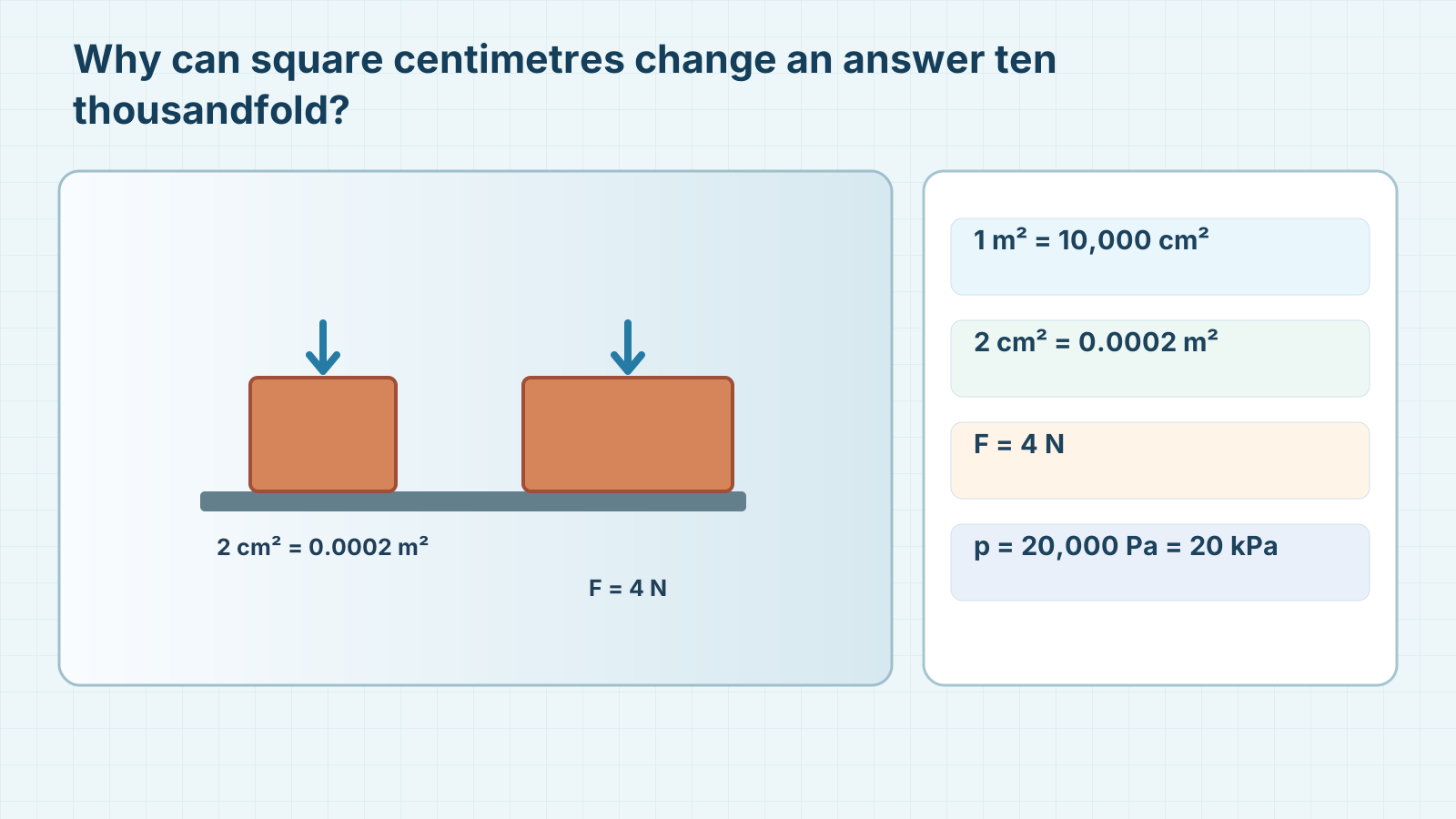
Given F = 4 N and A = 2 cm² = 0.0002 m², p = 4/0.0002 = 20,000 Pa = 20 kPa. The prefix kilo means a thousand: 1 kPa = 1000 Pa. Check backwards: 20,000 Pa × 0.0002 m² = 4 N. If you enter 2 as if it were square metres, you get 2 Pa, an entirely different situation.
A safe investigation
Draw a 2 cm by 2 cm square and label its area 4 cm². Convert this to 0.0004 m². With the same 4 N force, calculate 10,000 Pa. Check by multiplying pressure by area. Extension: why does doubling both side lengths quadruple area instead of doubling it?
A likely mistake
Trap: treating cm² like a length and dividing by only 100. Area has two dimensions, so the conversion uses 100 × 100. Do not confuse kPa with kN: the first measures pressure, the second force.
Support map
A new case without hints
Cover the worked example. Redraw the situation, name the object and the forces acting on it. Then change just one given number, recalculate with units and say what stayed the same. If you had no measuring instrument, write “calculated from a worked model”, not “measured”.
Lab notebook entry
Write four lines: question; prediction; given data or observation; conclusion with a condition. Add one reason a real trial may differ from the ideal drawing. Return to this page after the next lesson and revise the conclusion if a new check changes it.
If you have found a mistake or a typo in this article, tell us about it
Comments (0)
Log in to leave a comment →
No comments yet. Be the first.