


Physics around us: from a first experiment to your own lab Lesson 29 of 36
Why does a ski sink less than a narrow heel?
The same person can leave different marks in snow. Learn pressure through force and contact area without mistaking it for force itself.
Story and prediction
Imagine snow after a walk. A wide ski leaves a shallow mark while a narrow heel leaves a deep one. For the same person, Earth’s pull has hardly changed. What changes is the area through which that action reaches the snow. How would you compare the marks before claiming a cause? Predict what happens when a light book rests flat on one soft sponge and on its narrow edge on another. Press gently and avoid heavy objects.
Before reading, put your prediction in your notebook and justify it in one sentence. After calculating, return to it: a result matching your guess does not yet prove your explanation. Check which conditions were supplied and which things you actually observed.
Words to learn
Support is the surface an object pushes on. Contact area is the part of the surfaces actually touching; call it A and measure it in square metres (m²). Pressure p tells us the force per unit area: p = F/A. F is the force perpendicular to the support, measured in newtons (N). A pascal (Pa) is the pressure unit: 1 Pa = 1 N/m². Pressure is a ratio, not an additional force.
Check the model with numbers
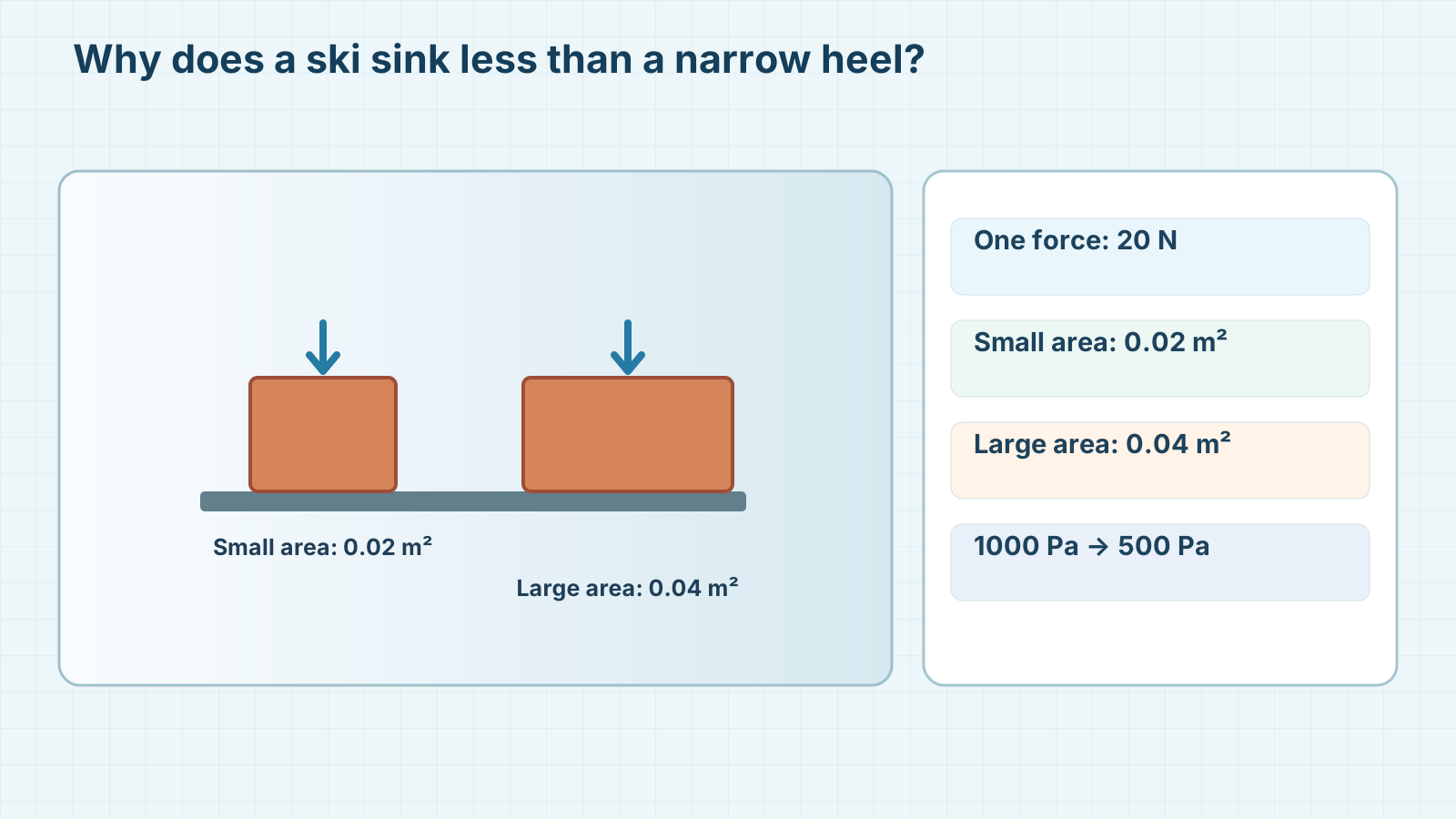
Worked model: 20 N acts over 0.02 m². Then p = 20/0.02 = 1000 Pa. Spread the same force over 0.04 m² and pressure becomes 500 Pa. Force remains 20 N, area doubles and pressure halves. These are supplied teaching values. We have not measured pressure on real snow with a sensor.
A safe investigation
Make two notebook columns, “same force” and “different area”. Compare a light book’s marks on a soft sponge or modelling clay. Do not call mark depth a precise measurement of pressure. If you lack materials, calculate the model at 0.01 m²: 2000 Pa. Extension: why might contact area change while you run the trial?
A likely mistake
Trap: “the wide ski reduces gravity”. It does not. The force is nearly the same; the pressure on snow is smaller. F/A models a perpendicular force spread uniformly over the area. An imprint alone does not tell us its exact distribution.
Support map
A new case without hints
Cover the worked example. Redraw the situation, name the object and the forces acting on it. Then change just one given number, recalculate with units and say what stayed the same. If you had no measuring instrument, write “calculated from a worked model”, not “measured”.
Lab notebook entry
Write four lines: question; prediction; given data or observation; conclusion with a condition. Add one reason a real trial may differ from the ideal drawing. Return to this page after the next lesson and revise the conclusion if a new check changes it.
Next lesson: Why can square centimetres change an answer ten thousandfold?
If you have found a mistake or a typo in this article, tell us about it
Comments (0)
Log in to leave a comment →
No comments yet. Be the first.