


Physics around us: from a first experiment to your own lab Lesson 46 of 46
Checkpoint: how can a room stay warmer without extra energy?
Use the particle model, three transfer processes and an energy budget in one safe design project.
A real-life question and prediction
Imagine a teaching room in winter. Its owner wants to reduce energy loss without changing wiring or buying an expensive device. Propose one safe change: sealing a gap, using a thick curtain, or something similar. First phrase a testable question: “Will this reduce window losses over the same hour?” Predict the direction of change and state what would have to be measured to verify it.
Pause before the explanation: what exactly do you expect to see, and why? Write a prediction before calculating. After the lesson, separate what you observed, what you calculated from supplied numbers, and what you only inferred about invisible particles. That record lets you correct a model without replacing evidence with a neat answer.
Words to understand
A success criterion is fixed before testing, such as smaller calculated loss under the same external conditions. A constraint is a rule that must hold: safety, budget, free exit from the room. Iteration means revising a design after checking it. Keep three levels of evidence apart: a numerical example, a temperature observation and real energy savings. Use the same system boundary and time interval for comparisons.
A worked example
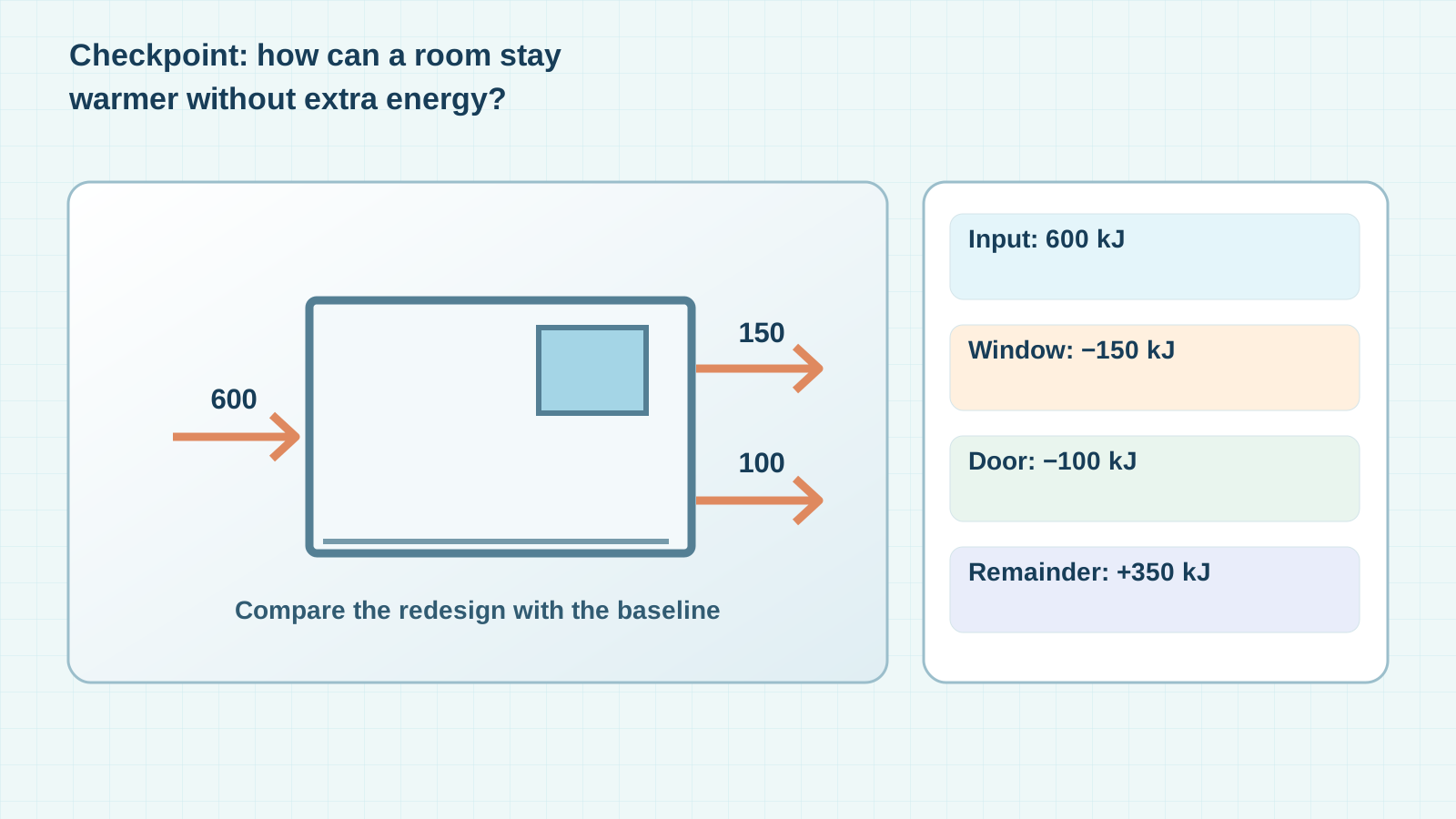
Baseline teaching figures for one interval: 600 kJ enter, 200 kJ leave through the window and 100 kJ through the door; remainder +300 kJ. In a hypothetical redesign, the window loss becomes 150 kJ while everything else is equal. The new remainder is 600 − 150 − 100 = +350 kJ, or 50 kJ more left in the system. This is a model comparison. Without actual energy readings, neither money saved nor degrees gained can be claimed.
Test it safely
Build a notebook page with room diagram, prediction, two cases in identical units, calculation, constraint and conclusion. A safe observation is to compare room temperature at the same time on several days, noting weather and heating state. Do not block ventilation or exits or touch wiring. If a fair comparison is impossible, present the work as a design using supplied numbers.
An easy mistake to make
Mistake: attributing the modelled 50 kJ to a real window without measurements, or calling +350 kJ a temperature. “Improving” insulation by blocking ventilation is unsafe and changes the task. A good conclusion includes the conditions behind its number.
Support map
Your turn
Cover the worked solution. Draw a boundary around the system: what is inside and what is outside? Label energy-flow arrows and the units of each quantity. Change just one supplied number and explain in words which way the result changes. If there was no experiment, write “calculated from teaching data”, not “measured”.
Lab notebook entry
Write four lines: question; initial prediction; observation or supplied values; revised conclusion with its conditions. Identify one concrete source of error, such as a coarse thermometer, energy escaping into the room, or a changed amount of water. Return to the conclusion after the next lesson and see whether it survives a new situation.
If you have found a mistake or a typo in this article, tell us about it
Comments (0)
Log in to leave a comment →
No comments yet. Be the first.