

Physics around us: from a first experiment to your own lab Lesson 44 of 46
Where does energy go while ice melts?
Temperature can remain nearly steady while energy arrives: the material changes state.
A real-life question and prediction
Ice in a cup slowly becomes water under ordinary conditions. You might expect every added bit of energy to raise a thermometer reading immediately, but that is not so in an idealized melting stage of pure ice at 0 °C. Energy changes interactions among particles. Predict whether the same calculation handles warming liquid water and melting ice of the same mass.
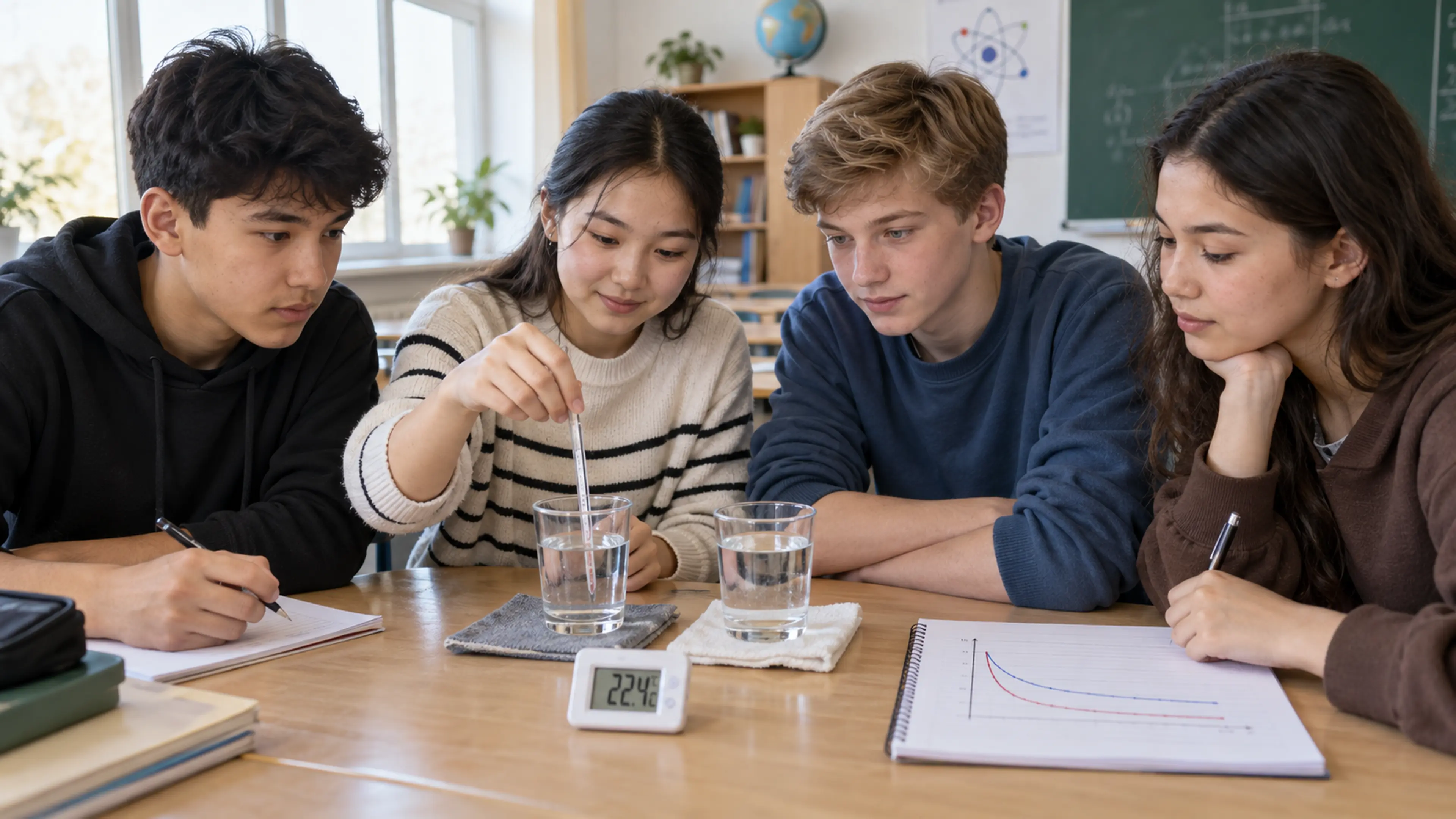
Pause before the explanation: what exactly do you expect to see, and why? Write a prediction before calculating. After the lesson, separate what you observed, what you calculated from supplied numbers, and what you only inferred about invisible particles. That record lets you correct a model without replacing evidence with a neat answer.
Words to understand
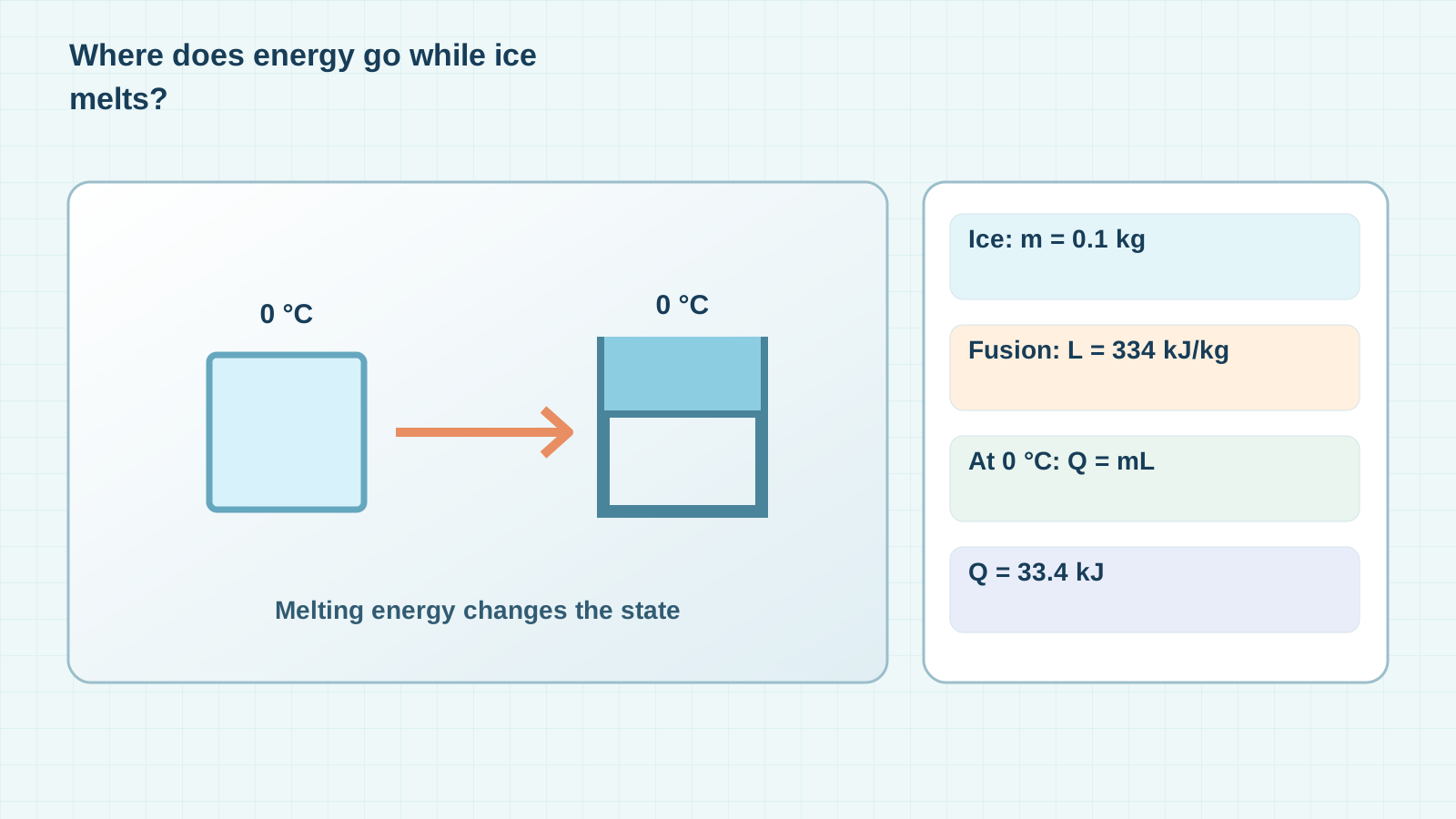
Melting changes a solid to a liquid; the reverse is freezing. Specific latent heat of fusion L is the energy needed to melt 1 kg at its melting temperature; the school-model value for ice is about 334 kJ/kg. 1 kJ = 1000 J. At unchanged pressure, a pure substance ideally remains at one temperature during the phase change until it ends. Evaporation changes liquid to gas and has different conditions and an associated latent heat.
A worked example
Teaching condition: 0.1 kg of ice already starts at 0 °C. To melt it completely there, Q = mL = 0.1 × 334 = 33.4 kJ. The resulting liquid is still near 0 °C just after melting. Warming it to 5 °C then takes a separate Q ≈ 0.1 × 4200 × 5 = 2100 J = 2.1 kJ. Add these stages only if you show both.
Test it safely
If you have an ice cube, observe it melting on a dish at room temperature. Record how the amount of ice changes over time; do not report a measured temperature without a thermometer. Do not press frozen items to your tongue or use dry ice. Without an experiment, draw: ice at 0 °C → mixture → liquid at 0 °C → warmer liquid.
An easy mistake to make
Mistake: applying Q = mcΔT only to the melting stage, setting ΔT = 0, and concluding “no energy needed”. State change requires energy. Also keep kJ and J distinct: 33.4 kJ is 33,400 J.
Support map
Your turn
Cover the worked solution. Draw a boundary around the system: what is inside and what is outside? Label energy-flow arrows and the units of each quantity. Change just one supplied number and explain in words which way the result changes. If there was no experiment, write “calculated from teaching data”, not “measured”.
Lab notebook entry
Write four lines: question; initial prediction; observation or supplied values; revised conclusion with its conditions. Identify one concrete source of error, such as a coarse thermometer, energy escaping into the room, or a changed amount of water. Return to the conclusion after the next lesson and see whether it survives a new situation.
If you have found a mistake or a typo in this article, tell us about it
Comments (0)
Log in to leave a comment →
No comments yet. Be the first.