


Physics around us: from a first experiment to your own lab Lesson 39 of 46
Why do your palms warm when you rub them?
Internal energy can change by heating and by work. Learn to count energy entering and leaving a system.
A real-life question and prediction
Rub your palms for a few seconds. They become warm without a nearby heater or sunlight. Moving them takes effort; friction converts some motion energy into internal energy of skin and air. Predict whether the palms remain warm forever in a cool room after you stop. To explain, set a boundary: what counts as “the palms”, and what is the surrounding environment?
Pause before the explanation: what exactly do you expect to see, and why? Write a prediction before calculating. After the lesson, separate what you observed, what you calculated from supplied numbers, and what you only inferred about invisible particles. That record lets you correct a model without replacing evidence with a neat answer.
Words to understand
Internal energy is energy associated with the motion and interaction of an object’s particles. Heat Q means energy transferred because of a temperature difference; it is not a substance stored inside. Work W is energy transferred when a force acts through a displacement. The joule (J) is an energy unit. If W means work done on the object, then ΔU = Q + W; negative Q means energy leaves by heating. Explain the sign instead of guessing it.
A worked example
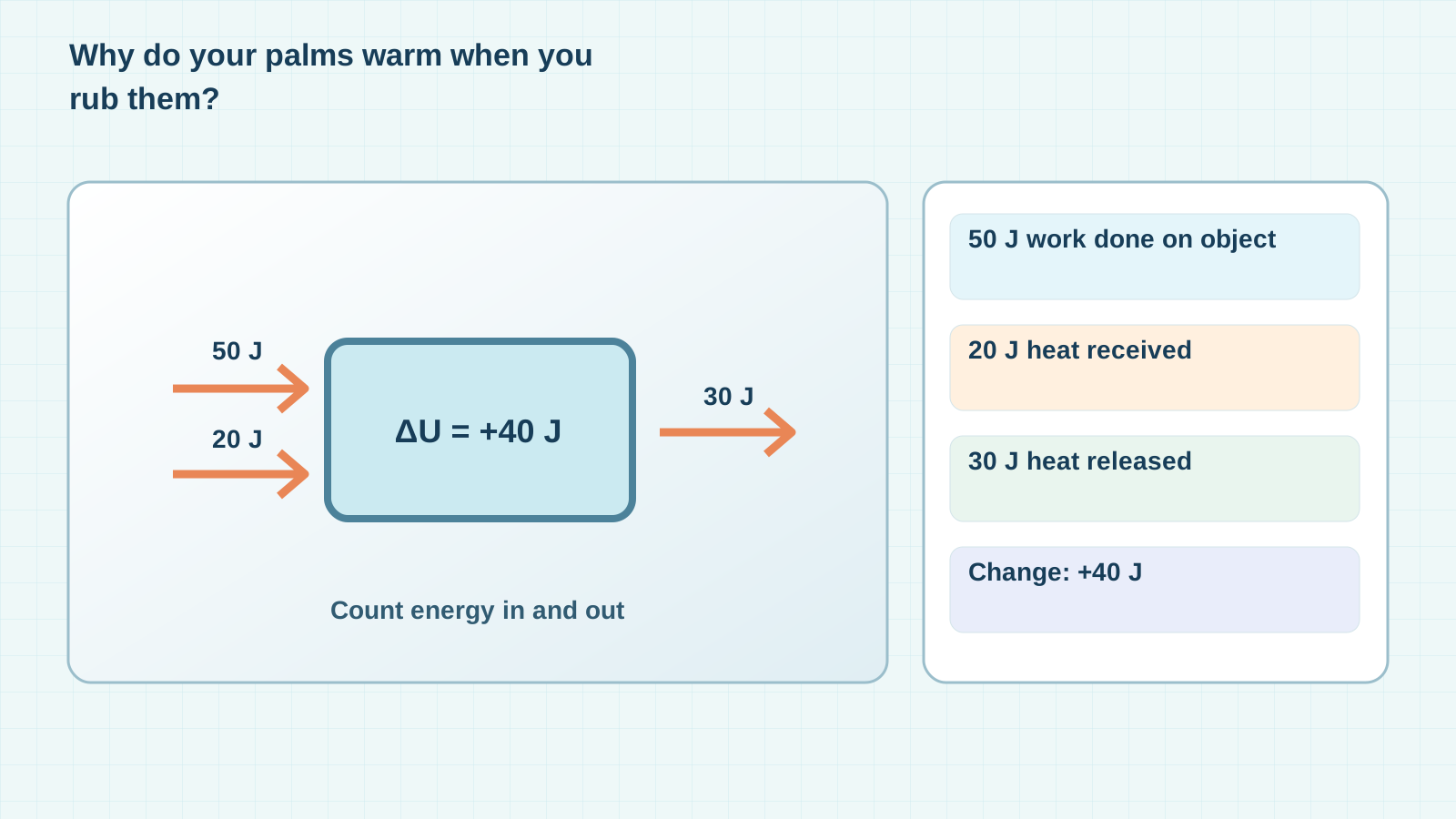
Teaching data: 50 J of work is done on an object; it receives 20 J as heat and releases 30 J as heat. Hence ΔU = 50 + 20 − 30 = +40 J. This is an internal-energy change, not necessarily a thermometer reading: material state and amount also matter. If W instead meant work done by the object, its sign would reverse.
Test it safely
Rub your palms and then let them cool. Record a sensation and the time, but assign no numerical temperature without an instrument. Draw a boundary around your palms and arrows showing work entering and energy leaving for cooler air. Do not use heaters or rub your skin until it hurts.
An easy mistake to make
Mistake: writing “the palms contain 20 J of heat”. Heat names a transfer process, while internal energy describes a state. Always state which sign represents energy entering and leaving in a numerical balance.
Support map
Your turn
Cover the worked solution. Draw a boundary around the system: what is inside and what is outside? Label energy-flow arrows and the units of each quantity. Change just one supplied number and explain in words which way the result changes. If there was no experiment, write “calculated from teaching data”, not “measured”.
Lab notebook entry
Write four lines: question; initial prediction; observation or supplied values; revised conclusion with its conditions. Identify one concrete source of error, such as a coarse thermometer, energy escaping into the room, or a changed amount of water. Return to the conclusion after the next lesson and see whether it survives a new situation.
Next lesson: Why does a metal spoon feel colder than a wooden one?
If you have found a mistake or a typo in this article, tell us about it
Comments (0)
Log in to leave a comment →
No comments yet. Be the first.