

Physics around us: from a first experiment to your own lab Lesson 37 of 46
What happens to water when it warms up?
Move from a drop of water to a model of invisible particles. The model helps explain heating, but its drawing is not a photograph.
A real-life question and prediction
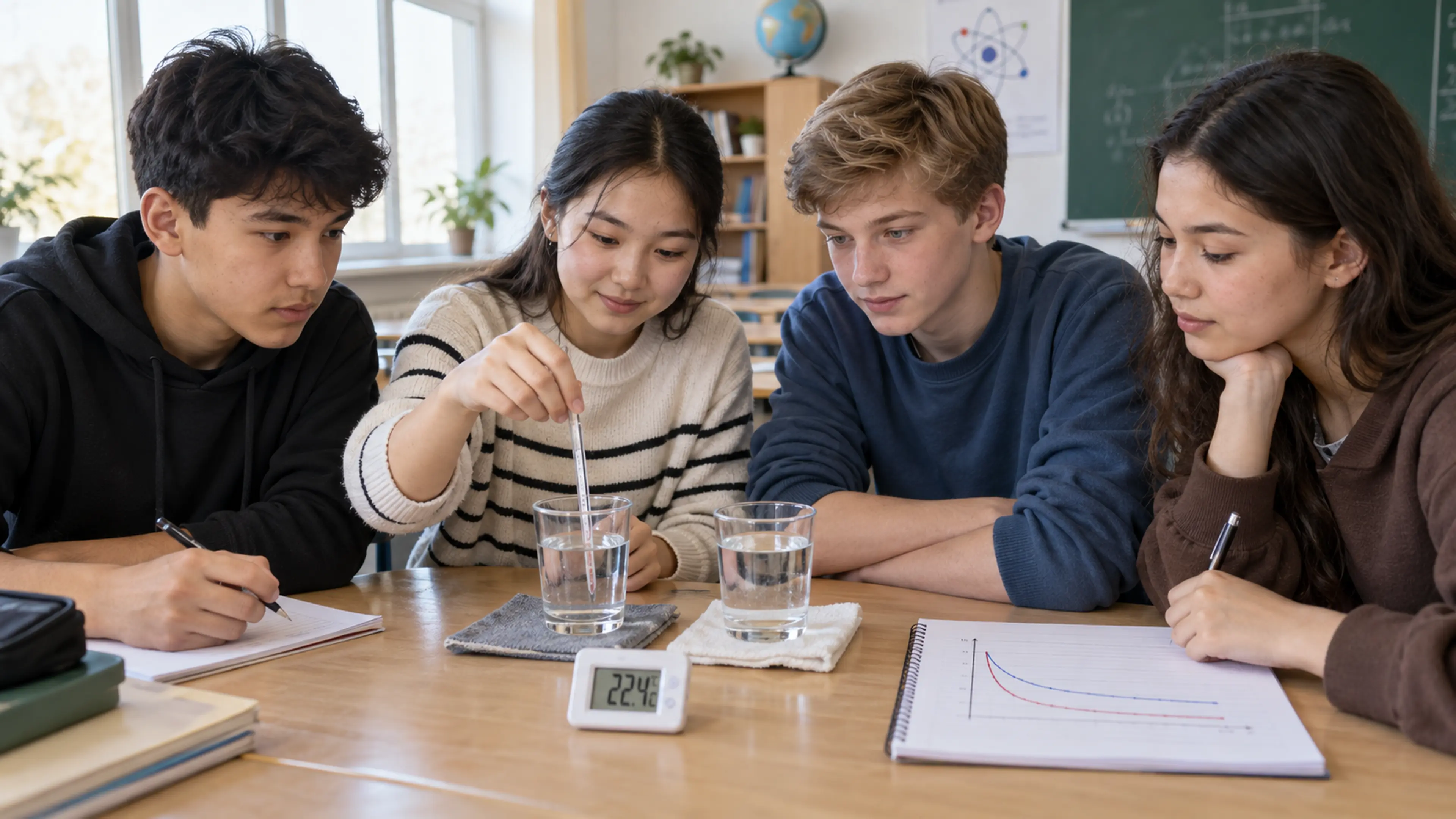
Put two identical closed cups on a desk: one contains water warmer than room air, the other cooler. The first cools and the second warms towards room temperature. Which part can you see, and which part requires a model? Imagine water as a very large number of tiny particles. Do not draw each as a miniature cup. Predict whether the mass of a closed cup changes just because its temperature changes.
Pause before the explanation: what exactly do you expect to see, and why? Write a prediction before calculating. After the lesson, separate what you observed, what you calculated from supplied numbers, and what you only inferred about invisible particles. That record lets you correct a model without replacing evidence with a neat answer.
Words to understand
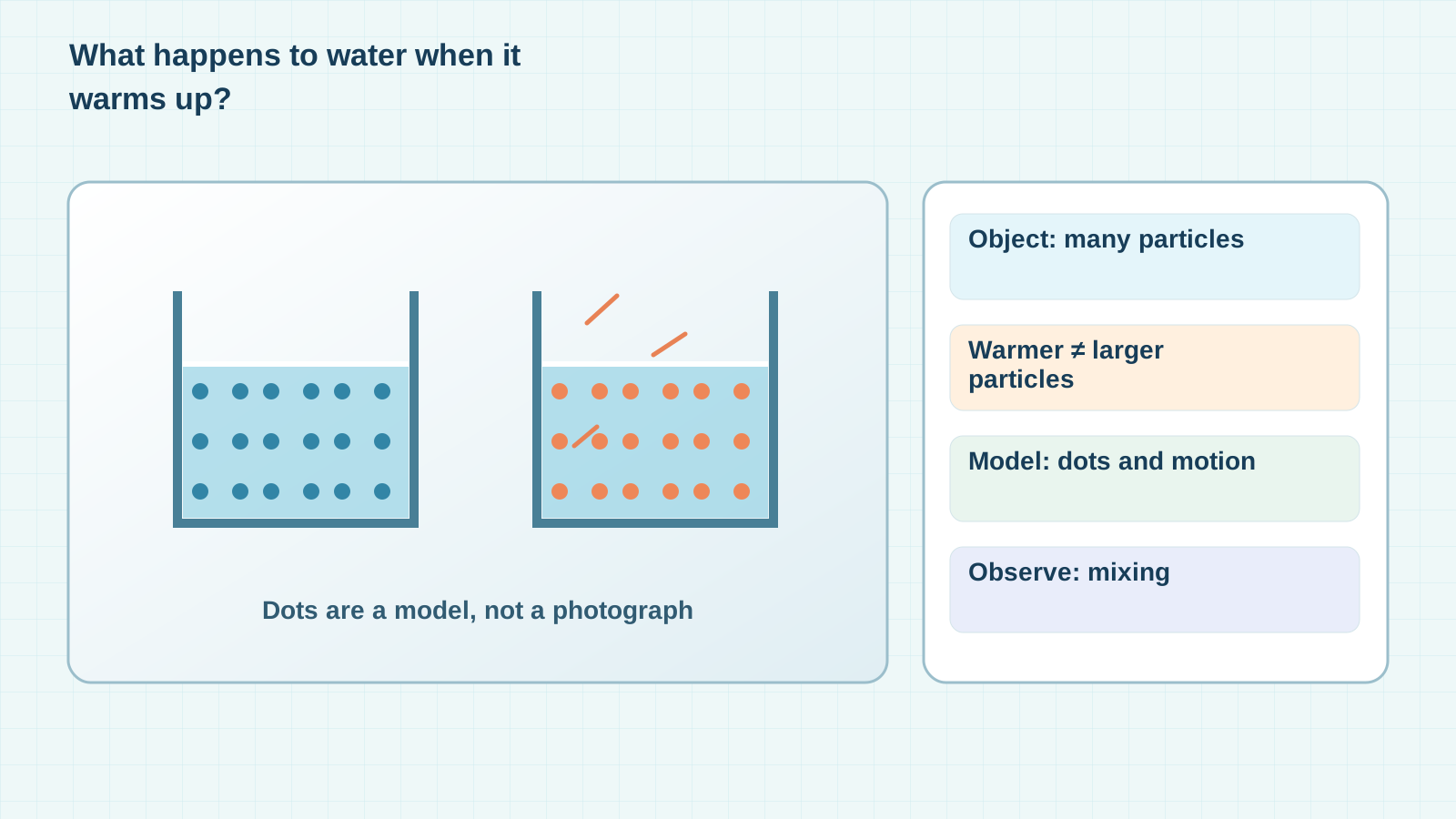
A particle is a tiny constituent of matter; moving, interacting dots are enough for this school model. A model is a simplified picture tested against observations. Thermal motion is the irregular motion of particles. Heating neither creates new particles nor makes each one bigger. Later we will connect temperature to their average energy of motion; at this point it is an explanatory idea, not a particle path you measured.
A worked example
In a teaching model, two closed cups each contain 200 g of water. After gentle warming, a cup still contains 200 g if nothing spills and vapour cannot escape. Different temperatures do not imply different numbers of particles in equally filled cups. Remove a lid and allow water to evaporate out: the mass of water left can decrease because the condition changed.
Test it safely
Put one drop of food dye into each of two clear cups of room-temperature and slightly warm water. Boiling water is unnecessary. Record equal volumes and where and when the colour spreads. Stirring with a spoon introduces another process. If you have no materials, sketch two possible outcomes and state what observation would support each.
An easy mistake to make
Mistake: seeing dye spread and claiming you saw individual molecules. A coloured patch is visible; single water particles are not. Water currents also affect mixing, so one observation cannot measure particle speed.
Support map
Your turn
Cover the worked solution. Draw a boundary around the system: what is inside and what is outside? Label energy-flow arrows and the units of each quantity. Change just one supplied number and explain in words which way the result changes. If there was no experiment, write “calculated from teaching data”, not “measured”.
Lab notebook entry
Write four lines: question; initial prediction; observation or supplied values; revised conclusion with its conditions. Identify one concrete source of error, such as a coarse thermometer, energy escaping into the room, or a changed amount of water. Return to the conclusion after the next lesson and see whether it survives a new situation.
If you have found a mistake or a typo in this article, tell us about it
Comments (0)
Log in to leave a comment →
No comments yet. Be the first.