

Physics around us: from a first experiment to your own lab Lesson 38 of 46
Can you measure warmth with your hand?
A hand senses change, but temperature needs an instrument and a scale. Learn to read three results honestly.
A real-life question and prediction
After a cold walk, a room-temperature table feels warm; after a warm bath the same table feels cool. The table may not have changed. Skin responds to the direction of energy transfer and its own state; it is not a precise thermometer. Predict what a thermometer will show if you measure the same room air twice in succession.
Pause before the explanation: what exactly do you expect to see, and why? Write a prediction before calculating. After the lesson, separate what you observed, what you calculated from supplied numbers, and what you only inferred about invisible particles. That record lets you correct a model without replacing evidence with a neat answer.
Words to understand
Temperature helps predict the direction of spontaneous energy transfer on thermal contact: from higher to lower temperature. The Celsius scale uses °C. Scale interval is the difference between adjacent marks. Thermal equilibrium is reached when contact no longer produces average energy transfer due to a temperature difference. A thermometer needs time to approach the temperature of its surroundings.
A worked example
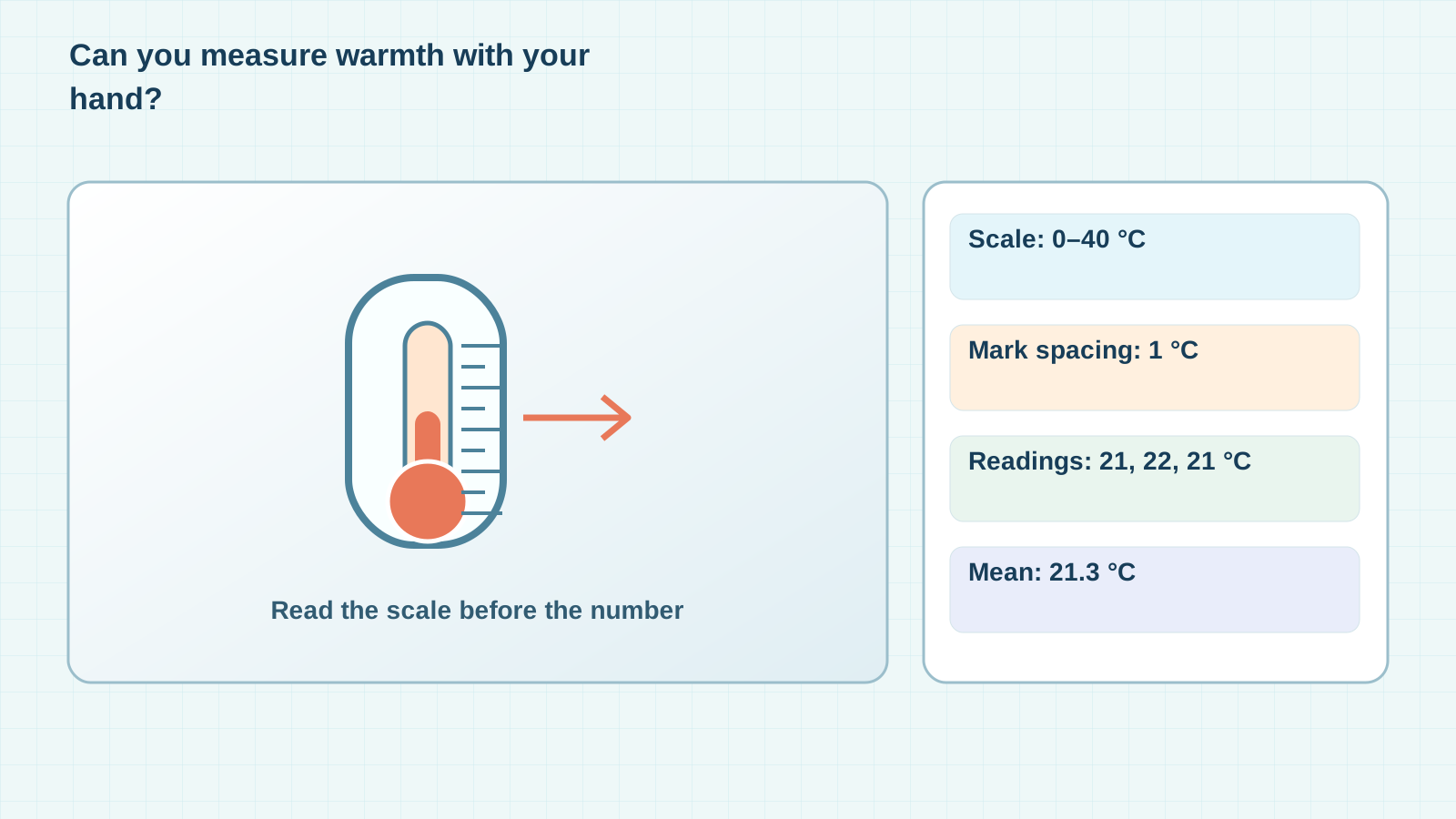
A teaching scale runs from 0 to 40 °C in 1 °C steps. Three supplied room readings are 21, 22, and 21 °C. Their mean is (21 + 22 + 21)/3 = 21.3 °C. A decimal is useful when comparing means, but it does not mean the instrument could resolve a tenth of a degree. For an individual reading, report the 1 °C interval and the measurement conditions.
Test it safely
Use an ordinary room thermometer, not a mercury medical thermometer. Leave it in the room for several minutes, read it at eye level three times, and record the time. Do not warm the sensor with your hand. Without a thermometer, compare drawn scales marked every 1 and 2 °C: which permits a finer reading, and why?
An easy mistake to make
Mistake: treating a sensation as a thermometer, or claiming that 21.3 °C is the precision of the real instrument. Averaging smooths changes but does not refine the scale interval. Nor can you compare different room positions without recording where the sensor was.
Support map
Your turn
Cover the worked solution. Draw a boundary around the system: what is inside and what is outside? Label energy-flow arrows and the units of each quantity. Change just one supplied number and explain in words which way the result changes. If there was no experiment, write “calculated from teaching data”, not “measured”.
Lab notebook entry
Write four lines: question; initial prediction; observation or supplied values; revised conclusion with its conditions. Identify one concrete source of error, such as a coarse thermometer, energy escaping into the room, or a changed amount of water. Return to the conclusion after the next lesson and see whether it survives a new situation.
If you have found a mistake or a typo in this article, tell us about it
Comments (0)
Log in to leave a comment →
No comments yet. Be the first.