


Physics around us: from a first experiment to your own lab Lesson 45 of 46
Why can a room cool with the window shut?
Build a simple energy budget for a room, then ask what it cannot tell us about temperature.
A real-life question and prediction
The window is shut and heating turned off, yet the room becomes cooler. Closed does not mean perfectly insulated: energy can pass through glass, walls and door gaps. Draw a boundary around the room and choose a time interval. What enters and what leaves? Do not confuse that with guessing an air temperature without knowing the air mass and heat capacity.
Pause before the explanation: what exactly do you expect to see, and why? Write a prediction before calculating. After the lesson, separate what you observed, what you calculated from supplied numbers, and what you only inferred about invisible particles. That record lets you correct a model without replacing evidence with a neat answer.
Words to understand
Our system is the selected room, including air and objects; a boundary separates it from outside and neighbouring rooms. An energy budget compares all inputs and outputs over the same interval. Insulation slows energy transfer; it does not create energy or necessarily remove all losses. Conduction and radiation can cross a window, and moving air can pass through gaps. Label each path honestly.
A worked example
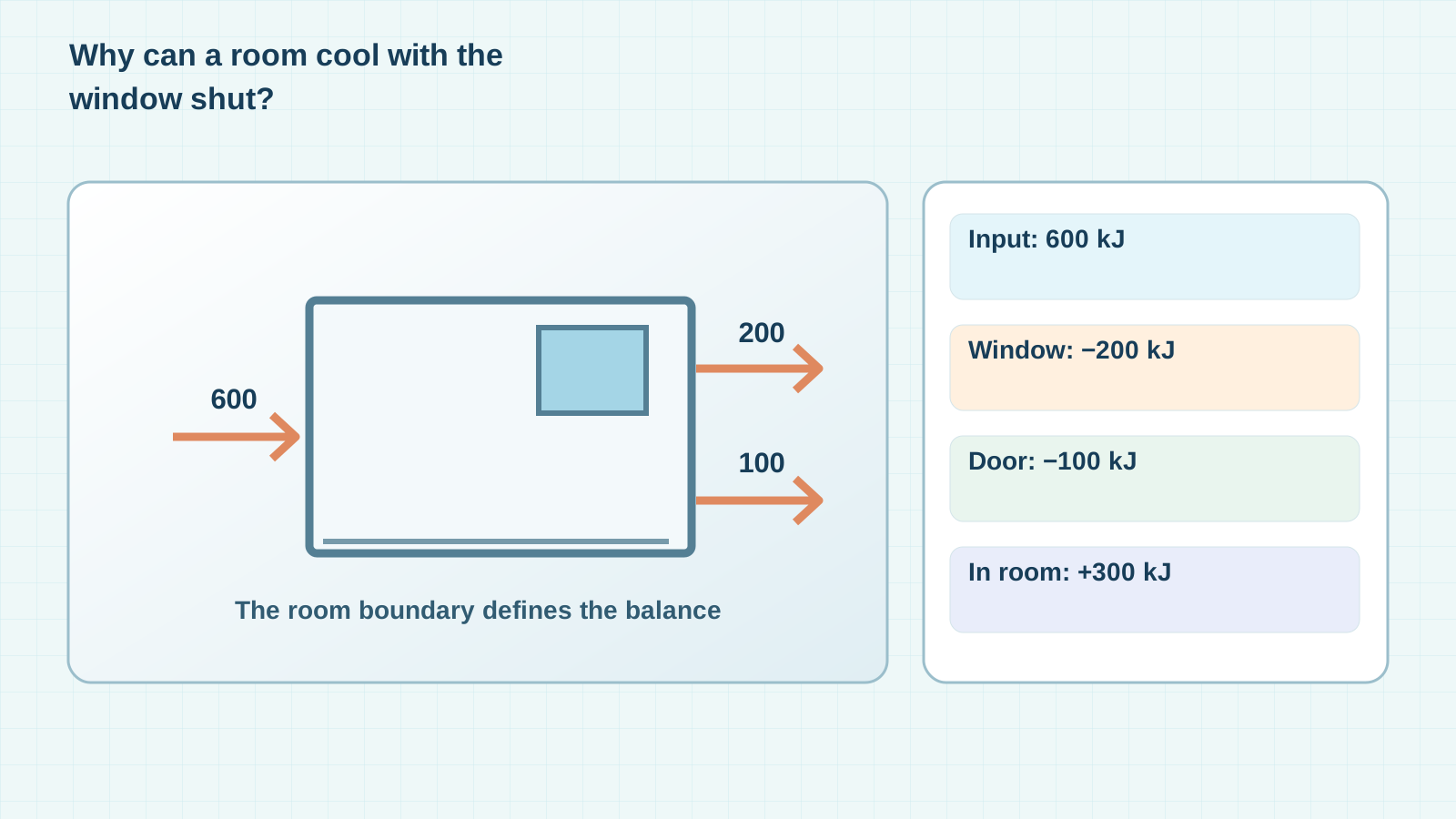
Supplied teaching data for one interval: heating adds 600 kJ, 200 kJ leave through the window and 100 kJ through the door. Thus ΔU = 600 − 200 − 100 = +300 kJ, assuming other flows are negligible. This is internal-energy change of the chosen system, not a temperature rise of 300 degrees. Nor does it prove that only air gained energy: furniture and walls are included.
Test it safely
Audit the room on paper. Outline it, label the input and two outputs, then add a possible third route through the ceiling. Recalculate if another 50 kJ leaves by that route. No experiments with wiring, outlets or heating appliances are needed. If observing a real room, record only safe room-temperature readings and the time.
An easy mistake to make
Mistake: treating a closed window as perfect insulation or calling the calculated 300 kJ a measurement. Keep joules and kilojoules apart: 600 kJ is 600,000 J. The balance applies only to the chosen boundary and interval.
Support map
Your turn
Cover the worked solution. Draw a boundary around the system: what is inside and what is outside? Label energy-flow arrows and the units of each quantity. Change just one supplied number and explain in words which way the result changes. If there was no experiment, write “calculated from teaching data”, not “measured”.
Lab notebook entry
Write four lines: question; initial prediction; observation or supplied values; revised conclusion with its conditions. Identify one concrete source of error, such as a coarse thermometer, energy escaping into the room, or a changed amount of water. Return to the conclusion after the next lesson and see whether it survives a new situation.
Next lesson: Checkpoint: how can a room stay warmer without extra energy?
If you have found a mistake or a typo in this article, tell us about it
Comments (0)
Log in to leave a comment →
No comments yet. Be the first.