


Physics around us: from a first experiment to your own lab Lesson 41 of 46
Why is a room heater placed near the floor?
Moving air carries energy along with matter. Distinguish convection from conduction.
A real-life question and prediction
In a heated room, warm air near the heater may rise while cooler air sinks towards it. This forms a circulation, not a rule that “heat always goes up”. Draw a room section with a window and heater. Where would you expect cooler air? Refine the question: what changes when the window is open and wind sets the air motion?
Pause before the explanation: what exactly do you expect to see, and why? Write a prediction before calculating. After the lesson, separate what you observed, what you calculated from supplied numbers, and what you only inferred about invisible particles. That record lets you correct a model without replacing evidence with a neat answer.
Words to understand
Convection is energy transfer by a moving gas or liquid. A flow is directed motion of matter; this separates convection from conduction. Air generally expands on warming and is less dense under comparable conditions. Gravity and pressure then contribute to motion, while room shape, ventilation and wind can change the pattern. A drawing cannot replace measuring a real room.
A worked example
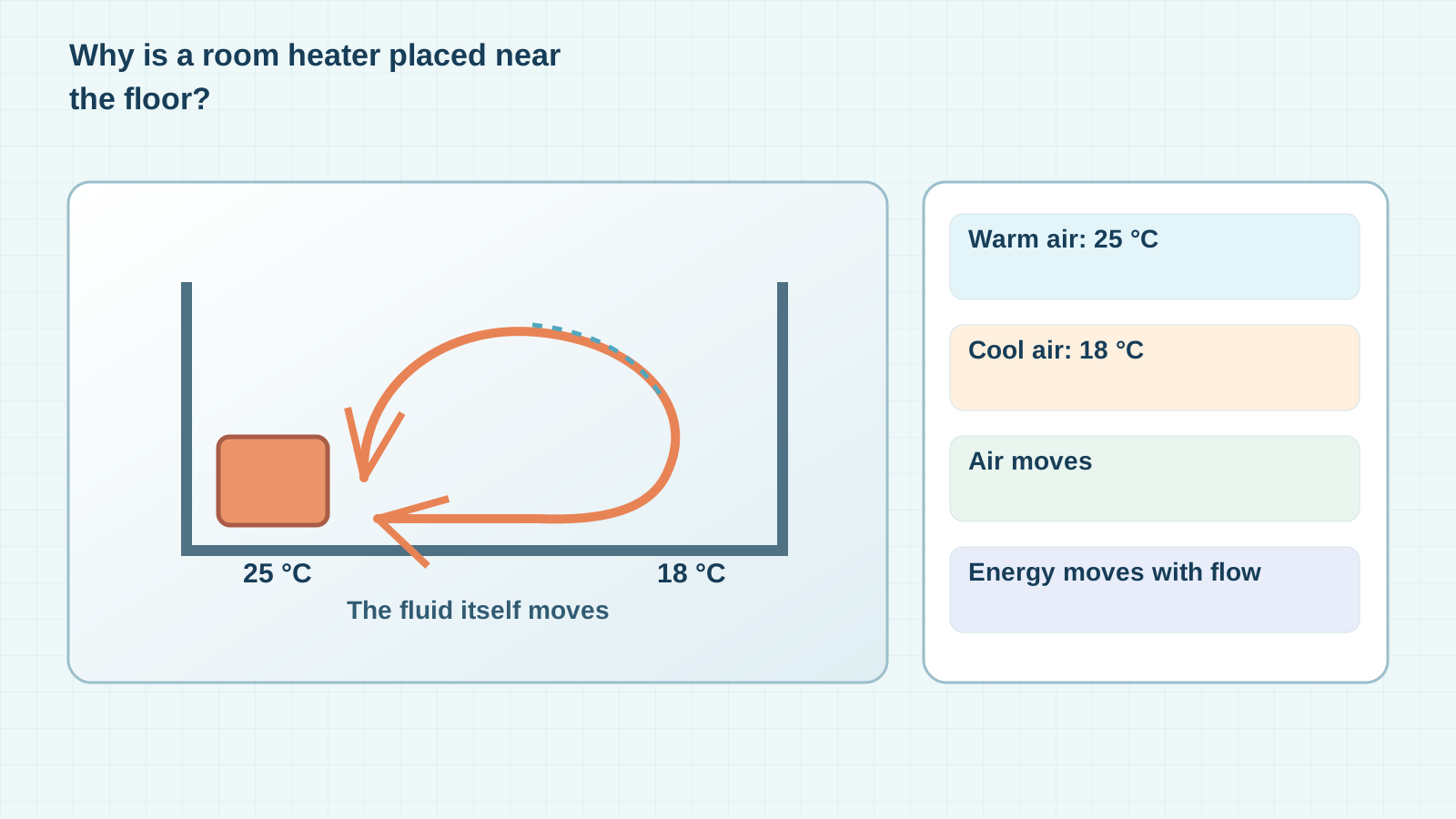
In the teaching picture, air near the heater is 25 °C and distant air 18 °C. The warm region may rise and carry energy upward; cooler air returns below. The 7 °C difference does not determine flow speed or joules: room dimensions, time and amount of air are missing. When the heater is switched off, this direction can eventually disappear.
Test it safely
Hang two light paper strips safely at different room locations, away from hot surfaces and fans. Record whether they move alike. A strong draught prevents a clean test of natural convection. Without an experiment, trace the loop on your room drawing and identify where the material itself moves.
An easy mistake to make
Mistake: insisting warm air “wants to rise” under every condition. Wind or a fan can drive it elsewhere. Another mistake is drawing an energy arrow but omitting the motion arrow for the air itself.
Support map
Your turn
Cover the worked solution. Draw a boundary around the system: what is inside and what is outside? Label energy-flow arrows and the units of each quantity. Change just one supplied number and explain in words which way the result changes. If there was no experiment, write “calculated from teaching data”, not “measured”.
Lab notebook entry
Write four lines: question; initial prediction; observation or supplied values; revised conclusion with its conditions. Identify one concrete source of error, such as a coarse thermometer, energy escaping into the room, or a changed amount of water. Return to the conclusion after the next lesson and see whether it survives a new situation.
If you have found a mistake or a typo in this article, tell us about it
Comments (0)
Log in to leave a comment →
No comments yet. Be the first.