


Physics around us: from a first experiment to your own lab Lesson 55 of 56
How much energy does a tiny lamp use?
Separate power, energy and cost so watts do not get confused with watt-hours.
Situation and prediction
Two devices run for different lengths of time. The more powerful one need not use more energy in a day: duration matters. Before calculating, predict which teaching lamp receives more energy: 0.06 W for 60 s or 0.03 W for 180 s. We are extending the notebook: we now estimate electrical energy use as carefully as we estimated room heating.
New words, step by step
Power P is the rate of energy transfer, P = E/t. Its unit, the watt (W), is a joule per second. For a circuit component P = UI: each coulomb transfers U joules and I coulombs pass each second. Energy E = Pt = UIt is measured in joules. A watt-hour (Wh) is also energy: 1 Wh = 3600 J. A kilowatt-hour (kWh) = 1000 Wh is used on electricity bills; multiply kWh by a local tariff for cost, and tariffs depend on location and terms.
Working through supplied data
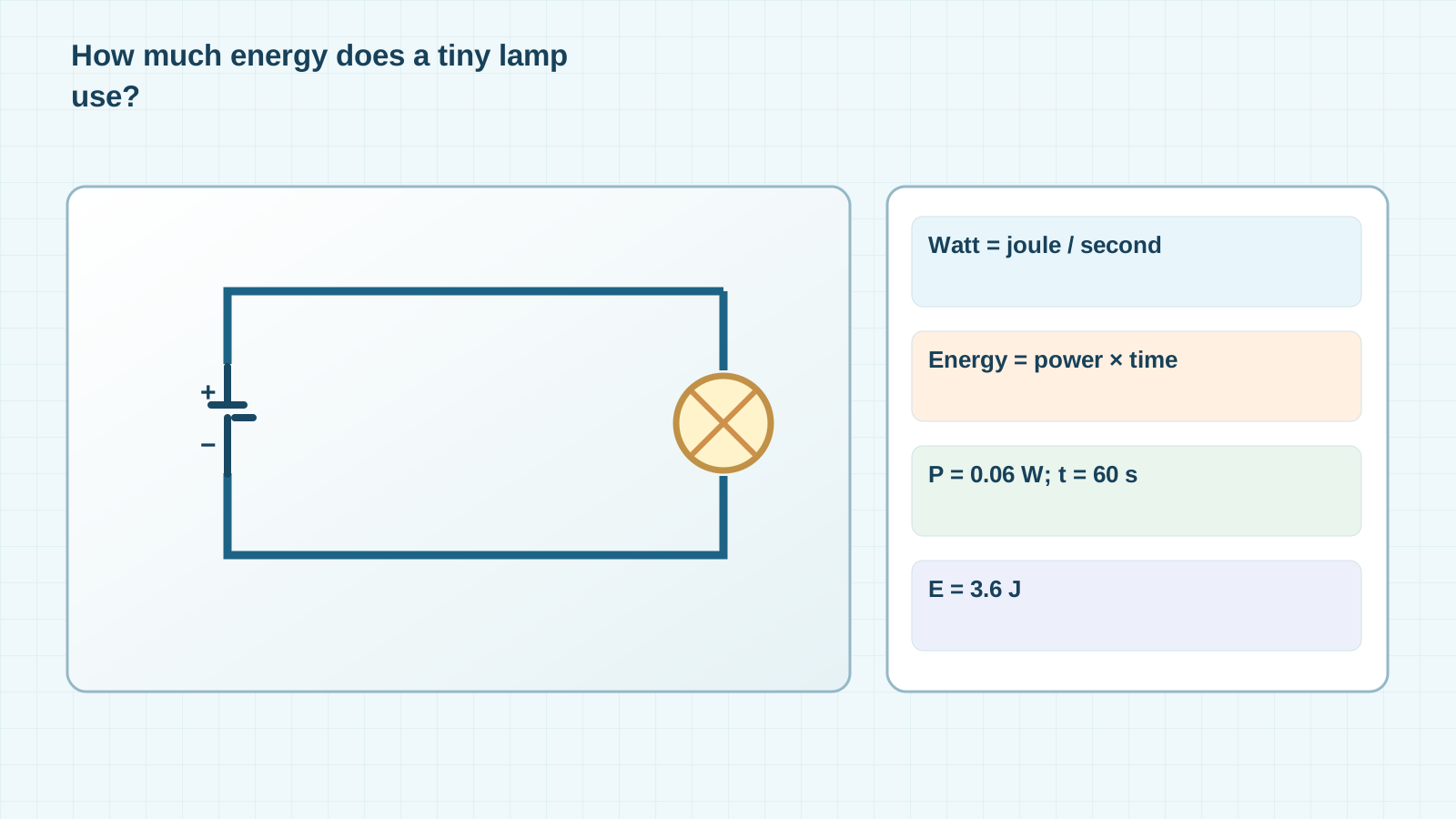
Supplied data give 3 V, 0.02 A and 60 s for a lamp. P = 3 × 0.02 = 0.06 W. E = 0.06 × 60 = 3.6 J = 0.001 Wh. A second device at 0.03 W for 180 s receives 5.4 J despite lower power. These numbers do not prove that every LED operates at 3 V and 0.02 A.
A safe check
Draw energy bars for the two supplied devices. If you have a household bill, find its kWh unit, but never alter wiring or open an electrical panel. The whole activity can be done on paper.
A reasoning trap
A mistake is to give the minute’s total as 0.06 W. Watts are a rate; the total is 3.6 J or 0.001 Wh. Energy received by a lamp is also not the quantity of charge stored by its battery.
Support map
Transfer to a new case
For 3 V, 0.01 A and 2 minutes, find power and energy. Convert minutes to seconds before multiplying.
Lab notebook entry
Add a page to My World Lab Notebook with four lines: question; prediction before reading the answer; observation or calculation from supplied numbers; revised conclusion and its conditions. If you did not do an experiment, do not write ‘measured’. After the diagram, explain where charge moves, where energy is transferred, and where the model simplifies a real device.
If you have found a mistake or a typo in this article, tell us about it
Comments (0)
Log in to leave a comment →
No comments yet. Be the first.