


Physics around us: from a first experiment to your own lab Lesson 47 of 56
Why does a balloon stick to a wall?
Observe static electricity, separate charge from current, and start the electrical page of your lab notebook.
Situation and prediction
Rub a balloon on dry cloth and bring it near tiny paper pieces. Some may rise. The balloon has neither become a magnet nor acquired a battery. First predict whether skipping the rubbing would change the result. Humidity and fabric matter, so one unsuccessful trial does not disprove the effect.
New words, step by step
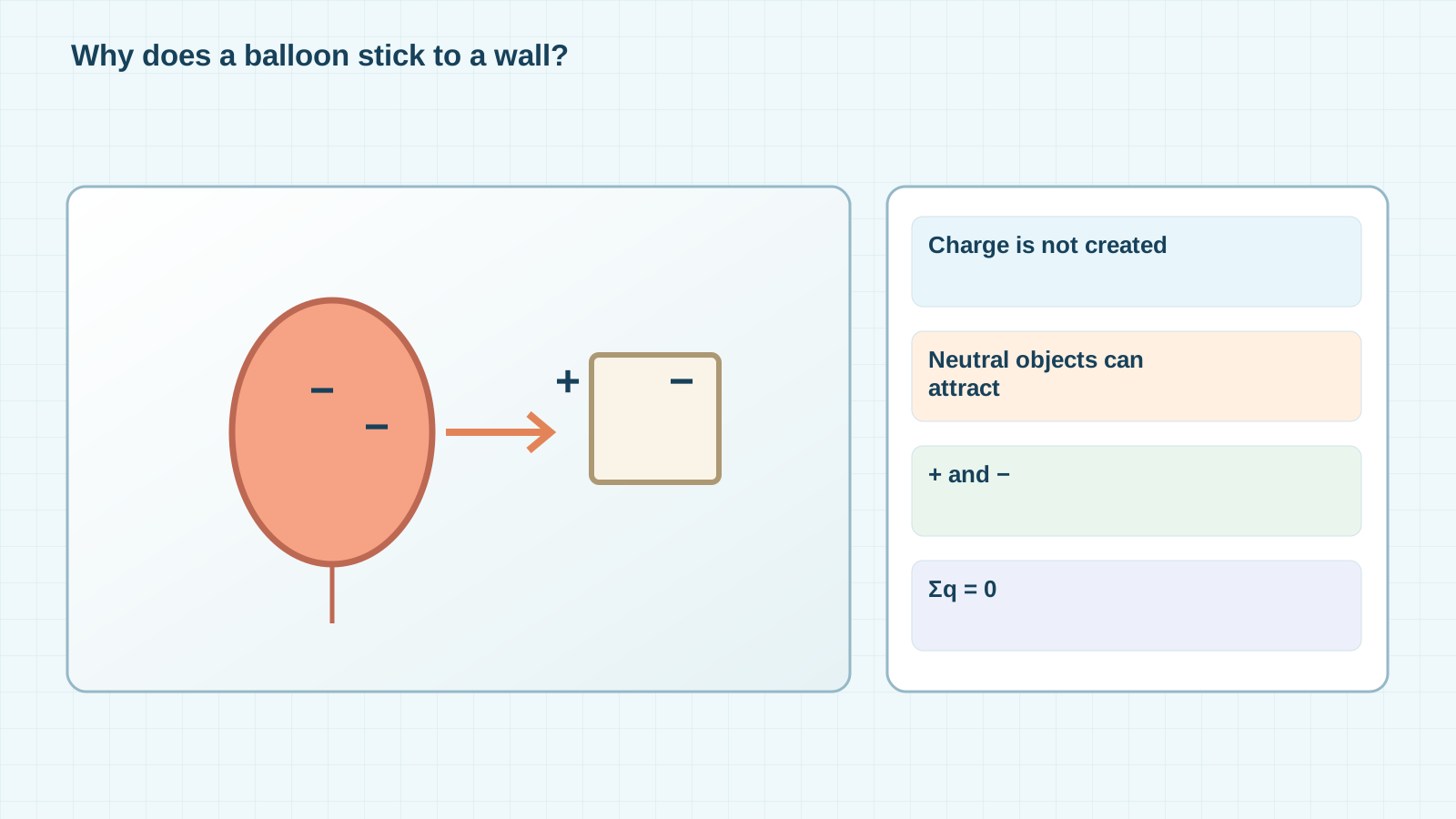
Electric charge is a property of particles that makes them interact electrically. We label two kinds + and −; these are names, not good and bad. Like charges repel; unlike charges attract. A neutral object has zero net charge, yet its charges can shift slightly. That is why a charged balloon can attract neutral paper. Static means accumulated charge is not yet flowing steadily around a circuit. Rubbing can move electrons between materials; it does not create charge from nothing.
Working through supplied data
In the diagram, neutral paper has equal total positive and negative charge. Near a negatively charged balloon, its positive side lies closer and its negative side farther away. The nearer attraction can outweigh the farther repulsion. This model explains a direction, but cannot calculate force without distance and material properties.
A safe check
Use only a balloon, dry cloth and paper pieces. Compare unrubbed and rubbed cases at the same distance. Keep away from flammable vapour and sensitive electronics. Without materials, draw a prediction instead of inventing an observation.
A reasoning trap
A common mistake is to assume every attracted object carries opposite net charge. Paper may be neutral: its charges shift. The next lesson distinguishes a one-off discharge from a steady current.
Support map
Transfer to a new case
Sketch a balloon and two paper pieces, one neutral and one negatively charged. Predict each interaction and say what information a numerical force calculation would need.
Lab notebook entry
Add a page to My World Lab Notebook with four lines: question; prediction before reading the answer; observation or calculation from supplied numbers; revised conclusion and its conditions. If you did not do an experiment, do not write ‘measured’. After the diagram, explain where charge moves, where energy is transferred, and where the model simplifies a real device.
If you have found a mistake or a typo in this article, tell us about it
Comments (0)
Log in to leave a comment →
No comments yet. Be the first.