


Physics around us: from a first experiment to your own lab Lesson 50 of 56
Why is a battery marked 3 V?
Introduce voltage as energy transferred per unit charge, and measure it between two points.
Situation and prediction
A lamp may carry current, but without a source it would not continually receive energy. In our notebook the battery is like an energy pump: that comparison reminds us that the source does work, not that water flows in the wire. Predict whether the same source gives different voltage if only the length of an ideal wire changes.
New words, step by step
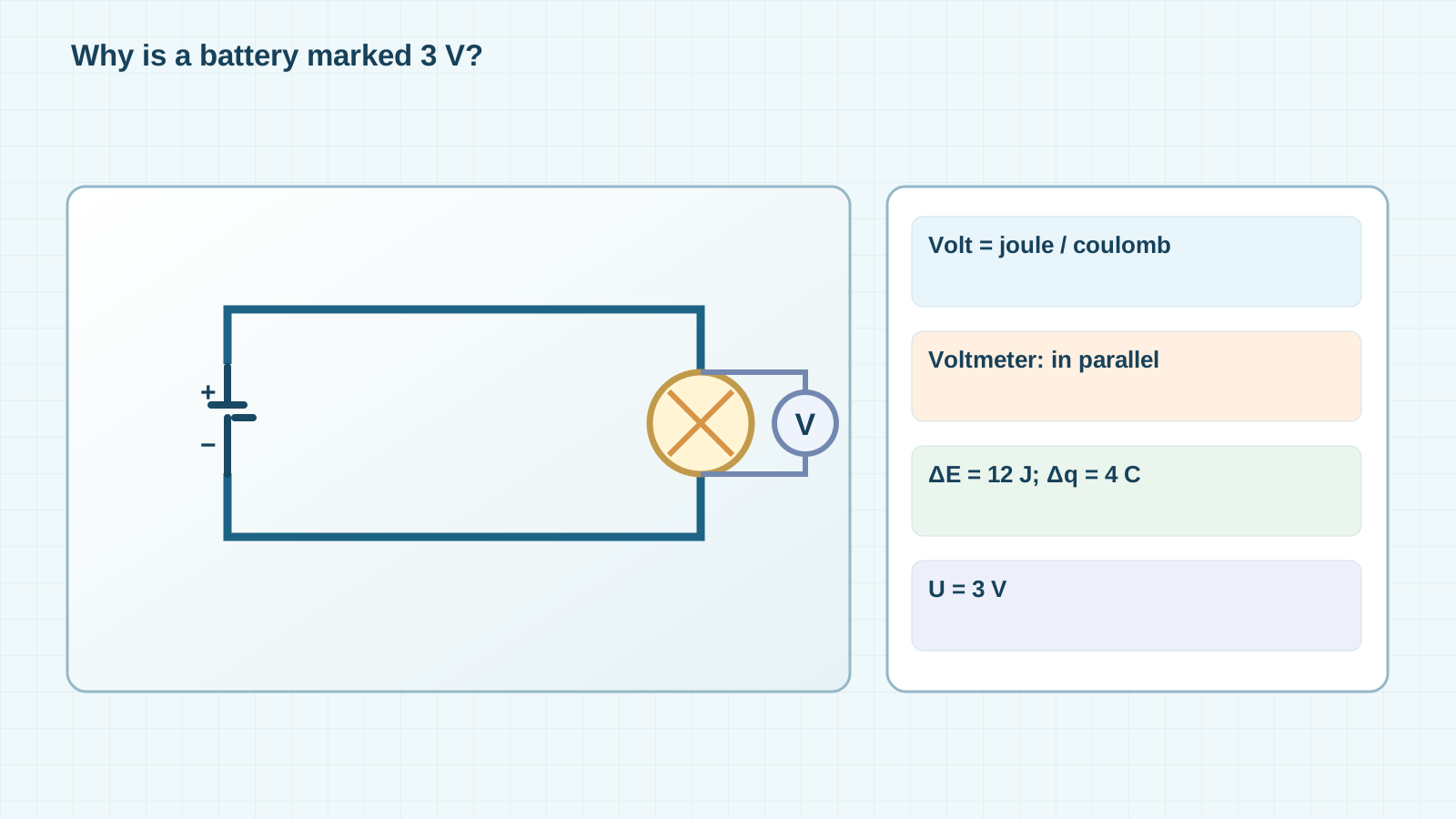
Voltage U between two points is energy ΔE transferred per coulomb of charge Δq: U = ΔE/Δq. A volt (V) is a joule per coulomb: 1 V = 1 J/C. It is a difference between points; a single point needs a chosen reference. A voltmeter is connected in parallel across a component, to its two ends, without breaking the main path. A cell labelled 3 V can show a different terminal voltage while supplying current because it has internal resistance.
Working through supplied data
In supplied teaching data a lamp receives 12 J when 4 C pass through it. U = 12/4 = 3 V across the lamp. This does not imply 3 A: amperes count charge per second, and no time was given. Voltage drop along an ideal wire is negligible in this school model; a long real wire may have measurable resistance.
A safe check
Label both lamp terminals A and B on your diagram and write U_AB. With a ready-made kit and voltmeter, an adult selects the range and attaches probes across the low-voltage lamp. Never test a wall outlet or open a cell.
A reasoning trap
A mistake is to treat volts as the number of electrons inside a cell. Voltage is energy per charge and belongs to a pair of points. Energy needs charge as well; power also needs time.
Support map
Transfer to a new case
A model device receives 9 J when 3 C pass. Find the voltage. At unchanged voltage, what happens to energy if the charge doubles?
Lab notebook entry
Add a page to My World Lab Notebook with four lines: question; prediction before reading the answer; observation or calculation from supplied numbers; revised conclusion and its conditions. If you did not do an experiment, do not write ‘measured’. After the diagram, explain where charge moves, where energy is transferred, and where the model simplifies a real device.
If you have found a mistake or a typo in this article, tell us about it
Comments (0)
Log in to leave a comment →
No comments yet. Be the first.