


Physics around us: from a first experiment to your own lab Lesson 49 of 56
What does an ammeter show?
Understand current as charge passing a chosen cross-section per unit time, not as stored electricity inside a cell.
Situation and prediction
Think of a queue entering a shop through one door. People entering per minute differ from people already in the building. In a wire, choose an imaginary door across its width. Predict what happens to current if twice as much charge crosses it in the same time. The queue analogy helps count flow, but electrons in metal do not run from battery to lamp like people.
New words, step by step
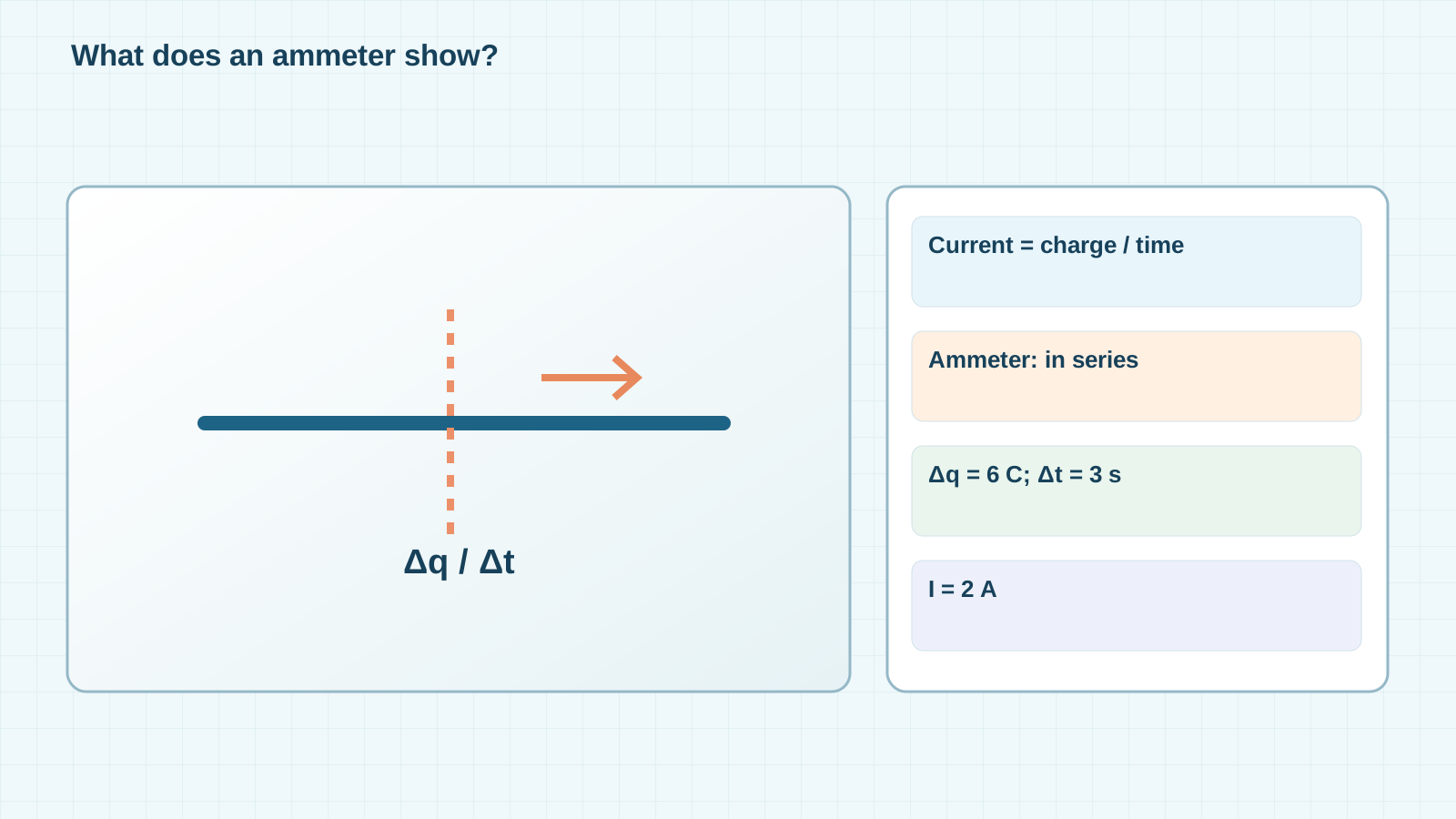
Electric current I is charge Δq passing the chosen cross-section in time Δt: I = Δq/Δt. A coulomb (C) measures charge; an ampere (A) is one coulomb per second. Conventional current direction follows positive charge; electrons in a metal wire drift the other way. An ammeter measures current when inserted in series in a break, so the same current passes through it. In current mode, never place it directly across a battery.
Working through supplied data
Given teaching data say 6 C cross in 3 s. I = 6/3 = 2 A. This is an arithmetic example, not a suggestion to push 2 A through a classroom lamp or meter. If 3 C cross in 3 s, current is 1 A. Before measuring a real circuit, learn the meter range and use adult supervision.
A safe check
Draw two marks on a timeline and make a charge–time–current table. If you have a safe ready-made low-voltage kit, an adult checks the series connection and meter range before power is connected. Without a kit, solve the supplied data on paper; never short the battery with a meter.
A reasoning trap
A mistake is to treat 2 A as the charge stored in the battery. Ampere describes transfer rate. In a single closed series branch charge does not disappear: equal charge passes each cross-section in equal time.
Support map
Transfer to a new case
If 1 C passes in 2 s, find current with its unit. Why can you not automatically assign that value to each branch of a parallel circuit?
Lab notebook entry
Add a page to My World Lab Notebook with four lines: question; prediction before reading the answer; observation or calculation from supplied numbers; revised conclusion and its conditions. If you did not do an experiment, do not write ‘measured’. After the diagram, explain where charge moves, where energy is transferred, and where the model simplifies a real device.
If you have found a mistake or a typo in this article, tell us about it
Comments (0)
Log in to leave a comment →
No comments yet. Be the first.