

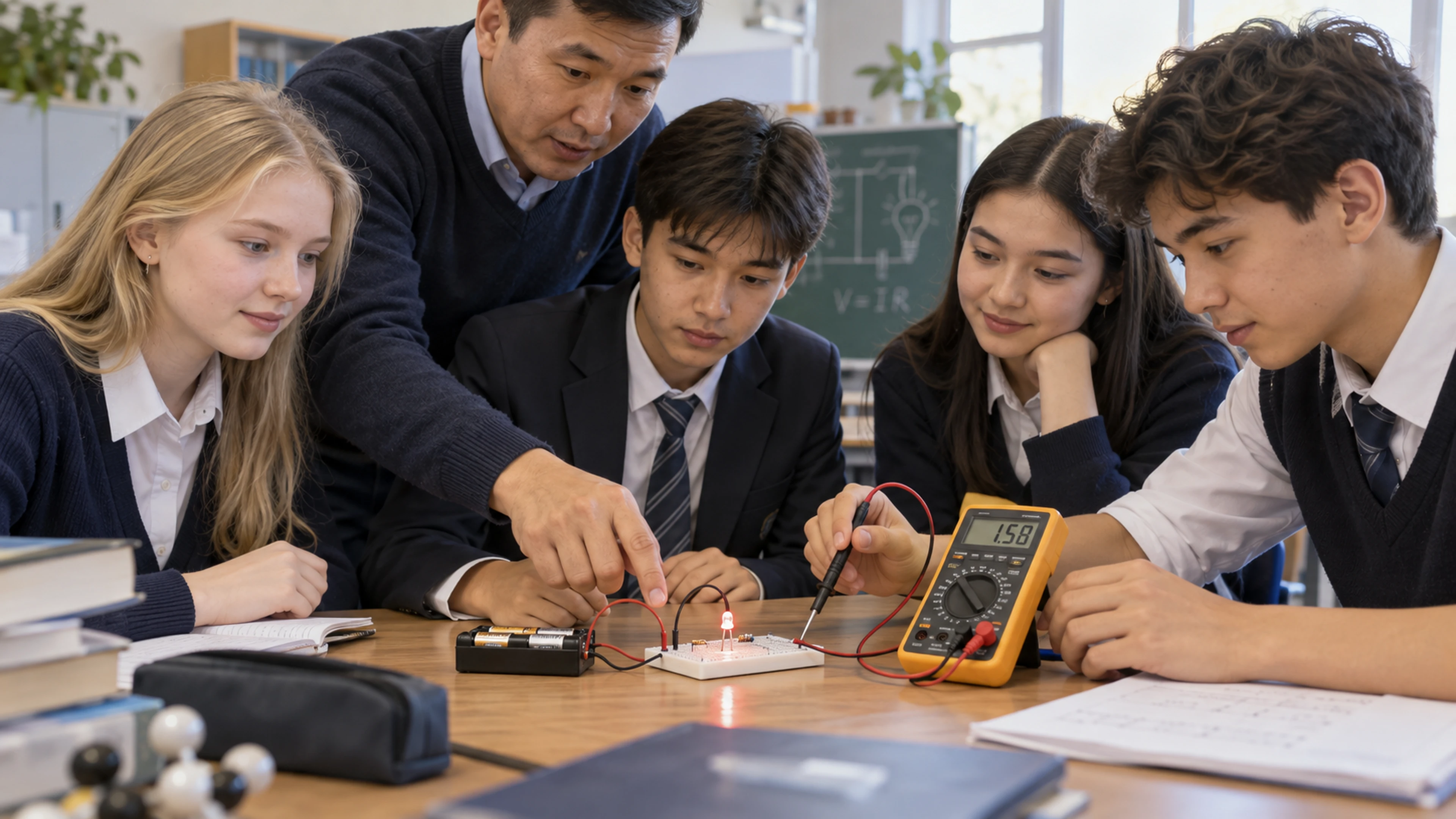
Physics around us: from a first experiment to your own lab Lesson 48 of 56
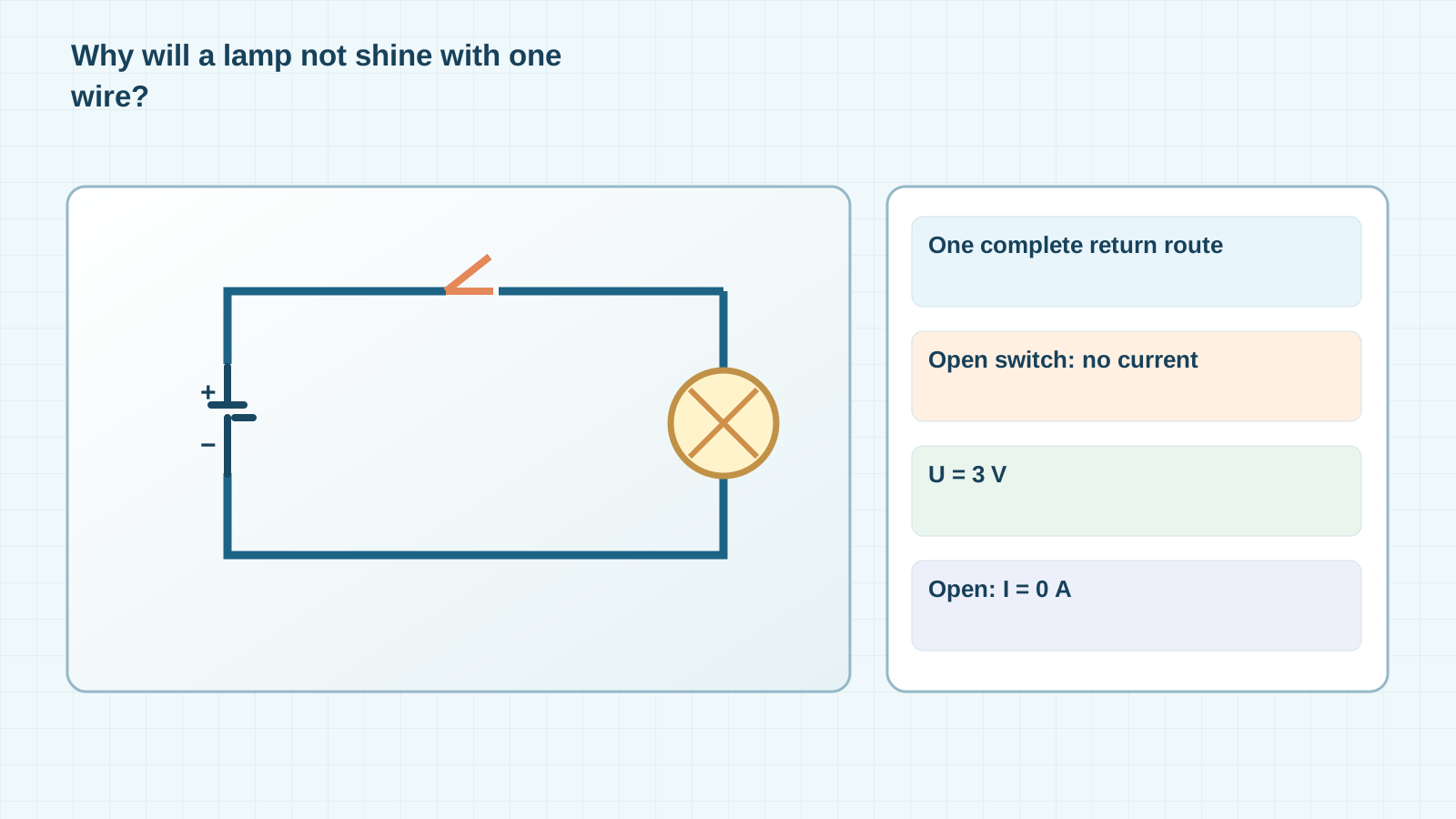
Why will a lamp not shine with one wire?
Build a first closed low-voltage circuit and read its diagram without touching a mains outlet.
Situation and prediction
Picture a doorbell: a source, wires, a button and a device that needs energy. One wire from battery to lamp gives no continuous return path to the battery. Predict what changes when the button closes the gap. Draw the real objects in your notebook, then a simple diagram of their connections.
New words, step by step
A source maintains an electrical potential difference and transfers energy to charges; here two AA cells in a holder supply roughly 3 V. A conductor provides a path for charge. A load receives electrical energy and turns it into light, heat or motion. A switch opens or closes the path. A closed circuit provides a continuous route from one source terminal, through the load, to the other. Closed does not mean short-circuited: a wire directly between source terminals bypasses the load and can dangerously heat the cells.
Working through supplied data
In the teaching diagram, a 3 V source, switch and small lamp rated for 3 V are connected in series. With the switch open, current through the lamp is zero; closing it completes the route. Voltage alone cannot tell us brightness: the lamp and source characteristics matter. An LED needs a current-limiting resistor and correct polarity; it is not a drop-in substitute.
A safe check
You may use a two-AA holder, a small 3 V lamp, wires and a switch. Connect with the source disconnected and have an adult check the layout. Never link the cell terminals directly, use a wall outlet, or open a cell. If you lack parts, draw both switch states.
A reasoning trap
The mistaken picture says charge is used up in the lamp and does not return. Charge is conserved around a closed circuit; the source gives it energy and the lamp receives energy. Keep charge transfer separate from energy transfer.
Support map
Transfer to a new case
Add a second open switch in series. What happens to the lamp even when the first switch is closed? Trace the whole route between source terminals.
Lab notebook entry
Add a page to My World Lab Notebook with four lines: question; prediction before reading the answer; observation or calculation from supplied numbers; revised conclusion and its conditions. If you did not do an experiment, do not write ‘measured’. After the diagram, explain where charge moves, where energy is transferred, and where the model simplifies a real device.
If you have found a mistake or a typo in this article, tell us about it
Comments (0)
Log in to leave a comment →
No comments yet. Be the first.