


Physics around us: from a first experiment to your own lab Lesson 67 of 74
A wave carries a disturbance, not the whole tray of water
Use water and a floating marker to separate the moving wave from the material it passes through.
Question and prediction
Let one drop fall into a shallow tray. Rings travel away from the point of impact; a tiny floating marker rises and falls but does not ride every ring to the rim. What reached the rim? Sketch a prediction first, then compare it with what you see.
New words without gaps
A disturbance is a temporary departure from a resting state. A medium is material whose neighbouring parts can affect one another; here it is water. A wave is a travelling disturbance. Neighbouring patches of water pass motion along, so energy travels while a given patch moves approximately around its position. The advancing edge is the wavefront. It is not a strip made of special water.
Work through supplied data
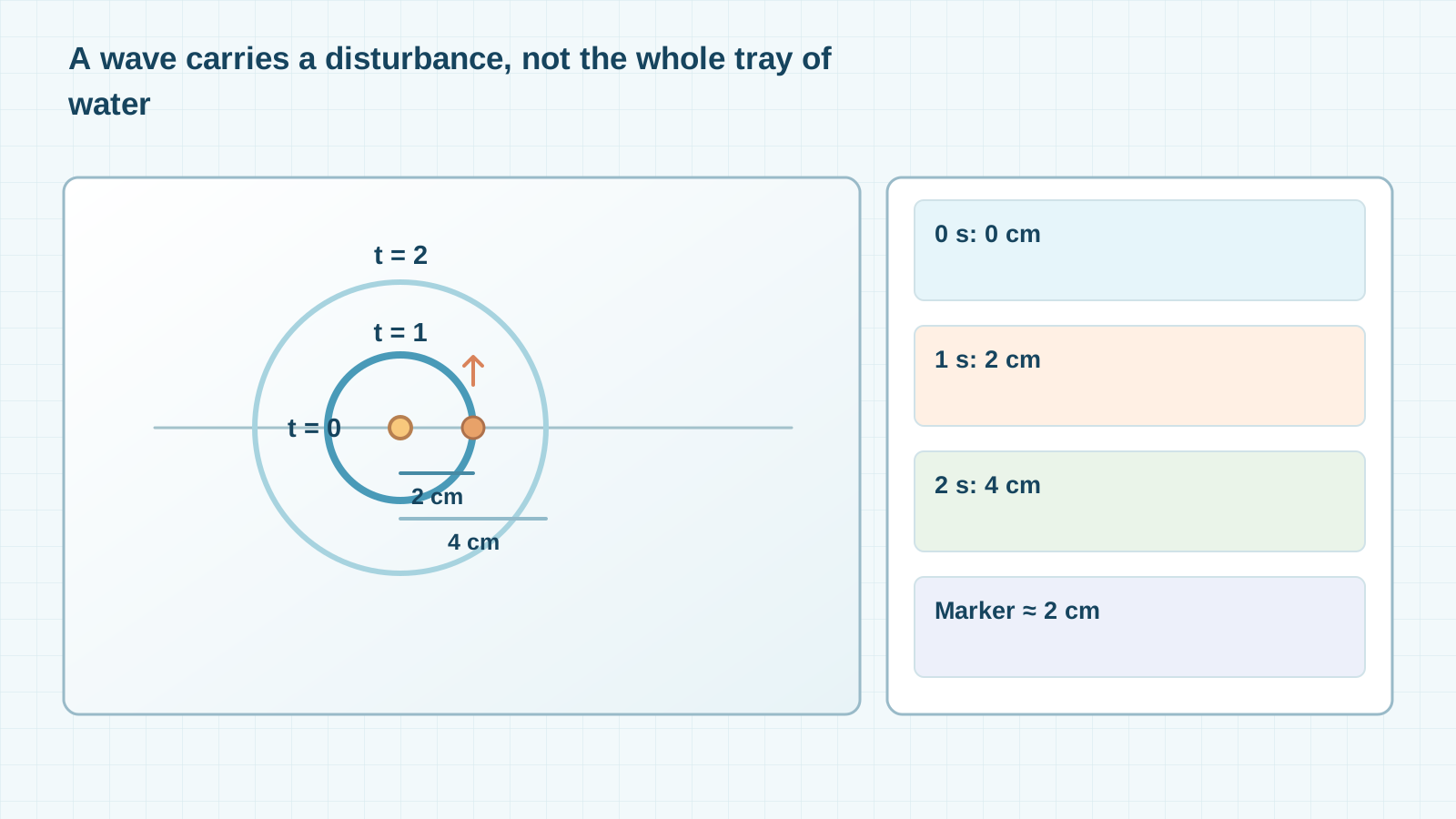
In the supplied diagram, fronts at 0, 1 and 2 seconds lie 0, 2 and 4 cm from the source. The model assumes a constant 2 cm per second. The marker stays near the 2 cm position; its up-and-down motion is not the front’s journey. Three drawings do not prove that every real water particle has zero sideways movement: currents and reflections can matter.
Test safely
A shallow saucer, a drop and a scrap of floating paper are enough. Keep electricity away from water. Record two ring positions and the marker at successive moments. Do not report the supplied diagram’s figures as measurements you made.
A common mistake
A common mistake is to say the same parcel of water crosses the tray with the ring. The floating marker tests that claim. Another is to say every wave needs material: light does not need air or water, as we will see later.
Support diagram
Transfer to another case
A pulse travels along a long rope. What arrives at your friend’s end: your hand, one piece of rope, or the disturbance? Where would you place a marker to test it?
Check your understanding
Close the text and explain the left-to-right drawing to a new learner. Name an observation, a teaching assumption and something the evidence does not prove. Then answer the transfer question without a hint and check units or direction against the diagram. If you disagree, return to the first unfamiliar word rather than memorising a sentence. A spoken explanation, a drawing and a measurement are different kinds of evidence: label each honestly.
Lab notebook page
Add a line to My World Lab Notebook: question → prediction → controlled conditions → changed condition → observation or calculation → conclusion → limit. Put a scale on a drawing or mark it ‘schematic’. If you ran no experiment, write ‘supplied calculation’, not ‘we measured’. Revisit the entry after the next lesson and note what became clearer.
Next lesson: How often a wave arrives: period, frequency and wavelength
If you have found a mistake or a typo in this article, tell us about it
Comments (0)
Log in to leave a comment →
No comments yet. Be the first.