


Physics around us: from a first experiment to your own lab Lesson 68 of 74
How often a wave arrives: period, frequency and wavelength
Count repeated motions without confusing the time for one cycle with the distance between crests.
Question and prediction
Move one end of a rope steadily. When your hand repeats more often, more crests pass each second. Yet crests per second and the distance between crests are different quantities. Before calculating, decide which you would measure with a clock and which with a ruler.
New words without gaps
An oscillation is repeated motion around an equilibrium position. Period T is the time for one complete cycle, measured in seconds. Frequency f is cycles per second, measured in hertz (Hz), so f = 1/T. Wavelength λ is the distance between neighbouring crests at the same instant, measured in metres. Wave speed v is the distance a front travels per second. For a steady wave, v = λf.
Work through supplied data
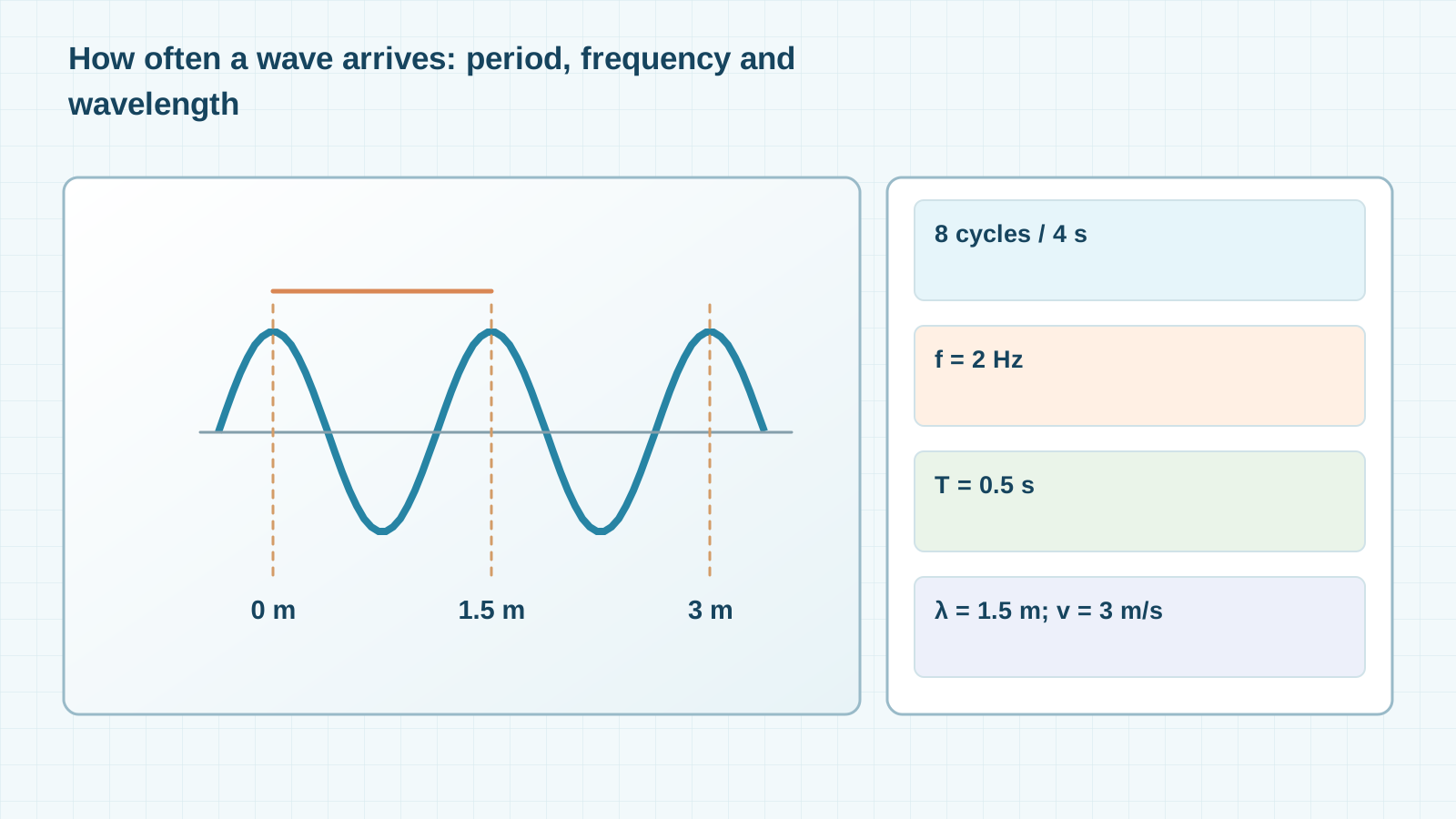
Supplied example: the hand completes 8 cycles in 4 s. Then f = 8/4 = 2 Hz and T = 4/8 = 0.5 s. If adjacent crests are 1.5 m apart, the front speed is v = 1.5 × 2 = 3 m/s. The diagram marks crests at x = 0, 1.5 and 3 m at one instant. Do not call the crest spacing a period: their units differ.
Test safely
Mark a rope or use the drawing. If you cannot run the activity, label these numbers ‘supplied’. For a real measurement, time many cycles together rather than trying to catch one quick movement with a stopwatch.
A common mistake
The equation v = λf does not mean increasing frequency always increases speed. In a given medium, speed is often set approximately by the medium; wavelength then changes. Keep rope tension fixed when comparing trials.
Support diagram
Transfer to another case
A source completes 6 cycles in 3 s. Find f and T. If speed under the same conditions stays 3 m/s, what is λ? Check your units.
Check your understanding
Close the text and explain the left-to-right drawing to a new learner. Name an observation, a teaching assumption and something the evidence does not prove. Then answer the transfer question without a hint and check units or direction against the diagram. If you disagree, return to the first unfamiliar word rather than memorising a sentence. A spoken explanation, a drawing and a measurement are different kinds of evidence: label each honestly.
Lab notebook page
Add a line to My World Lab Notebook: question → prediction → controlled conditions → changed condition → observation or calculation → conclusion → limit. Put a scale on a drawing or mark it ‘schematic’. If you ran no experiment, write ‘supplied calculation’, not ‘we measured’. Revisit the entry after the next lesson and note what became clearer.
Next lesson: Why does a ruler make sound, and does sound need air?
If you have found a mistake or a typo in this article, tell us about it
Comments (0)
Log in to leave a comment →
No comments yet. Be the first.