


Physics around us: from a first experiment to your own lab Lesson 63 of 66
Why does moving a magnet deflect a meter?
Introduce electromagnetic induction through a changing field, not current appearing by magic.
Situation and prediction
A coil is connected to a sensitive meter. A stationary nearby magnet changes the reading little. Push the magnet in and the needle moves one way; pull it out and it moves the other way. What do both motions share that stopping lacks? Predict before using the map.
New words, step by step
Electromagnetic induction is the production of voltage around a loop when magnetic flux through it changes. Magnetic flux roughly describes how much magnetic field passes through the turns’ area; it is not a flow of substance. Voltage can exist across an open coil; sustained current needs a closed path. Moving a magnet is one way to change flux; changing the field itself or moving the coil can also work.
Working through supplied data
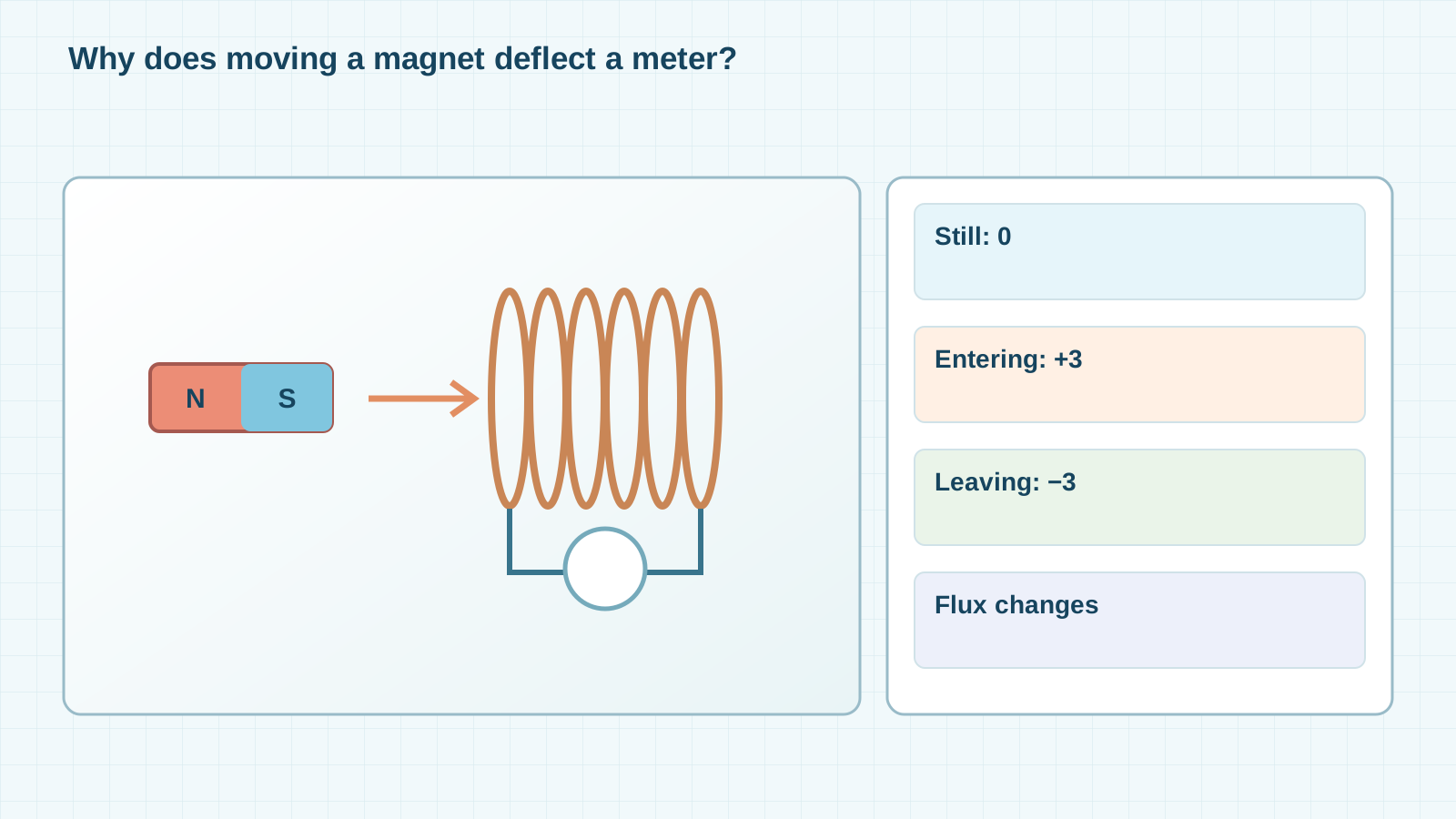
Supplied sequence: magnet still — 0 arbitrary divisions; pushed in — +3; pulled out — −3. The sign marks opposite deflection, not a speed in amperes. Faster motion often produces a larger voltage, but these three rows do not yield a universal equation for every coil.
A safe check
Use only a ready-made classroom coil and small magnet, never a mains connection. Move slowly so the meter is not struck. Without equipment, use cards for three states: still, entering, leaving; label when flux changes. Do not call the cards your measurement.
Where the reasoning breaks
It is wrong to think proximity alone produces a steady current. Induction requires changing flux. Do not confuse ‘voltage exists’ with ‘current flows’ when the path is open. The energy source here is work done moving the magnet.
Support diagram
Transfer to a new case
Magnet and coil are both stationary, but a nearby electromagnet’s field changes. Could induction occur? What changes, and why would a closed path be needed to observe a current?
Check your understanding
Close the explanation and say in your own words what was really observed, which figures were supplied for teaching, and which conclusion remains a prediction. Change one condition and predict the result before rereading. If it disagrees, find the first step where your reasoning parted from the diagram. A strong answer names the model’s limits rather than just a correct word or number. You can do this check on paper, without equipment or registration.
Lab notebook entry
Add a page to My World Lab Notebook. Record the question, a prediction made before testing, a sketch and a table of conditions. Keep actual observations separate from supplied teaching numbers. In the final line say what changed, what stayed constant, what the evidence supports and what it does not yet prove. If you did no experiment, label the work ‘calculation from supplied data’ or ‘prediction’, never ‘measured’.
Next lesson: Does a generator make electricity from nothing?
If you have found a mistake or a typo in this article, tell us about it
Comments (0)
Log in to leave a comment →
No comments yet. Be the first.