


Physics around us: from a first experiment to your own lab Lesson 58 of 66
Why do two magnets sometimes stick and sometimes push apart?
Tell poles, field direction and drawn field lines apart.
Situation and prediction
Imagine bringing two bar magnets together. One orientation attracts; after a turn they repel. The answer depends on orientation as well as distance. Before looking at the map, sketch both cases and label the facing ends.
New words, step by step
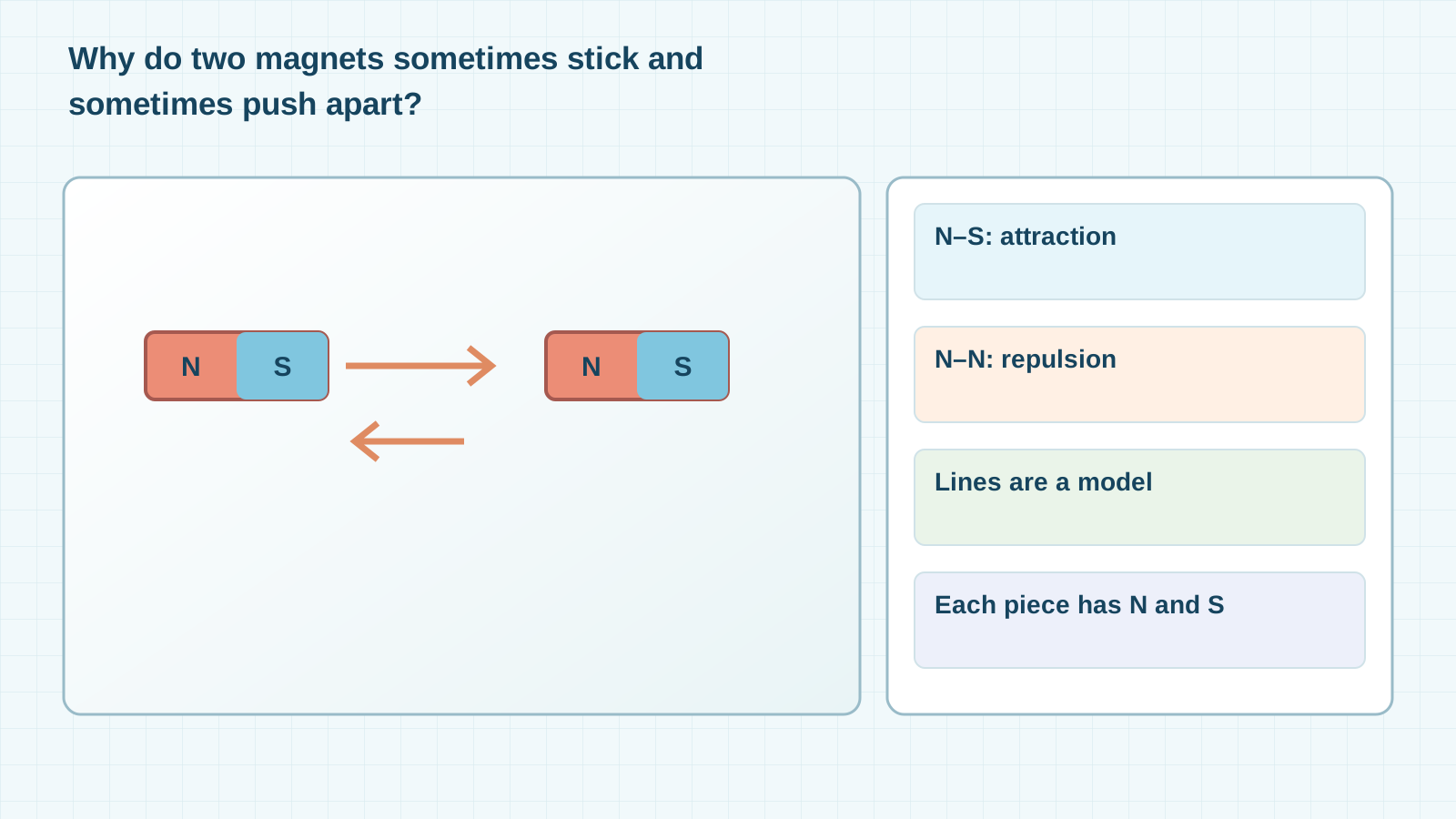
A magnet has two poles, conventionally called north N and south S. Like poles repel; unlike poles attract. A magnetic field describes the direction an effect would have on a small test magnet. A drawn field line is a direction guide, not a physical string. Outside a magnet we draw it from N to S; the path closes through the magnet.
Working through supplied data
N facing S predicts attraction; N facing N predicts repulsion. Splitting an ordinary magnet does not isolate one N and one S: each piece has both poles. The number of drawn lines is not an exact count of physical ‘flows’.
A safe check
Use only small enclosed classroom magnets. Bring them together slowly on a table so fingers cannot get trapped. Predict N–S and N–N before checking. Without magnets, trace the arrows on the diagram and explain both cases in words.
Where the reasoning breaks
Do not assume that red paint marks north on every magnet. A maker chooses paint colours; use a label or a compass. Field lines are not separate tracks: the field exists between drawn lines too.
Support diagram
Transfer to a new case
You have an unlabelled bar magnet and a labelled N–S magnet. How could you identify the unknown poles? Describe two checks, and explain why attraction alone does not prove an object is itself a magnet.
Check your understanding
Close the explanation and say in your own words what was really observed, which figures were supplied for teaching, and which conclusion remains a prediction. Change one condition and predict the result before rereading. If it disagrees, find the first step where your reasoning parted from the diagram. A strong answer names the model’s limits rather than just a correct word or number. You can do this check on paper, without equipment or registration.
Lab notebook entry
Add a page to My World Lab Notebook. Record the question, a prediction made before testing, a sketch and a table of conditions. Keep actual observations separate from supplied teaching numbers. In the final line say what changed, what stayed constant, what the evidence supports and what it does not yet prove. If you did no experiment, label the work ‘calculation from supplied data’ or ‘prediction’, never ‘measured’.
Next lesson: Why does a compass needle turn without a touch?
If you have found a mistake or a typo in this article, tell us about it
Comments (0)
Log in to leave a comment →
No comments yet. Be the first.