


Physics around us: from a first experiment to your own lab Lesson 60 of 66
Why does a compass turn beside a wire?
Discover a link between electricity and magnetism without shorting a battery.
Situation and prediction
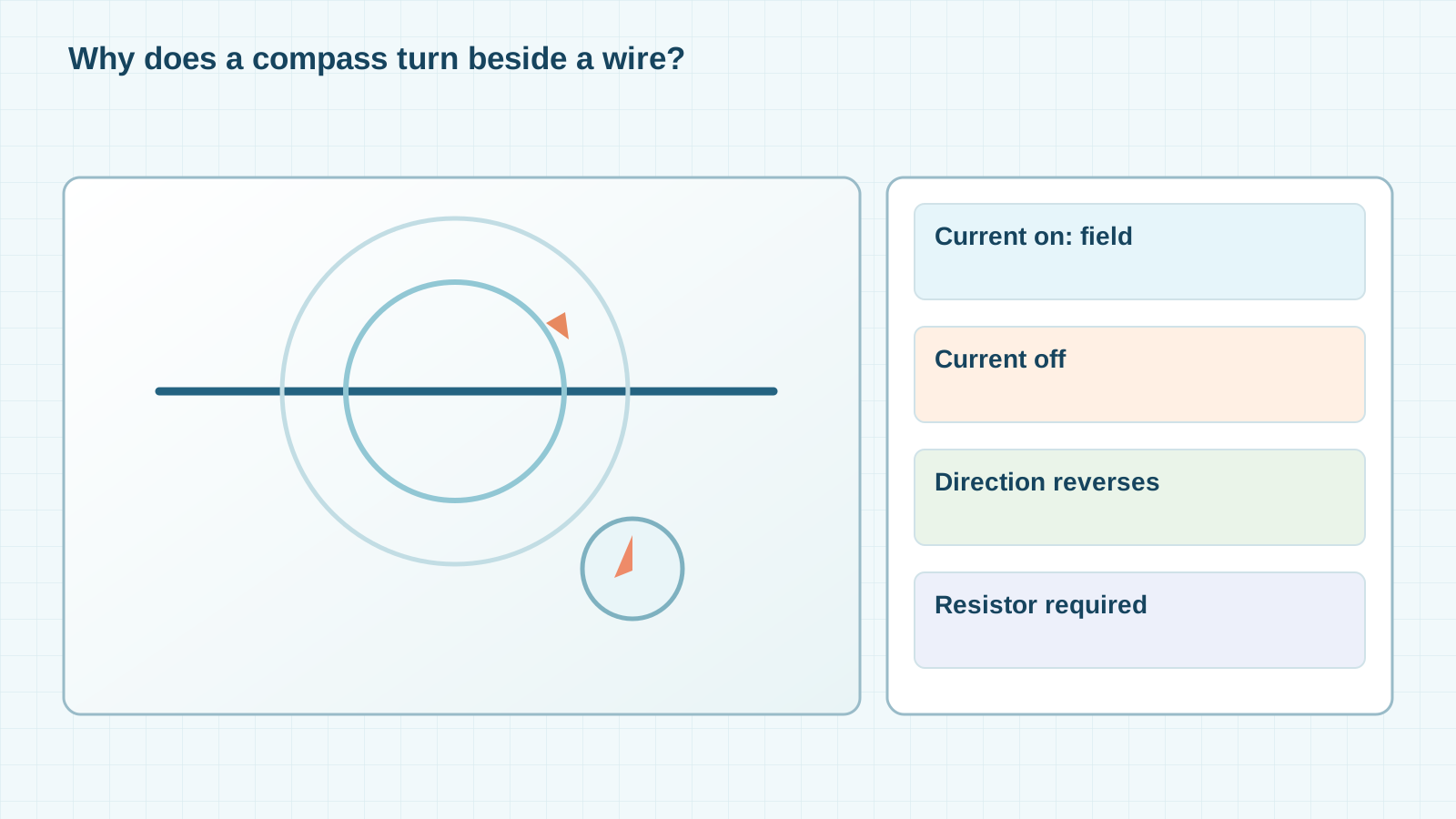
In the sketch a compass sits beside a straight wire. With current flowing the needle turns; after switching off it returns. You already know current as charge moving per unit time. What explains an effect on the magnet with no mechanical contact? Predict what reversing the current might do.
New words, step by step
A conductor carrying electric current produces a magnetic field around it. A conductor allows charge to move; here it is a circuit wire. Conventional current direction is from plus to minus in the external circuit, while electrons in metal move the other way. Around a straight wire the field has a circular direction. The drawn circles are a model, not visible air vortices.
Working through supplied data
Supplied table: circuit off — no extra deflection; on — needle turns; polarity reversed — the turn reverses. This is qualitative, not an angle measurement. It supports a link between current and field but does not let us calculate field strength without current and distance.
A safe check
Use only a ready-made low-voltage classroom kit with current limiting and adult supervision. A bare wire across a battery is a short circuit and can heat quickly. Without a kit, fill in predictions and check that a circuit drawing has a safe resistor or purpose-built module.
Where the reasoning breaks
Do not say that the compass responds to the battery’s charge in the same way while the circuit is open. In this experiment the current adds the noticeable field. Earth’s field remains present; the needle responds to the combined influence.
Support diagram
Transfer to a new case
Two wires carry the same current but lie at different distances from a compass. Which should cause more deflection? What would you hold constant for a fair test of distance?
Check your understanding
Close the explanation and say in your own words what was really observed, which figures were supplied for teaching, and which conclusion remains a prediction. Change one condition and predict the result before rereading. If it disagrees, find the first step where your reasoning parted from the diagram. A strong answer names the model’s limits rather than just a correct word or number. You can do this check on paper, without equipment or registration.
Lab notebook entry
Add a page to My World Lab Notebook. Record the question, a prediction made before testing, a sketch and a table of conditions. Keep actual observations separate from supplied teaching numbers. In the final line say what changed, what stayed constant, what the evidence supports and what it does not yet prove. If you did no experiment, label the work ‘calculation from supplied data’ or ‘prediction’, never ‘measured’.
If you have found a mistake or a typo in this article, tell us about it
Comments (0)
Log in to leave a comment →
No comments yet. Be the first.