


Physics around us: from a first experiment to your own lab Lesson 64 of 66
Does a generator make electricity from nothing?
Trace mechanical work, changing flux and electrical energy without breaking energy conservation.
Situation and prediction
A bicycle dynamo lamp shines while the wheel turns. Pedal harder and both turning and light may change. What happens to the lamp when the wheel stops? Predict and name the energy source before using the word ‘generator’.
New words, step by step
A generator converts mechanical work into electrical energy using induction. Turning a coil or magnet changes magnetic flux. Alternating voltage changes magnitude or direction with time; a rectifier can convert it when a circuit needs one current direction. Power is energy per second, not energy stored inside a coil.
Working through supplied data
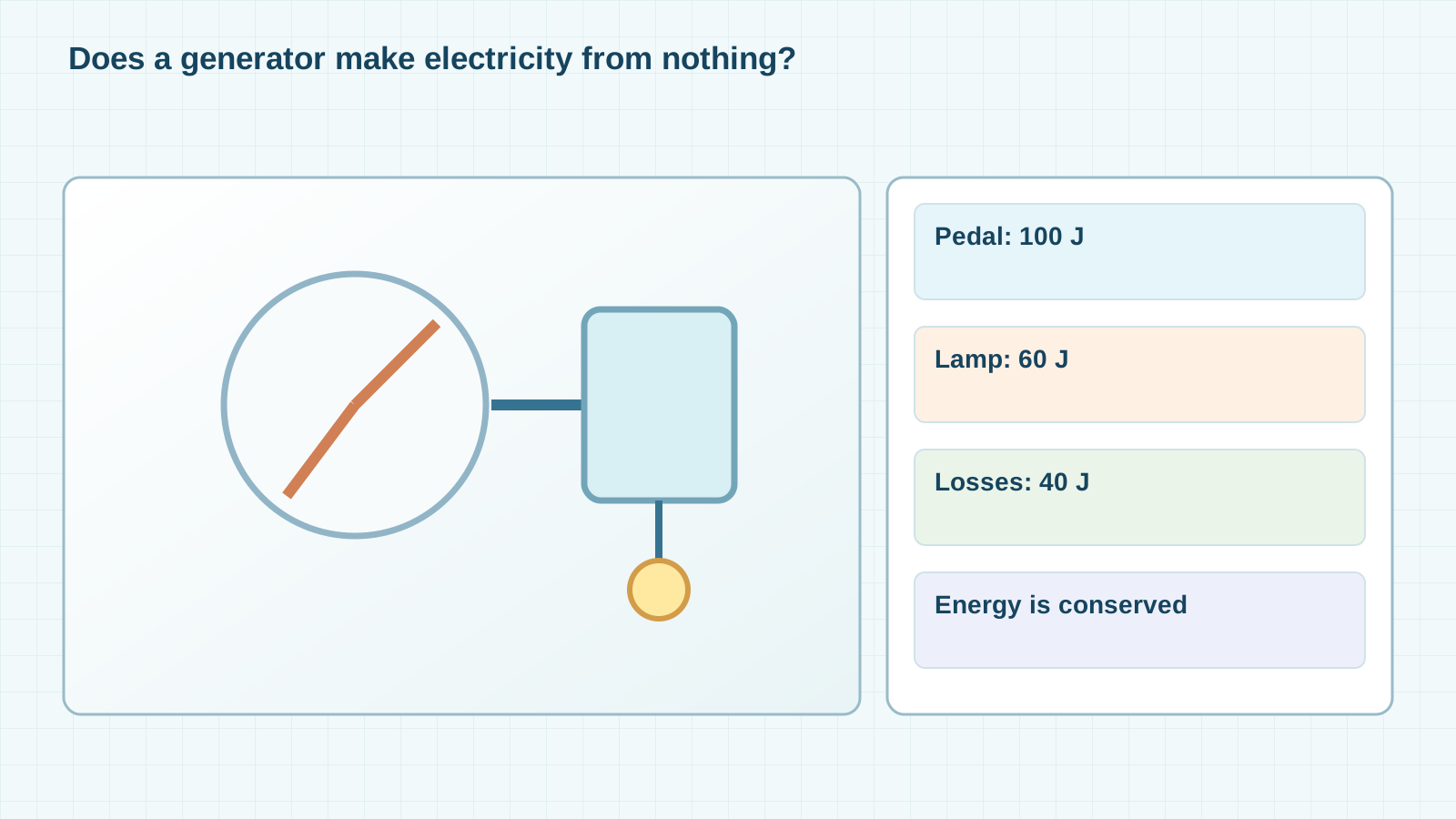
Supplied budget over an arbitrary interval: pedalling transfers 100 J of mechanical energy; the lamp receives 60 J; 40 J becomes heating and other losses. 60/100 = 60% for this imaginary system. These are not bicycle specifications. The generator did not make 100 J from nowhere: a person supplied them through the pedals.
A safe check
The safe option is a ready-made hand-cranked teaching generator used as instructed, or a paper energy chain. Do not connect a homemade generator to household wiring or touch rotating parts. In the notebook, distinguish supplied figures from anything you actually observed.
Where the reasoning breaks
Calling the generator a ‘creator’ of energy is wrong: it is a converter. It is also wrong to assume that every rotating generator always outputs steady voltage of one polarity; the output depends on design and electronics.
Support diagram
Transfer to a new case
You turn a generator handle at the same rate but attach a brighter load. How might the required effort change? Which measurements would separate generator losses from energy used by the lamp?
Check your understanding
Close the explanation and say in your own words what was really observed, which figures were supplied for teaching, and which conclusion remains a prediction. Change one condition and predict the result before rereading. If it disagrees, find the first step where your reasoning parted from the diagram. A strong answer names the model’s limits rather than just a correct word or number. You can do this check on paper, without equipment or registration.
Lab notebook entry
Add a page to My World Lab Notebook. Record the question, a prediction made before testing, a sketch and a table of conditions. Keep actual observations separate from supplied teaching numbers. In the final line say what changed, what stayed constant, what the evidence supports and what it does not yet prove. If you did no experiment, label the work ‘calculation from supplied data’ or ‘prediction’, never ‘measured’.
If you have found a mistake or a typo in this article, tell us about it
Comments (0)
Log in to leave a comment →
No comments yet. Be the first.