


Physics around us: from a first experiment to your own lab Lesson 61 of 66
Can you make a magnet that switches off?
Explore a coil, its core and fair comparisons of electromagnets.
Situation and prediction
Picture a lifting crane that releases a metal object on command. A permanent magnet is not so easily switched off. Can electric current control magnetism instead? Predict what a compass near a coil would do when its current is turned off.
New words, step by step
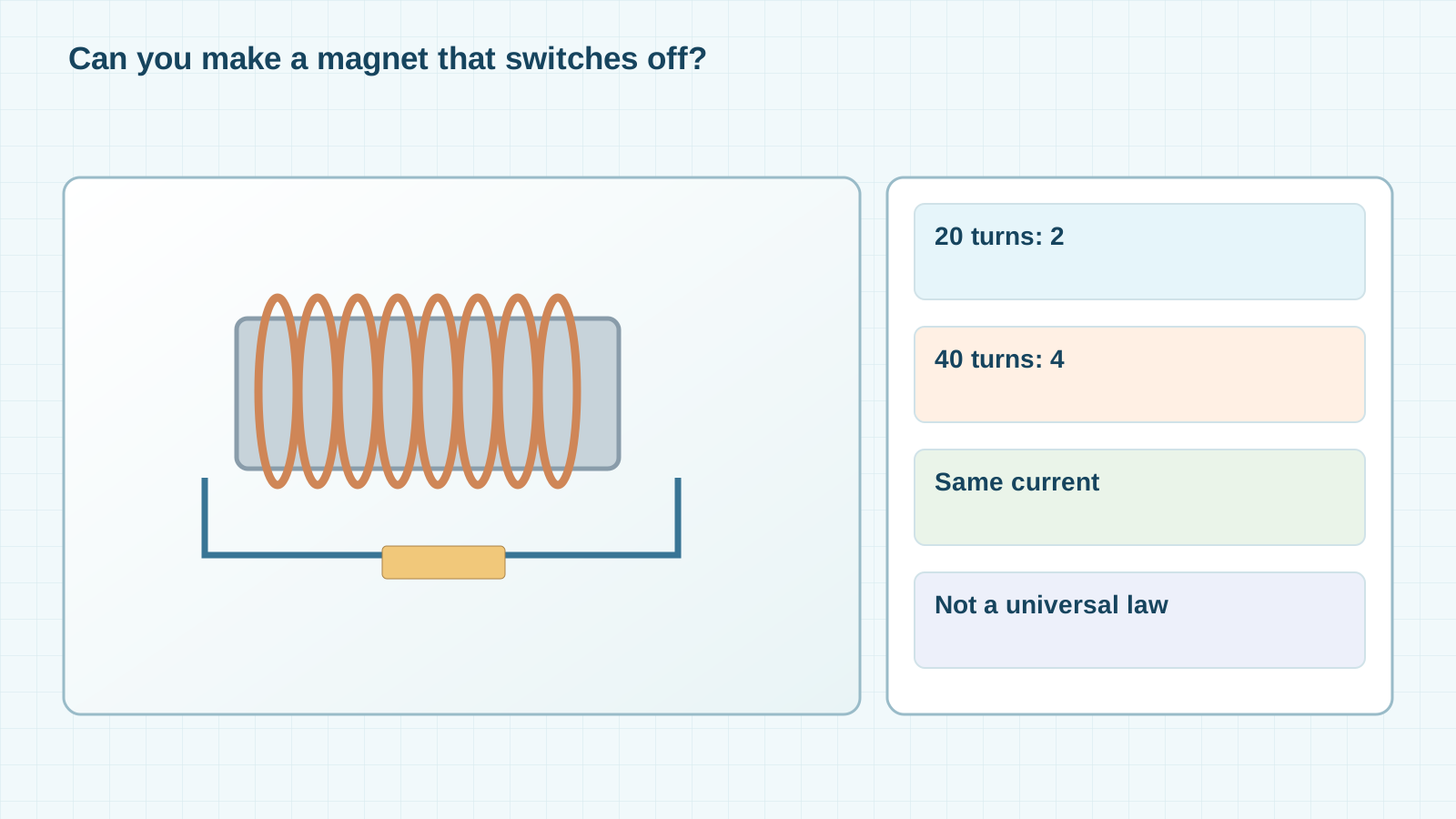
A coil is many turns of insulated wire. The fields from those turns combine inside it. An electromagnet uses controlled current for its magnetic effect; a soft iron core can strengthen it. A turn is one loop of wire. The effect depends on current, turn count, core and distance; changing them all at once cannot identify one cause.
Working through supplied data
Supplied example: at the same safe current, a 20-turn coil lifts 2 clips and a 40-turn one lifts 4. These are invented teaching numbers showing how to record a comparison, not a general law that doubling turns doubles clips. Clips vary, a core may saturate, and replacing the coil can change current.
A safe check
Connect a real coil only in a ready-made current-limited low-voltage kit, following instructions with an adult. Never wind wire onto household mains or leave an energised coil unattended: it can heat. On paper, compare two supplied tables and identify which one actually keeps current constant.
Where the reasoning breaks
It is wrong to claim that adding turns always increases lifting in exact proportion. More wire can raise resistance and reduce current with the same supply. Do not promise a result before measuring current.
Support diagram
Transfer to a new case
Two coils each have 30 turns; one has an iron core, the other a plastic one. What do you predict and how would you isolate the effect of the core? Name at least two conditions to keep equal.
Check your understanding
Close the explanation and say in your own words what was really observed, which figures were supplied for teaching, and which conclusion remains a prediction. Change one condition and predict the result before rereading. If it disagrees, find the first step where your reasoning parted from the diagram. A strong answer names the model’s limits rather than just a correct word or number. You can do this check on paper, without equipment or registration.
Lab notebook entry
Add a page to My World Lab Notebook. Record the question, a prediction made before testing, a sketch and a table of conditions. Keep actual observations separate from supplied teaching numbers. In the final line say what changed, what stayed constant, what the evidence supports and what it does not yet prove. If you did no experiment, label the work ‘calculation from supplied data’ or ‘prediction’, never ‘measured’.
If you have found a mistake or a typo in this article, tell us about it
Comments (0)
Log in to leave a comment →
No comments yet. Be the first.