

Physics around us: from a first experiment to your own lab Lesson 65 of 66
How can a message arrive without moving paper?
Build the signal route from information and code to a physical change and a receiver's reconstruction.
Situation and prediction
A friend wants to send ‘YES’ through a wall. Agree that one short flashlight blink means Y and two mean E; a different pattern can stand for S. Transmission works only if both people know the rule. Phones replace the light with electrical and electromagnetic signals. First invent a code and see whether a partner can read it.
New words, step by step
Information is distinguishable message content. A code maps content to a sequence of symbols. A signal is a physical change carrying those symbols, such as changing wire voltage or an electromagnetic field. A transmitter creates a signal; a receiver detects and decodes it. Radio uses changing fields; we study the nature of waves in the next block.
Working through supplied data
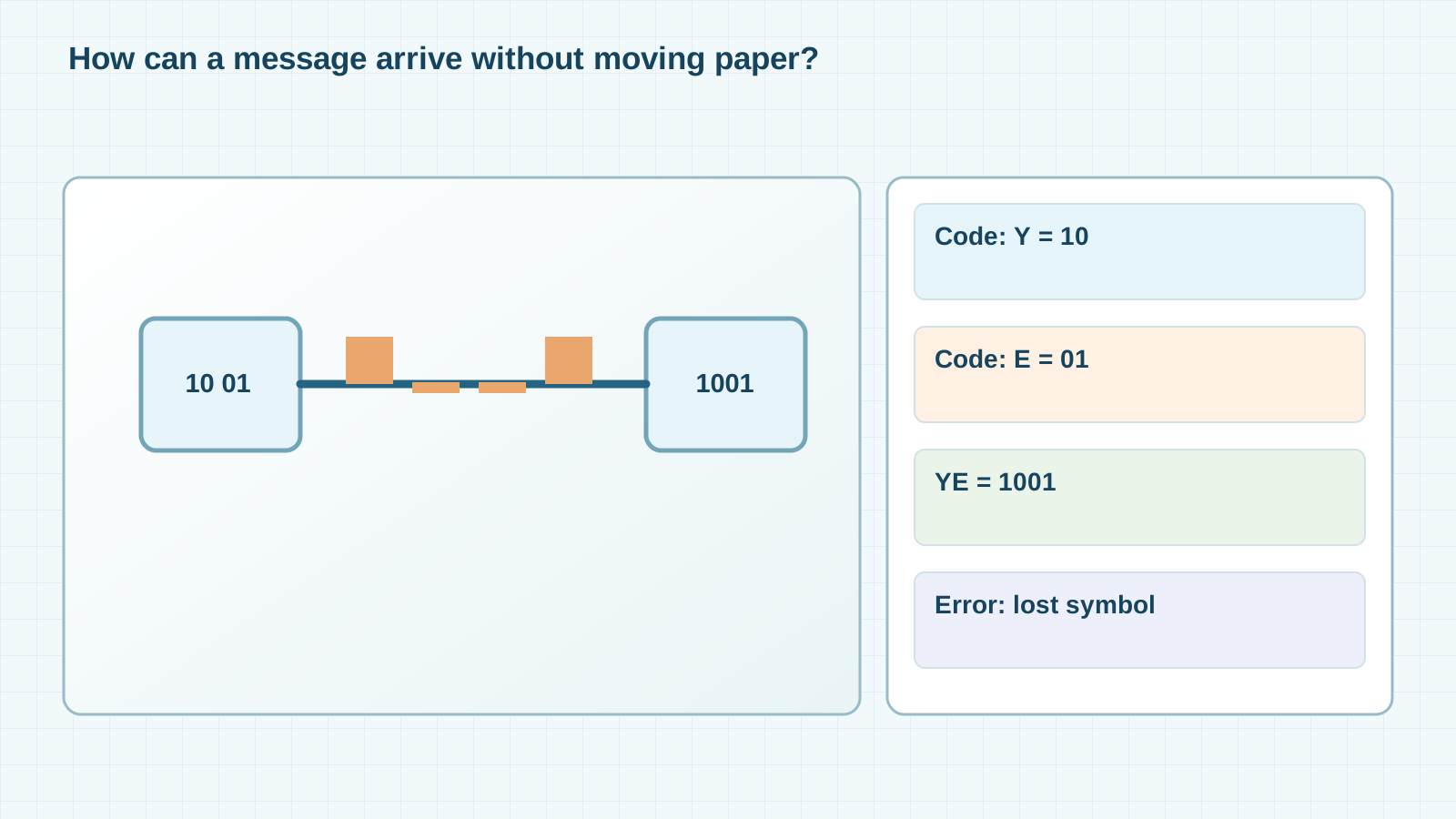
Teaching code: Y = 10, E = 01. ‘YE’ becomes 1001. Four code symbols do not mean four English letters or four electrons. Losing one symbol could produce a different message. Real systems add timing and error-detection rules, whose purpose we can name without building them yet.
A safe check
Use cards or paper ‘pulses’: one learner encodes, the other cannot see the original word and decodes using a pre-agreed table. No radio equipment or phone data is needed. If messages differ, record where the mismatch arose and change one rule at a time.
Where the reasoning breaks
A magnet or electron does not contain a word. Meaning lies in the agreed code and sequence of changes. Do not confuse how fast signal energy travels with how fast individual electrons drift in a wire.
Support diagram
Transfer to a new case
With Y = 10 and E = 01, write ‘YE’ and ‘EY’. What extra symbol could mark the start if a receiver switched on halfway through a message?
Check your understanding
Close the explanation and say in your own words what was really observed, which figures were supplied for teaching, and which conclusion remains a prediction. Change one condition and predict the result before rereading. If it disagrees, find the first step where your reasoning parted from the diagram. A strong answer names the model’s limits rather than just a correct word or number. You can do this check on paper, without equipment or registration.
Lab notebook entry
Add a page to My World Lab Notebook. Record the question, a prediction made before testing, a sketch and a table of conditions. Keep actual observations separate from supplied teaching numbers. In the final line say what changed, what stayed constant, what the evidence supports and what it does not yet prove. If you did no experiment, label the work ‘calculation from supplied data’ or ‘prediction’, never ‘measured’.
If you have found a mistake or a typo in this article, tell us about it
Comments (0)
Log in to leave a comment →
No comments yet. Be the first.